Faculty of Food Science and Nutrition, Poznań University of Life Sciences, Wojska Polskiego 31, 60-624 Poznań, Poland.
Faculty of Horticulture and Landscape Architecture, Poznań University of Life Sciences, Zgorzelecka 4, 60-198 Poznań, Poland.
Molecules. 2022 Sep 1;27(17):5636. doi: 10.3390/molecules27175636.
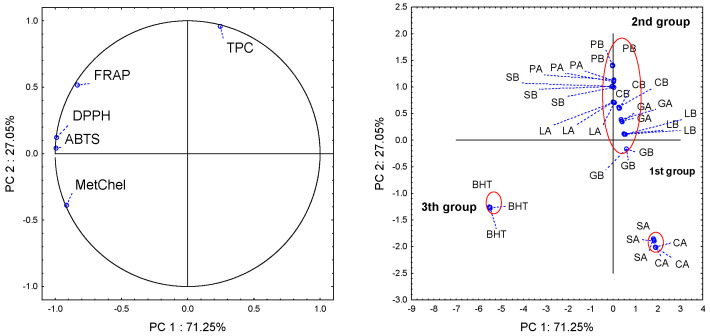
Total phenolic content (TPC) in extracts of basil depended on the cultivar and type of fertilization used in cultivation. TPC was determined spectrophotometrically with the Folin−Ciocalteu reagent. The antioxidant activity of extracts was analyzed by scavenging of DPPH and ABTS radicals, on the basis of metal chelating ability (MetChel) and ferric reducing antioxidant power (FRAP). The greatest TPC was determined in the purple cultivars—141.35 and 165.44 mg gallic acid/g d.m. for fertilized with ammonium nitrate (NH4NO3) and ammonium sulfate ((NH4)2SO4), respectively. Their extracts had the greatest antioxidant capacity in the majority of the methods used. The results varied depending on the modelling system used. The amount of polyphenols in individual basil cultivars differed significantly (p < 0.05) depending on the fertilization used in the culture. Regarding TPC, DPPH, ABTS, FRAP, and MetChel variables, we observed a significant effect for the applied cultivation. In the case of MetChel factor, lower results of all investigated basil species were observed for cultivation with ammonium sulfate. PCA demonstrated in the present study shows that Sweet and Cinnamon Basil samples cultivated with ammonium nitrate create a separated group. We recommend cultivation with ammonium sulfate fertilizers for these varieties of basil. The high content of phenolic compounds demonstrated in Sweet and Cinnamon Basil cultivated with ammonium sulfate, and thus associated antioxidant activity, indicates that it can constitute a valuable source for bioactive compounds in a balanced diet.
罗勒提取物中的总酚含量(TPC)取决于栽培中使用的品种和施肥类型。TPC 是用 Folin-Ciocalteu 试剂分光光度法测定的。提取物的抗氧化活性是通过清除 DPPH 和 ABTS 自由基来分析的,其基础是金属螯合能力(MetChel)和铁还原抗氧化能力(FRAP)。在施用硝酸铵(NH4NO3)和硫酸铵((NH4)2SO4)的紫色品种中,TPC 最高,分别为 141.35 和 165.44 mg 没食子酸/g d.m.。它们的提取物在大多数使用的方法中具有最大的抗氧化能力。结果因所使用的建模系统而异。不同罗勒品种中的多酚含量因培养中使用的施肥方式而有显著差异(p < 0.05)。就 TPC、DPPH、ABTS、FRAP 和 MetChel 变量而言,我们观察到应用的栽培有显著影响。对于 MetChel 因子,在使用硫酸铵进行栽培的情况下,所有研究的罗勒物种的结果都较低。本研究中的 PCA 表明,用硝酸铵栽培的甜罗勒和肉桂罗勒样本形成了一个单独的组。我们建议用硫酸铵肥料来种植这些品种的罗勒。用硫酸铵栽培的甜罗勒和肉桂罗勒中表现出的高含量酚类化合物及其相关的抗氧化活性表明,它可以成为均衡饮食中生物活性化合物的有价值来源。