State Key Laboratory of Advanced Design and Manufacture for Vehicle Body, Hunan University, Lushan South Road, Yuelu District, Changsha 410082, China.
Guizhou Institute of Water Resources Science, Guiyang 550002, China.
Sensors (Basel). 2022 Aug 25;22(17):6415. doi: 10.3390/s22176415.
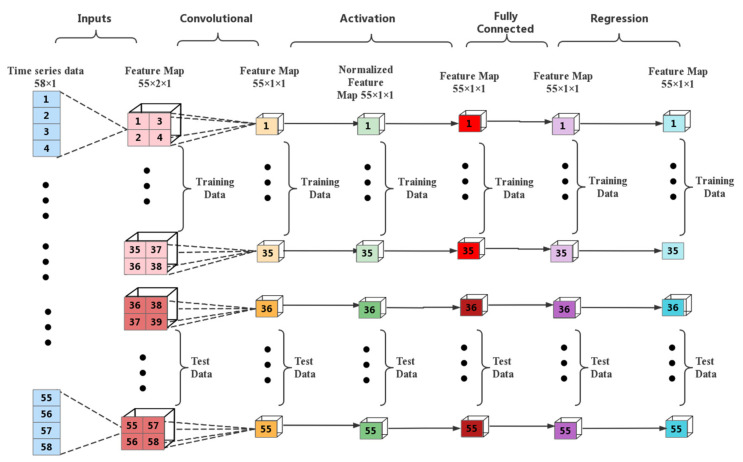
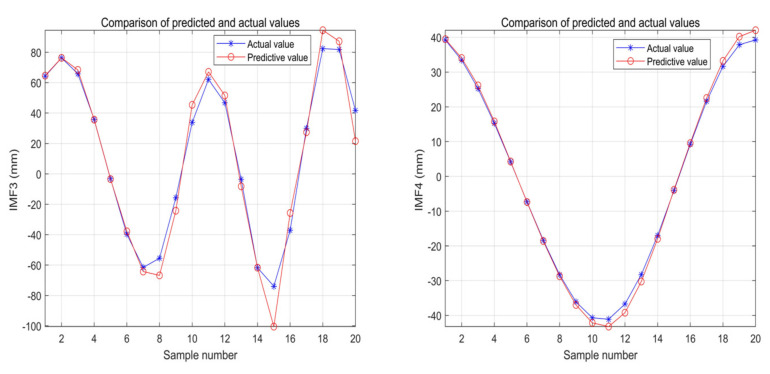
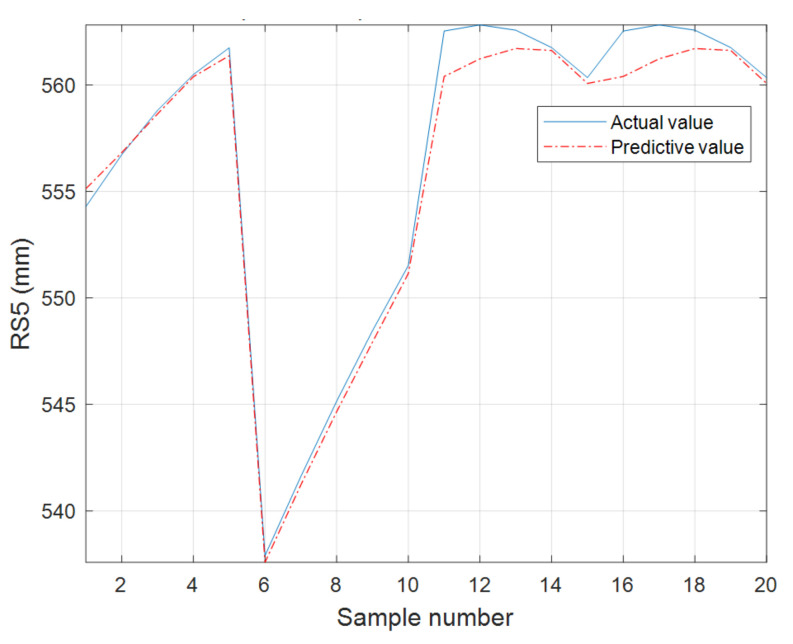
To address the problem of low prediction accuracy of precipitation time series data, an improved overall mean empirical modal decomposition-prediction-reconstruction model (MDPRM) is constructed in this paper. First, the non-stationary precipitation time series are decomposed into multiple decomposition terms by the improved overall mean empirical modal decomposition (MEEMD). Then, a particle swarm optimization support vector machine (PSO-SVM) and convolutional neural network (CNN) and recurrent neural network (RNN) models are used to make predictions according to the characteristics of different decomposition terms. Finally, the prediction results of each decomposition term are superimposed and reconstructed to form the final prediction results. In addition, the application is carried out with the summer precipitation in the Wujiang River basin of Guizhou Province from 1961 to 2018, using the first 38 years of data to train MDPRM and the last 20 years of data to test MDPRM, and comparing with a feedback neural network (BP), a support vector machine (SVM), a particle swarm optimization support vector machine (PSO-SVM), a convolutional neural network (CNN), and a recurrent neural network (RNN), etc. The results show that the mean relative error () of the proposed MDPRM is reduced from 0.31 to 0.09, the root mean square error () is reduced from 0.56 to 0.30, and the consistency index (α) is significantly improved from 0.33 to 0.86, which has a higher prediction accuracy. Finally, the trained MDPRM predicts the average summer precipitation in the Wujiang River basin from 2019 to 2028 to be 466.42 mm, the minimum precipitation in 2020 to be 440.94 mm, and the maximum precipitation in 2024 to be 497.94 mm. Based on the prediction results, the agricultural drought level is evaluated using the Z index, which indicates that the summer is normal in the 10-year period. The study provides technical support for the effective guidance of regional water resources' allocation and scheduling and drought mitigation.
为了解决降水时间序列数据预测精度低的问题,本文构建了一种改进的总体均值经验模态分解-预测-重构模型(MDPRM)。首先,通过改进的总体均值经验模态分解(MEEMD)将非平稳降水时间序列分解为多个分解项。然后,根据不同分解项的特点,采用粒子群优化支持向量机(PSO-SVM)、卷积神经网络(CNN)和递归神经网络(RNN)模型进行预测。最后,将各分解项的预测结果叠加重构,形成最终预测结果。此外,应用于 1961 年至 2018 年贵州省乌江流域夏季降水,利用前 38 年的数据训练 MDPRM,后 20 年的数据测试 MDPRM,并与反馈神经网络(BP)、支持向量机(SVM)、粒子群优化支持向量机(PSO-SVM)、卷积神经网络(CNN)、递归神经网络(RNN)等进行比较。结果表明,所提 MDPRM 的平均相对误差()由 0.31 降低至 0.09,均方根误差()由 0.56 降低至 0.30,一致性指数(α)由 0.33 显著提高至 0.86,预测精度更高。最后,训练好的 MDPRM 预测 2019 年至 2028 年乌江流域夏季平均降水量为 466.42mm,2020 年最小降水量为 440.94mm,2024 年最大降水量为 497.94mm。基于预测结果,采用 Z 指数评价农业干旱等级,表明该流域夏季 10 年为正常年景。研究为区域水资源配置和调度及抗旱的有效指导提供了技术支持。