Department of Medical Imaging, Haikou Maternal and Child Health Hospital, Haikou 570203, China.
Department of Breast Surgery, Haikou Maternal and Child Health Hospital, Haikou 570203, China.
Int J Clin Pract. 2022 Aug 25;2022:6440952. doi: 10.1155/2022/6440952. eCollection 2022.
Currently, whether magnetic resonance imaging (MRI) should be routinely applied to patients with breast cancer before surgery remains controversial. A pooled analysis of the association between preoperative MRI and surgical outcomes in female patients with newly diagnosed invasive breast cancer was conducted to provide evidence-based medicine for clinical practice.
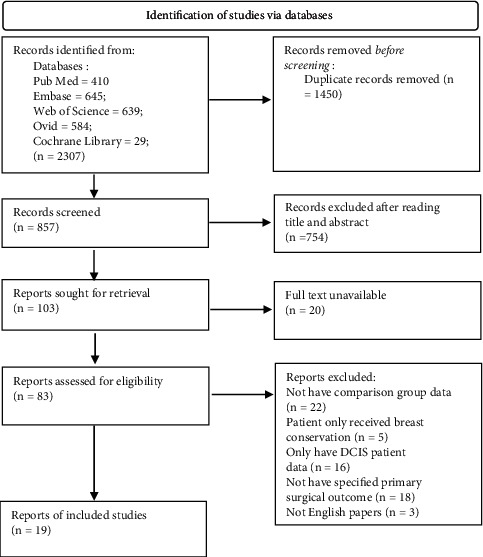
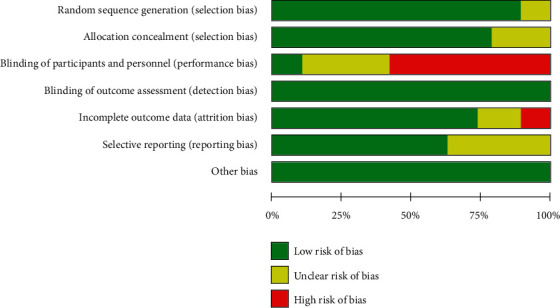
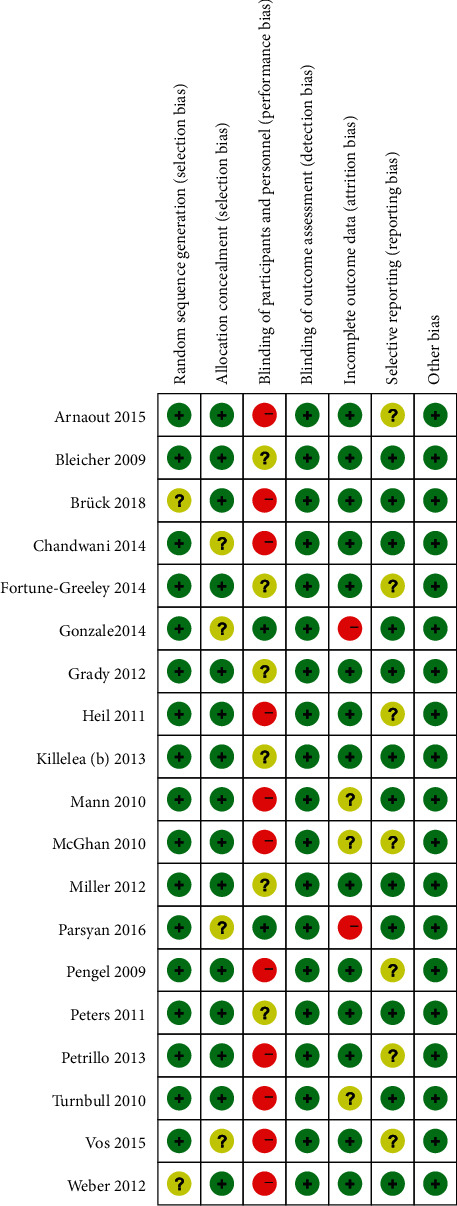
Three independent researchers searched the following databases: PubMed, Medline, Embase, Ovid, Cochrane Library, and Web of Science from inception to April 2022. Literature was included and excluded according to Cochrane's principles. The basic information from eligible documents was extracted. Systematic evaluation and meta-analysis were performed, and the odds ratio (OR) was analyzed by the random-effect model. The quality of the literature was assessed using the modified Jadad scale and the Newcastle-Ottawa (NOS) mean scale.
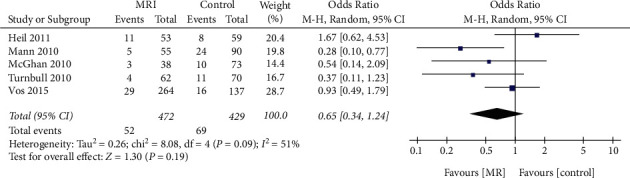
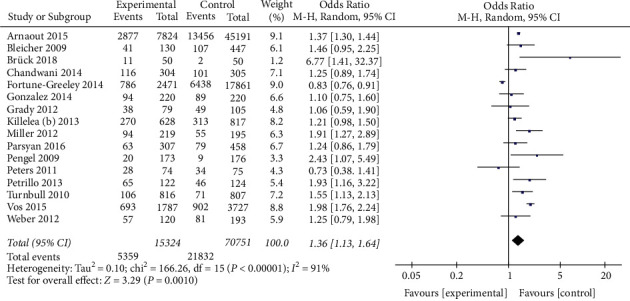
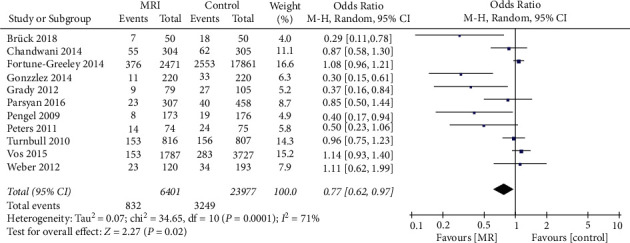
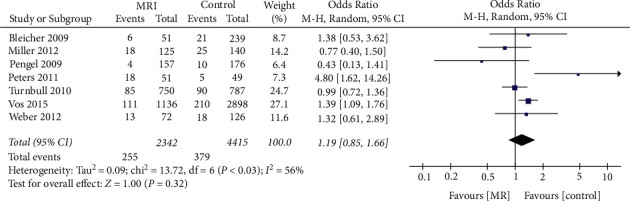
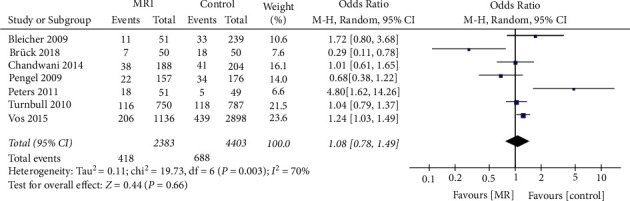
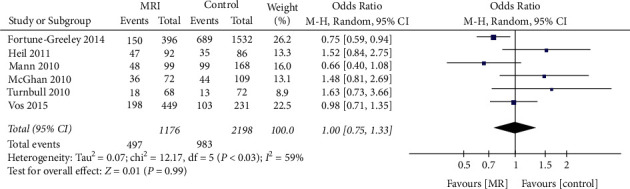
A total of 19 studies were included, including 4 randomized controlled trials and 15 observational comparative studies. Among them, most studies were not limited to a specific pathological type, with the exception of 3 that were limited to invasive lobular carcinoma. The results showed that preoperative MRI examination would significantly reduce the reoperation rate (OR = 0.77, =0.02) and increase the mastectomy rate (OR = 1.36, =0.001). In comparison, preoperative MRI did not significantly affect the rate of secondary mastectomy (OR = 0.77, =0.02), the rate of positive margin (OR = 1.08, =0.66), the rate of mastectomy (OR = 1.00, < 0.05), and reoperations (OR = 0.65, =0.19) in the subgroup analysis of patients with invasive lobular carcinoma.
Available evidence suggests that preoperative MRI examination increases the rate of mastectomy and reduces the rate of reoperations. The results indicate that preoperative MRI examination has the potential to benefit patients with breast cancer, but more high-quality studies are needed for confirmation.
目前,手术前是否应常规对乳腺癌患者进行磁共振成像(MRI)检查仍存在争议。本荟萃分析旨在为临床实践提供循证医学证据,评估女性新诊断浸润性乳腺癌患者术前 MRI 与手术结局的相关性。
三位独立研究员检索了以下数据库:PubMed、Medline、Embase、Ovid、Cochrane Library 和 Web of Science,检索时间从建库至 2022 年 4 月。根据 Cochrane 原则纳入和排除文献。提取合格文献的基本信息。采用随机效应模型分析比值比(OR)。使用改良 Jadad 量表和纽卡斯尔-渥太华(NOS)量表评估文献质量。
共纳入 19 项研究,包括 4 项随机对照试验和 15 项观察性比较研究。其中,大多数研究不限于特定的病理类型,仅 3 项研究限于浸润性小叶癌。结果显示,术前 MRI 检查可显著降低再次手术率(OR=0.77,=0.02)和增加乳房切除术率(OR=1.36,=0.001)。相比之下,术前 MRI 检查对二次乳房切除术率(OR=0.77,=0.02)、阳性切缘率(OR=1.08,=0.66)、乳房切除术率(OR=1.00, < 0.05)和再次手术率(OR=0.65,=0.19)无显著影响,在浸润性小叶癌亚组分析中。
现有证据表明,术前 MRI 检查可增加乳房切除术率,降低再次手术率。结果表明,术前 MRI 检查有可能使乳腺癌患者受益,但需要更多高质量的研究加以证实。