Wei Xiupan, Xia Nan, Li Yang-An, Gu Minghui, Zhang Tongming, Gao Wei, Liu Yali
Department of Rehabilitation Medicine, Tongji Hospital, Tongji Medical College, Huazhong University of Science and Technology, Wuhan, China.
World Health Organization Collaborating Centre for Training and Research in Rehabilitation, Wuhan, China.
Front Neurol. 2022 Aug 23;13:895580. doi: 10.3389/fneur.2022.895580. eCollection 2022.
Post-stroke spasticity is an important complication that greatly affects survivors' functional prognosis and daily activities. Increasing evidence points to aberrant contralesional neuromodulation compensation after brain injury as a possible culprit for increased spasticity in patients with severe stroke. Hyperactivity of the contralesional premotor area (cPMA) was supposed to be highly correlated with this progression. This study aims to demonstrate the immediate and short-term efficacy of continuous theta-burst stimulation (cTBS) targeting cPMA on upper limb spasticity in severe subacute stroke patients.
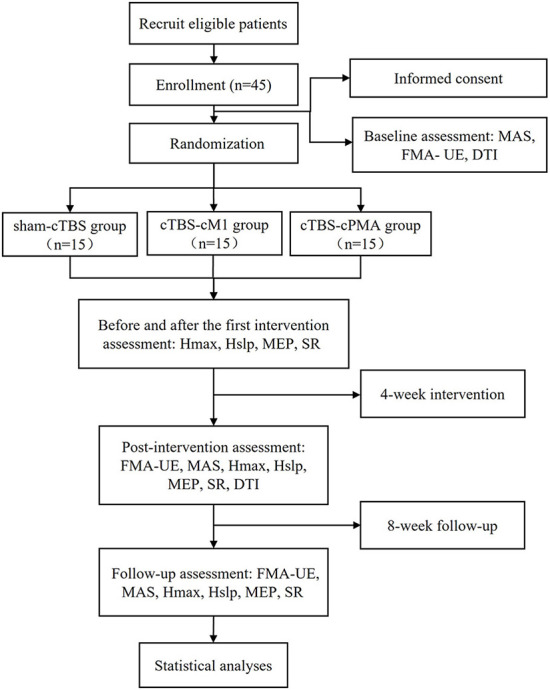
This trial is a single-center, prospective, three-group randomized controlled trial. Forty-five eligible patients will be recruited and randomized into three groups: the sham-cTBS group (sham cTBS targeting contralesional PMA), the cTBS-cM1 group (cTBS targeting contralesional M1), and the cTBS-cPMA group (cTBS targeting contralesional PMA). All subjects will undergo comprehensive rehabilitation and the corresponding cTBS interventions once a day, five times a week for 4 weeks. Clinical scales, neurophysiological examinations, and neuroimaging will be used as evaluation tools in this study. As the primary outcome, clinical performance on muscle spasticity of elbow/wrist flexor/extensors and upper-limb motor function will be evaluated with the modified Ashworth scale and the Fugl-Meyer Assessment of Upper Extremity Scale, respectively. These scale scores will be collected at baseline, after 4 weeks of treatment, and at follow-up. The secondary outcomes were neurophysiological examinations and Neuroimaging. In neurophysiological examinations, motor evoked potentials, startle reflex, and H reflexes will be used to assess the excitability of the subject's motor cortex, reticulospinal pathway, and spinal motor neurons, respectively. Results of them will be recorded before and after the first cTBS treatment, at post-intervention (at 4 weeks), and at follow-up (at 8 weeks). Neuroimaging tests with diffusion tensor imaging for all participants will be evaluated at baseline and after the 4-week treatment.
Based on the latest research progress on post-stroke spasticity, we innovatively propose a new neuromodulation target for improving post-stroke spasticity cTBS. We expected that cTBS targeting cPMA would have significant immediate and short-term effects on spasticity and related neural pathways. The effect of cTBS-cPMA may be better than that of cTBS conventional cM1. The results of our study will provide robust support for the application of cTBS neuromodulation in post-stroke spasticity after a severe stroke.
This trial was registered with chictr.org.cn on June 13, 2022 (protocol version). http://www.chictr.org.cn/showproj.aspx?proj=171759.
中风后痉挛是一种重要的并发症,严重影响幸存者的功能预后和日常活动。越来越多的证据表明,脑损伤后对侧神经调节异常补偿可能是导致严重中风患者痉挛增加的原因。对侧运动前区(cPMA)功能亢进被认为与这一进展高度相关。本研究旨在证明针对cPMA的连续theta爆发刺激(cTBS)对严重亚急性中风患者上肢痉挛的即时和短期疗效。
本试验是一项单中心、前瞻性、三组随机对照试验。将招募45名符合条件的患者并随机分为三组:假cTBS组(针对对侧PMA进行假cTBS)、cTBS-cM1组(针对对侧M1进行cTBS)和cTBS-cPMA组(针对对侧PMA进行cTBS)。所有受试者将接受综合康复治疗,并每天进行一次相应的cTBS干预,每周五次,共4周。本研究将使用临床量表、神经生理学检查和神经影像学作为评估工具。作为主要结局,将分别使用改良Ashworth量表和上肢Fugl-Meyer评估量表评估肘/腕屈肌/伸肌的肌肉痉挛临床表现和上肢运动功能。这些量表分数将在基线、治疗4周后和随访时收集。次要结局是神经生理学检查和神经影像学。在神经生理学检查中,运动诱发电位、惊吓反射和H反射将分别用于评估受试者运动皮层、网状脊髓通路和脊髓运动神经元的兴奋性。它们的结果将在首次cTBS治疗前和治疗后、干预后(4周时)和随访时(8周时)记录。所有参与者的弥散张量成像神经影像学检查将在基线和治疗4周后进行评估。
基于中风后痉挛的最新研究进展,我们创新性地提出了一种改善中风后痉挛的新神经调节靶点——cTBS。我们预期,针对cPMA的cTBS对痉挛和相关神经通路将有显著的即时和短期影响。cTBS-cPMA的效果可能优于传统的cTBS-cM1。我们的研究结果将为cTBS神经调节在严重中风后中风后痉挛中的应用提供有力支持。
本试验于2022年6月13日在chictr.org.cn注册(方案版本)。http://www.chictr.org.cn/showproj.aspx?proj=171759。