Liu Yu, Li Hong, Zhang Jun, Zhao Qing-Qing, Mei Hao-Nan, Ma Jiang
Department of Rehabilitation Medicine, Shijiazhuang People's Hospital, Shijiazhuang 050030, Hebei, China.
Rehabilitation District of Taihe Hospital, Shiyan 442000, Hubei, China.
Evid Based Complement Alternat Med. 2021 Nov 28;2021:7219293. doi: 10.1155/2021/7219293. eCollection 2021.
To evaluate the efficacy of repetitive transcranial magnetic stimulation (rTMS) in improving lower limb spasticity after stroke.
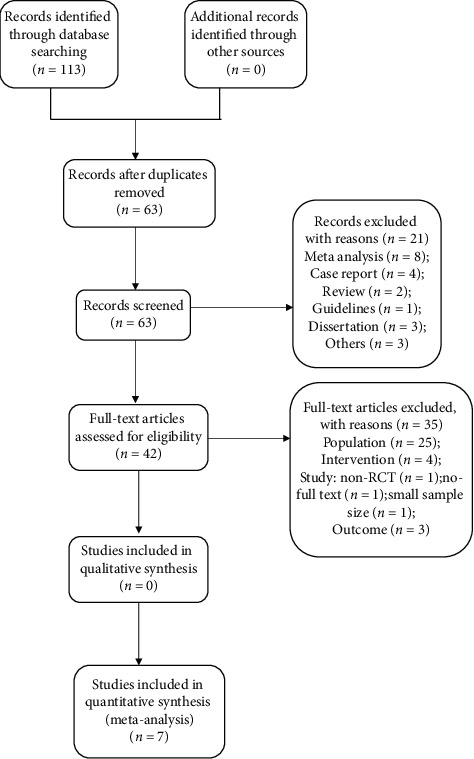
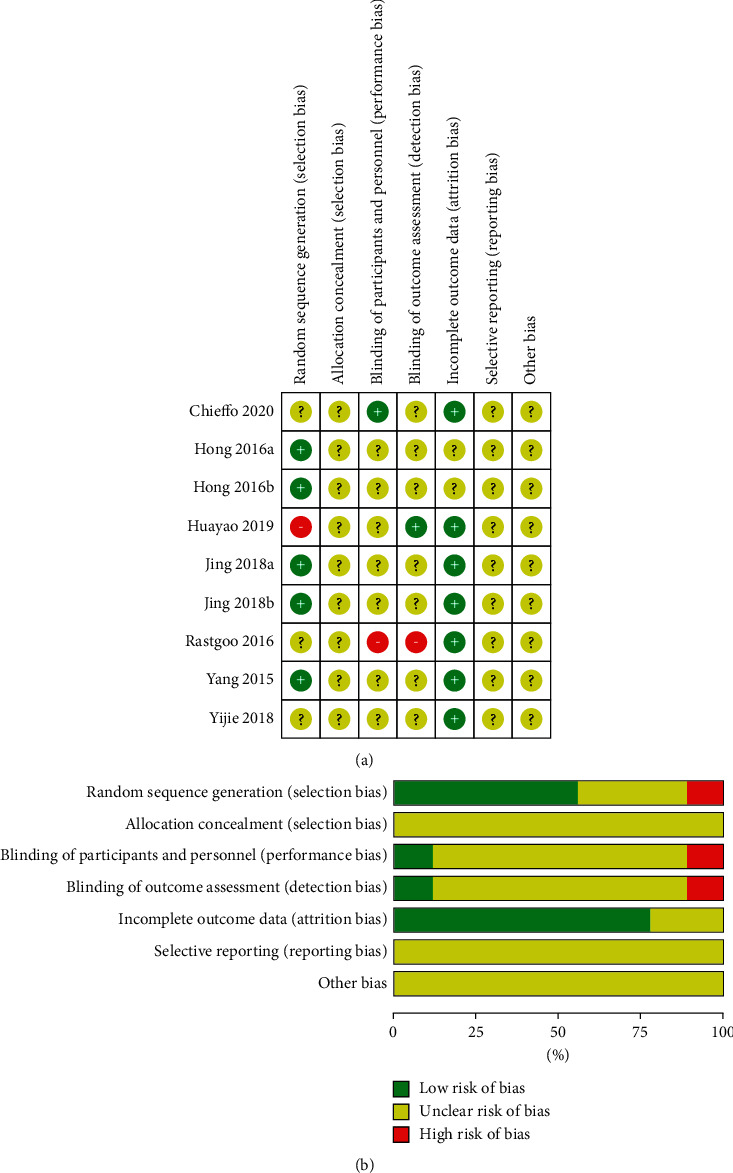
The PubMed, Web of Science, Cochrane Library, EMBASE, China National Knowledge Infrastructure (CNKI), China Biology Medicine (CBM) disc, China Science and Technology Journal Database (VIP), and Wanfang databases were searched online from their inception to May 2021 for randomized controlled trials (RCTs) involving repetitive transcranial magnetic stimulation for lower extremity spasticity after stroke. Valid data were extracted from the included literature, and the quality evaluation was conducted with the Cochrane Handbook for Systematic Reviews of Interventions along with the Physiotherapy Evidence Database scale (PE-Dro scale). The data that met the quality requirements were systematically analysed using Review Manager 5.4 software.
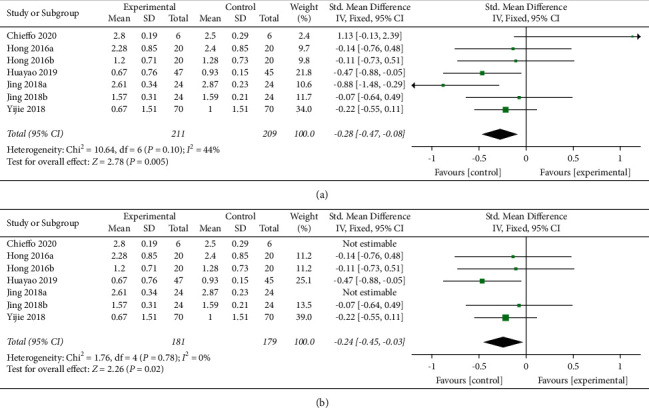
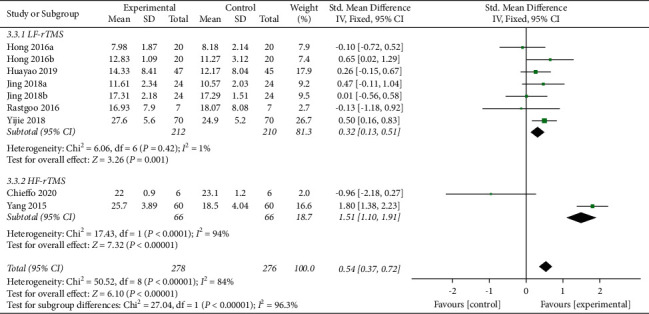
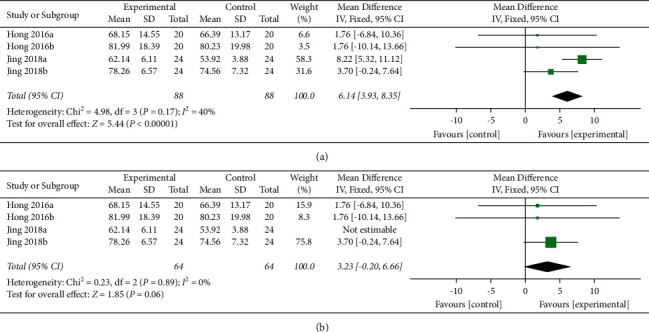
A total of 554 patients from seven articles (nine studies) were quantitatively analysed. Outcomes included the Modified Ashworth Scale (MAS), Fugl-Meyer Assessment of Lower Extremity (FMA-LE), Modified Barthel Index (MBI), and Timed Up and Go (TUG), measured as the effect of rTMS compared with controls conditions after treatment. The systematic review showed that rTMS reduced MAS and increased MBI scores, respectively (SMD = -0.24, 95% CI [-0.45, -0.03], = 0.02; MD = 6.14, 95% CI [-3.93,8.35], < 0.00001), compared with control conditions. Low-frequency rTMS (LF-rTMS) significantly improved FMA-LE scores (SMD = 0.32, 95% CI [0.13, 0.51], = 0.001). However, there was no significant difference in FMA-LE scores when using high-frequency rTMS (HF-rTMS) ( 0.1) and in TUG times ( > 0.1) between the treatment and control groups.
rTMS was effective in improving spasticity and activities of daily living. LF-rTMS has positive clinical effects on enhancing motor function in patients who experience lower extremity spasticity after stroke. To better validate the above conclusions, more multicentre, high-quality, and double-blind randomized controlled trials are needed.
评估重复经颅磁刺激(rTMS)改善脑卒中后下肢痉挛的疗效。
在PubMed、Web of Science、Cochrane图书馆、EMBASE、中国知网(CNKI)、中国生物医学文献数据库(CBMdisc)、维普中文科技期刊数据库(VIP)和万方数据库中进行在线检索,检索时间从建库至2021年5月,查找涉及重复经颅磁刺激治疗脑卒中后下肢痉挛的随机对照试验(RCT)。从纳入文献中提取有效数据,并使用《Cochrane干预措施系统评价手册》和物理治疗证据数据库量表(PE-Dro量表)进行质量评估。使用Review Manager 5.4软件对符合质量要求的数据进行系统分析。
对7篇文章(9项研究)中的554例患者进行了定量分析。结果指标包括改良Ashworth量表(MAS)、下肢Fugl-Meyer评估量表(FMA-LE)、改良Barthel指数(MBI)和起立行走测试(TUG),以治疗后rTMS与对照条件相比的效果进行测量。系统评价表明与对照条件相比,rTMS分别降低了MAS评分并提高了MBI评分(标准化均数差[SMD]=-0.24,95%可信区间[-0.45,-0.03],P=0.02;均数差[MD]=6.14,95%可信区间[-3.93,8.35],P<0.00001)。低频rTMS(LF-rTMS)显著提高了FMA-LE评分(SMD=0.32,95%可信区间[0.13,0.51],P=0.001)。然而,治疗组与对照组之间在使用高频rTMS(HF-rTMS)时FMA-LE评分(P>0.1)和TUG时间(P>0.1)方面无显著差异。
rTMS在改善痉挛和日常生活活动方面有效。低频rTMS对增强脑卒中后下肢痉挛患者的运动功能具有积极的临床效果。为更好地验证上述结论,需要更多多中心、高质量的双盲随机对照试验。