Jaffey Jared A, Su Dan, Monasky Ross, Hanratty Brenna, Flannery Elizabeth, Horman Melissa
Department of Specialty Medicine, Midwestern University College of Veterinary Medicine, Glendale, AZ, United States.
JustFoodForDogs LLC, Irvine, CA, United States.
Front Vet Sci. 2022 Aug 23;9:898056. doi: 10.3389/fvets.2022.898056. eCollection 2022.
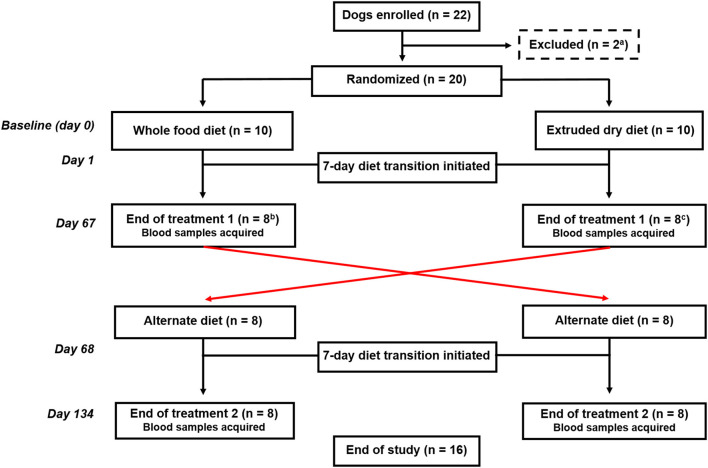
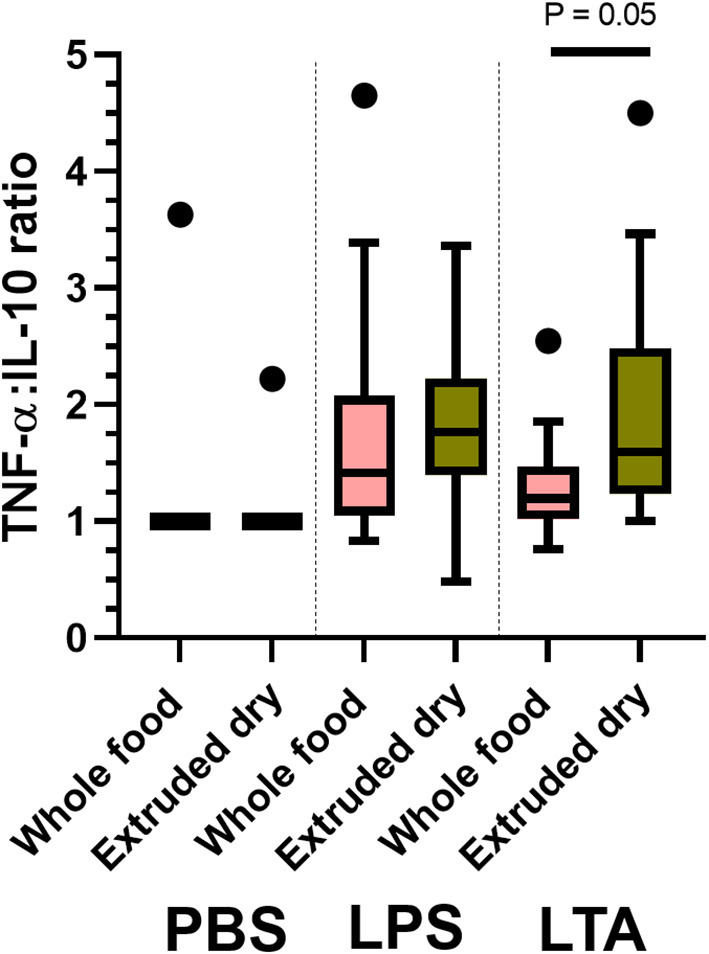
Whole foods in humans decrease inflammation and risk for various diseases, as well as increase weight loss and immune function. Nutrition has been shown to be an integral component in the management of various diseases in dogs but the immunologic and anti-inflammatory effects of whole food diets have not been explored. Therefore, our objective was to assess the effect of feeding a whole food diet on immune function and inflammatory phenotype in healthy dogs. A prospective, randomized, open-labeled, cross-over clinical trial was performed. Sixteen healthy client-owned dogs were fed either a whole food or an extruded dry diet, and after 67 days, they were fed the alternate diet for an additional 67 days. Blood samples were obtained at the completion of each treatment arm (i.e., days 67 and 134). Serum c-reactive protein (CRP), haptoglobin (Hp), and serum amyloid-A (SAA) were measured with ELISA assays. Whole blood cultures were performed with exposure to a phosphate-buffered solution (PBS), lipopolysaccharide (LPS), and lipoteichoic acid (LTA). A canine specific multiplex bead-based assay was then used to measure tumor necrosis factor (TNF)-α, interleukin (IL)-6, IL-10, granulocyte-macrophage colony-stimulating factor (GM-CSF), IL-2, IL-8, and monocyte chemoattractant protein (MCP)-1 concentrations. Granulocyte/monocyte (GM) phagocytosis and oxidative burst associated with were evaluated flow cytometry. Dogs fed a whole food diet had significantly lower TNF-α-to-IL-10 ratios ( = 0.05) and higher production of IL-8 ( = 0.03) with LTA-exposed leukocytes compared to dogs fed an extruded dry diet. There were no between-treatment differences in the remaining leukocyte cytokine responses, serum CRP, Hp, SAA concentrations, or GM phagocytic and oxidative burst capacities. Whole food diets could have immunomodulatory effects in dogs. Future studies in non-healthy dogs are warranted.
全食物对人类而言可减轻炎症并降低患各种疾病的风险,还能促进体重减轻和增强免疫功能。营养已被证明是犬类各种疾病管理中不可或缺的组成部分,但全食物饮食的免疫和抗炎作用尚未得到探索。因此,我们的目标是评估给健康犬喂食全食物饮食对其免疫功能和炎症表型的影响。我们进行了一项前瞻性、随机、开放标签、交叉临床试验。16只健康的客户拥有的犬被喂食全食物或挤压干饲料,67天后,它们再被喂食另一种饲料67天。在每个治疗阶段结束时(即第67天和第134天)采集血样。用ELISA法检测血清C反应蛋白(CRP)、触珠蛋白(Hp)和血清淀粉样蛋白A(SAA)。全血培养在暴露于磷酸盐缓冲溶液(PBS)、脂多糖(LPS)和脂磷壁酸(LTA)的情况下进行。然后使用基于犬特异性多重微珠的检测方法来测量肿瘤坏死因子(TNF)-α、白细胞介素(IL)-6、IL-10、粒细胞-巨噬细胞集落刺激因子(GM-CSF)、IL-2、IL-8和单核细胞趋化蛋白(MCP)-1的浓度。通过流式细胞术评估与粒细胞/单核细胞(GM)吞噬作用和氧化爆发相关的情况。与喂食挤压干饲料的犬相比,喂食全食物饮食的犬在LTA刺激的白细胞中TNF-α与IL-10的比值显著更低(P = 0.05),IL-8的产生更高(P = 0.03)。其余白细胞细胞因子反应、血清CRP、Hp、SAA浓度或GM吞噬和氧化爆发能力在不同处理之间没有差异。全食物饮食可能对犬具有免疫调节作用。有必要对非健康犬进行进一步研究。