Section for Ecoinformatics & Biodiversity, Department of Biology, Aarhus University, Aarhus C, Denmark.
Center for Biodiversity Dynamics in a Changing World (BIOCHANGE), Department of Biology, Aarhus University, Aarhus C, Denmark.
Glob Chang Biol. 2022 Dec;28(24):7296-7312. doi: 10.1111/gcb.16426. Epub 2022 Sep 24.
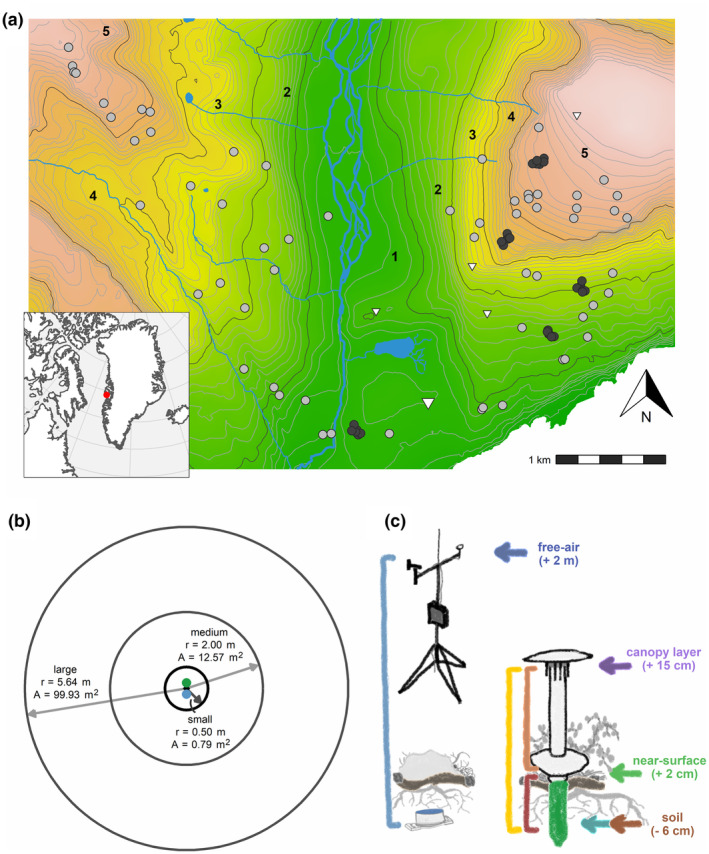
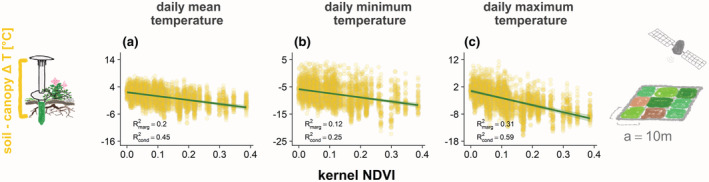
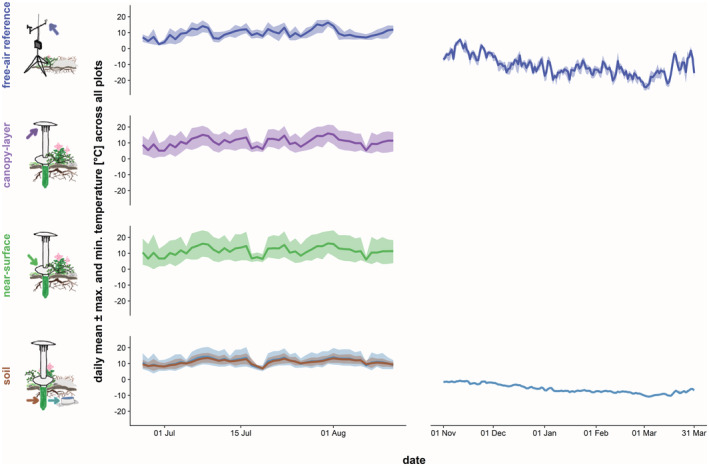
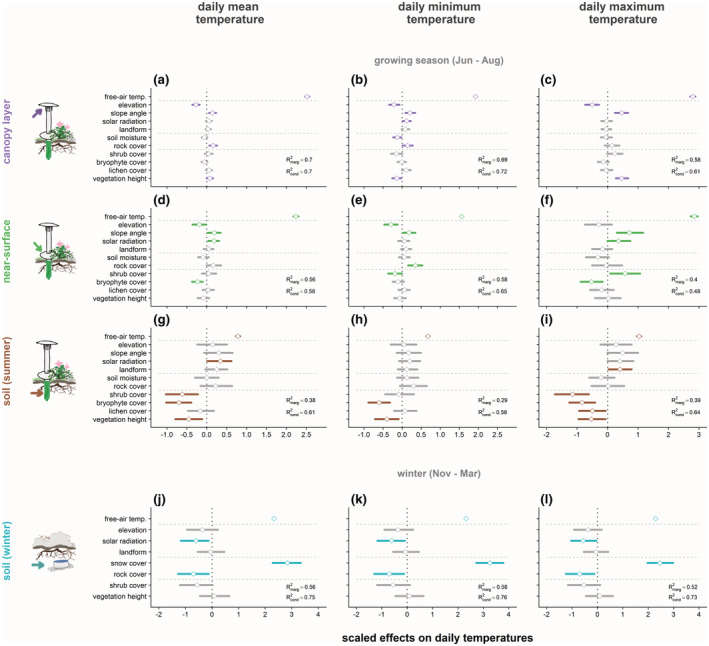
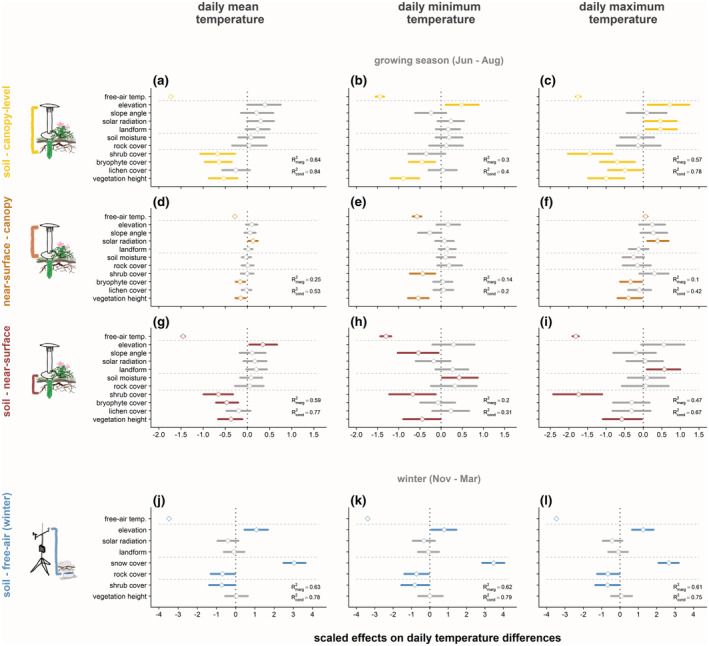
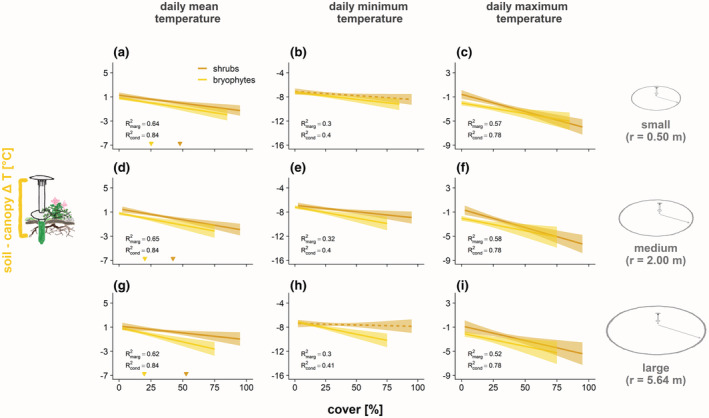
Climate warming is inducing widespread vegetation changes in Arctic tundra ecosystems, with the potential to alter carbon and nutrient dynamics between vegetation and soils. Yet, we lack a detailed understanding of how variation in vegetation and topography influences fine-scale temperatures ("microclimate") that mediate these dynamics, and at what resolution vegetation needs to be sampled to capture these effects. We monitored microclimate at 90 plots across a tundra landscape in western Greenland. Our stratified random study design covered gradients of topography and vegetation, while nested plots (0.8-100 m ) enabled comparison across different sampling resolutions. We used Bayesian mixed-effect models to quantify the direct influence of plot-level topography, moisture and vegetation on soil, near-surface and canopy-level temperatures (-6, 2, and 15 cm). During the growing season, colder soils were predicted by shrub cover (-0.24°C per 10% increase), bryophyte cover (-0.35°C per 10% increase), and vegetation height (-0.17°C per 1 cm increase). The same three factors also predicted the magnitude of differences between soil and above-ground temperatures, indicating warmer soils at low cover/height, but colder soils under closed/taller canopies. These findings were consistent across plot sizes, suggesting that spatial predictions of microclimate may be possible at the operational scales of satellite products. During winter, snow cover (+0.75°C per 10 snow-covered days) was the key predictor of soil microclimate. Topography and moisture explained little variation in the measured temperatures. Our results not only underline the close connection of vegetation and snow with microclimate in the Arctic tundra but also point to the need for more studies disentangling their complex interplay across tundra environments and seasons. Future shifts in vegetation cover and height will likely mediate the impact of atmospheric warming on the tundra soil environment, with potential implications for below-ground organisms and ecosystem functioning.
气候变暖正在引发北极苔原生态系统中广泛的植被变化,有可能改变植被与土壤之间的碳和养分动态。然而,我们缺乏对植被和地形变化如何影响调节这些动态的微观气候(“小气候”)的详细了解,以及需要以何种分辨率采样植被才能捕捉到这些影响。我们在格陵兰岛西部的苔原生态景观中监测了 90 个小气候图。我们的分层随机研究设计涵盖了地形和植被的梯度,而嵌套的图(0.8-100 m)使我们能够在不同的采样分辨率下进行比较。我们使用贝叶斯混合效应模型来量化地形、水分和植被对土壤、近地表和冠层温度(-6、2 和 15 cm)的直接影响。在生长季节,灌木覆盖度(每增加 10%,温度降低 0.24°C)、苔藓覆盖度(每增加 10%,温度降低 0.35°C)和植被高度(每增加 1 cm,温度降低 0.17°C)预测了较冷的土壤。这三个因素也预测了土壤和地上温度之间差异的大小,表明低覆盖/高度下的土壤较暖,但在封闭/较高的冠层下的土壤较冷。这些发现与图的大小一致,表明微气候的空间预测可能在卫星产品的操作规模上成为可能。在冬季,积雪覆盖(每增加 10 个积雪日,温度升高 0.75°C)是土壤微气候的关键预测因子。地形和水分对测量温度的变化解释很少。我们的研究结果不仅强调了植被和积雪与北极苔原生态系统中小气候的密切联系,还指出需要更多的研究来厘清它们在苔原生态环境和季节中的复杂相互作用。未来植被覆盖和高度的变化可能会调节大气变暖对苔原土壤环境的影响,这可能对地下生物和生态系统功能产生影响。