Division of Maternal-Fetal Medicine, University of Texas Medical Branch, Galveston, Texas; and the Department of Obstetrics and Gynecology, Lawrence Hospital, Bronxville New York.
Obstet Gynecol. 2022 Oct 1;140(4):584-590. doi: 10.1097/AOG.0000000000004942. Epub 2022 Sep 7.
To assess whether outpatient cervical ripening with a synthetic osmotic dilator shortens the length of hospital stay in term pregnancies undergoing labor induction.
Pregnant participants scheduled for labor induction at term with unfavorable cervix (less than 3-cm dilated and less than 60% effaced) and not requiring inpatient maternal or fetal monitoring were consented, and synthetic osmotic dilator rods were inserted on the day of scheduled induction. After reassuring fetal heart tracing, patients randomized to the outpatient group were asked to return 12 hours after insertion or sooner if needed. Those randomized to the inpatient group remained in the hospital. After the first round of ripening, additional ripening, oxytocin, and labor management were left up to the clinical health care professionals. The primary outcome was the proportion of participants with hospital stays longer than 48 hours. We estimated that a sample size of 338 would provide 85% power to detect a 30% difference between groups.
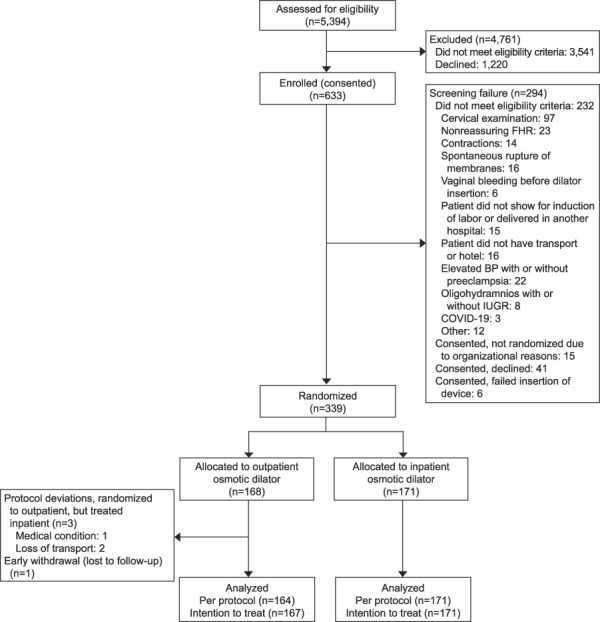
From November 2018 to November 2021, 339 participants were randomized (171 inpatient, 167 outpatient, one withdrawal). Four patients in the outpatient group were admitted before12 hours for suspected labor and rupture of membranes, and 19 in the inpatient group had the device removed before 12 hours. The proportion of participants with hospital stays longer than 48 hours was lower in the outpatient group compared with the inpatient group (89 [53%] vs 152 [89%], relative risk [RR] 0.60, 95% CI 0.52-0.70). Patients in the outpatient group had a shorter total length of stay and time from admission to active labor. They were more likely to have a vaginal delivery within 24 hours of admission and were less likely to receive analgesics during ripening. Route of delivery and other maternal and neonatal outcomes were not significantly different between groups.
Outpatient cervical ripening with a cervical osmotic dilator decreased hospital stay compared with inpatient ripening, without significant adverse outcomes.
Medicem Technology s.r.o., Czech Republic.
ClinicalTrials.gov, NCT03665688.
评估在足月妊娠引产中,门诊使用合成渗透扩张器进行宫颈成熟是否能缩短住院时间。
纳入计划在足月时引产且宫颈条件不佳(宫颈扩张小于 3cm 且宫颈管消失小于 60%)且无需住院监测产妇或胎儿的孕妇,在计划引产日插入合成渗透扩张器。在胎儿心电图监测结果令人安心后,将门诊组患者随机分组,在插入后 12 小时或有需要时提前返回。住院组患者则留在医院。第一轮成熟后,其他成熟、催产素和分娩管理由临床医护人员决定。主要结局为住院时间超过 48 小时的患者比例。我们估计,338 名参与者的样本量将有 85%的效力来检测两组之间 30%的差异。
2018 年 11 月至 2021 年 11 月,共 339 名参与者被随机分组(门诊 171 例,住院 167 例,1 例退出)。门诊组有 4 例患者在 12 小时前因疑似临产和胎膜破裂而住院,住院组有 19 例患者在 12 小时前取出了装置。与住院组相比,门诊组住院时间超过 48 小时的患者比例较低(89[53%]例比 152[89%]例,相对风险[RR]0.60,95%CI0.52-0.70)。门诊组患者的总住院时间和从入院到活跃分娩的时间更短。她们在入院后 24 小时内阴道分娩的可能性更高,在成熟过程中使用止痛药的可能性更低。两组的分娩方式和其他母婴结局没有显著差异。
与住院成熟相比,门诊使用宫颈渗透扩张器进行宫颈成熟可缩短住院时间,且无明显不良结局。
捷克共和国 Medicem Technology s.r.o.。
ClinicalTrials.gov,NCT03665688。