Nicholson Sarah M, Flood Karen, Dicker Patrick, Molphy Zara E, Smith Orla T, Oprescu Corina I, Wall Eimear M, El Nimr Sara N, Shanahan Ita M, Kennedy Bernard J, Daly Ronan V, Gannon Geraldine, Looi Claudia, Fernandez Elena, Malone Fergal D
Rotunda Hospital, Dublin, Ireland.
Department of Obstetrics and Gynaecology, Royal College of Surgeons in Ireland, (RCSI), University of Medicine and Health Sciences, Dublin, Ireland.
EClinicalMedicine. 2024 Jul 17;74:102741. doi: 10.1016/j.eclinm.2024.102741. eCollection 2024 Aug.
The increased demand for induction of labour (IOL) at 39 weeks' gestation in normal-risk nulliparous patients creates significant logistical challenges for busy maternity units. A potential innovation is commencing induction by means of outpatient cervical ripening, using either a vaginal prostaglandin preparation (Propess) or an osmotic cervical dilator (Dilapan-S).
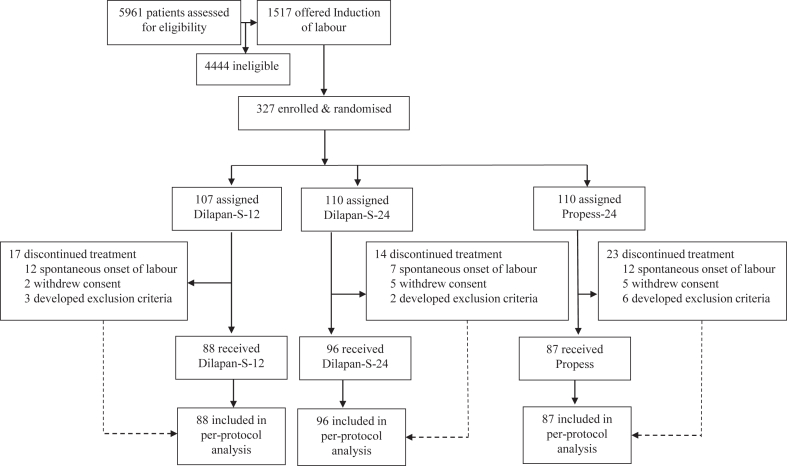
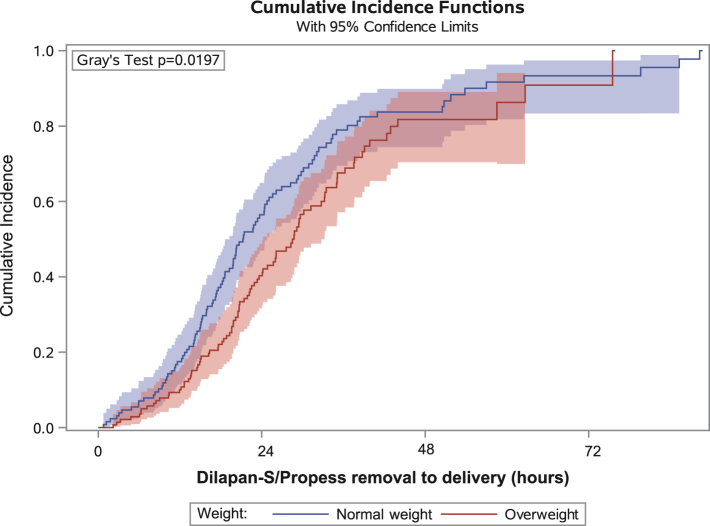
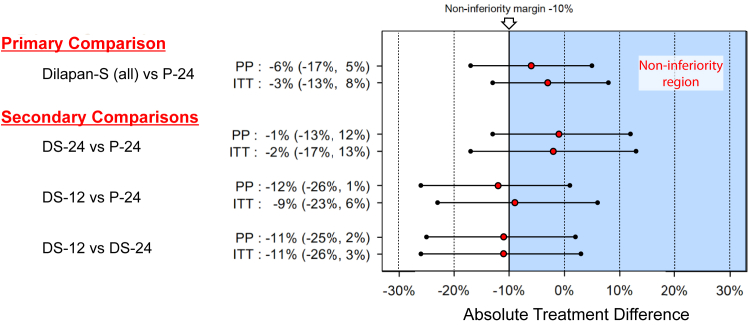
A Phase III, open label, single centre non-inferiority trial (EudraCT number 2019-004697-25) randomised healthy nulliparous women who chose elective IOL at 39 weeks to one of three methods of initial cervical ripening, specifically 12 h of Dilapan-S(D12), 24 h of Dilapan-S(D24), or 24 h of Propess(P24) between November 2020 and July 2023. After initial administration of the IOL agent in the hospital, participants returned home for 12 or 24 h, before readmission to complete delivery. The primary outcome was vaginal delivery achieved at any time, and this was compared in a non-inferiority analysis of Dilapan-S compared to Propess, within a 10% non-inferiority margin. Secondary outcomes included pairwise comparisons for each induction agent, and a range of logistical factors, such as time to delivery, the need for an additional cervical ripening agent, and length of hospital stay.
Of the 327 women randomised at 38 weeks, 271 (83%) completed the induction intervention. The D24 and P24 groups showed similarly high rates of vaginal delivery, 75% and 76% respectively. D12 had a lower vaginal delivery rate of 64% and consequently the overall comparison of Dilapan-S to Propess did not demonstrate non-inferiority (difference = -6%, 95% CI = -17%, 5%) because the lower 95% CI exceeded the -10% threshold of non-inferiority. The majority of participants across all groups were delivered by any means within 72 h of starting the induction process, inclusive of time spent at home (89% of the D24 group, 98% of the D12 group, 95% of the P24 group). There were no differences in rates of adverse events between groups.
There were similarly high vaginal delivery rates for D24 and P24, with at least 75% of patients successfully delivering vaginally following outpatient cervical ripening, with no significant adverse maternal or neonatal outcomes.
The Rotunda Foundation, Medicem Technology s.r.o.
正常风险初产妇在妊娠39周时引产需求的增加给繁忙的产科病房带来了巨大的后勤挑战。一种潜在的创新方法是通过门诊宫颈成熟来开始引产,使用阴道前列腺素制剂(普贝生)或渗透性宫颈扩张器(狄拉潘 - S)。
一项III期、开放标签、单中心非劣效性试验(欧洲临床试验注册号2019 - 004697 - 25)将在39周选择择期引产的健康初产妇随机分为三种初始宫颈成熟方法之一,具体为2020年11月至2023年7月期间的12小时狄拉潘 - S(D12)、24小时狄拉潘 - S(D24)或24小时普贝生(P24)。在医院首次给予引产药物后,参与者回家12或24小时,然后再次入院完成分娩。主要结局是在任何时间实现阴道分娩,在狄拉潘 - S与普贝生的非劣效性分析中进行比较,非劣效性 margin 为10%。次要结局包括每种引产药物的两两比较以及一系列后勤因素,如分娩时间、是否需要额外的宫颈成熟药物和住院时间。
在38周随机分组的327名女性中,271名(83%)完成了引产干预。D24组和P24组的阴道分娩率同样较高,分别为75%和76%。D12组的阴道分娩率较低,为64%,因此狄拉潘 - S与普贝生的总体比较未显示非劣效性(差异 = -6%,95% CI = -17%,5%),因为95% CI的下限超过了 -10%的非劣效性阈值。所有组中的大多数参与者在开始引产过程的72小时内通过任何方式分娩,包括在家中度过的时间(D24组的89%,D12组的98%,P24组的95%)。各组之间不良事件发生率无差异。
D24和P24的阴道分娩率同样较高,门诊宫颈成熟后至少75%的患者成功阴道分娩,且无明显的母婴不良结局。
罗通达基金会,Medicem Technology s.r.o.