Department of Otorhinolaryngology, Head and Neck Surgery, University Medicine Halle (Saale), Martin Luther University Halle-Wittenberg, Ernst-Grube-Str. 40, 06120, Halle (Saale), Germany.
Department of Otorhinolaryngology, Head and Neck Surgery, Martha-Maria Hospital Halle-Dölau, Halle (Saale), Germany.
HNO. 2023 Aug;71(Suppl 1):1-9. doi: 10.1007/s00106-022-01190-w. Epub 2022 Sep 9.
The simultaneous implantation of the Bonebridge (MED-EL, Innsbruck, Austria), a semi-implantable active transcutaneous bone conduction hearing device and anchors for auricular prostheses can be challenging as both implants contain magnets and compete for the narrow space in the designated implantation area.
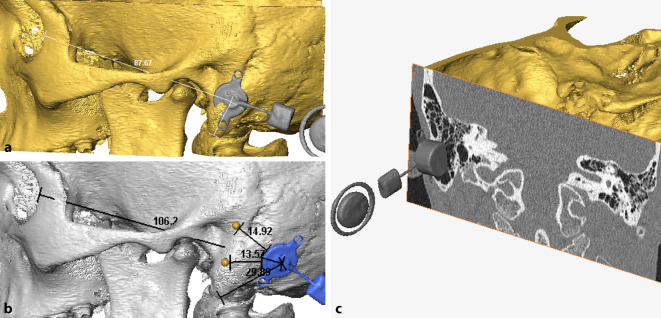
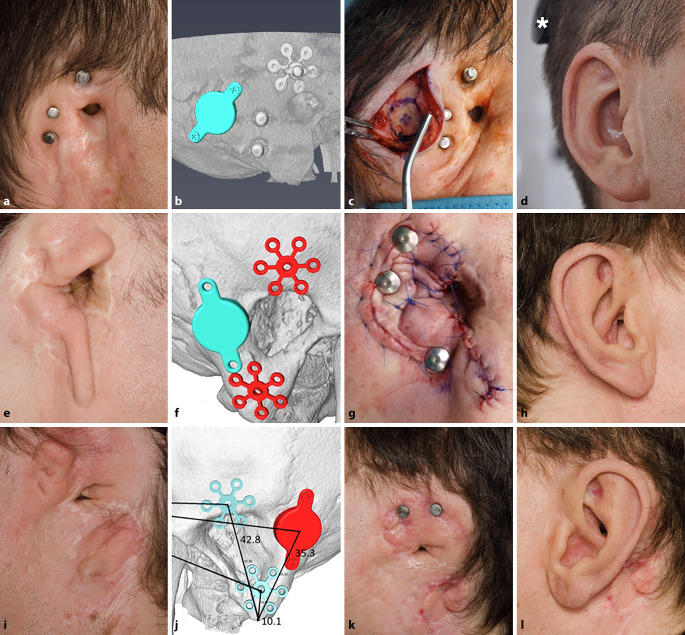
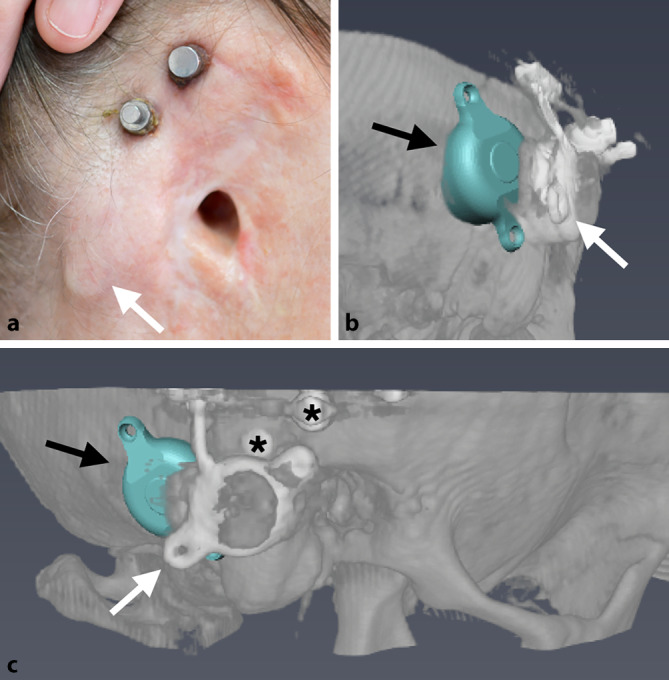
A preoperative planning tool (virtual surgery) was used with individual 3D computer models of the skull and implants for finding optimal implant positions for both the floating mass transducer (FMT) and the anchors for the auricular prosthesis. The interaction between the magnetic prosthesis anchors and the FMT was measured by means of static magnetic forces. A retrospective data analysis was conducted to evaluate the surgical and audiological outcome.
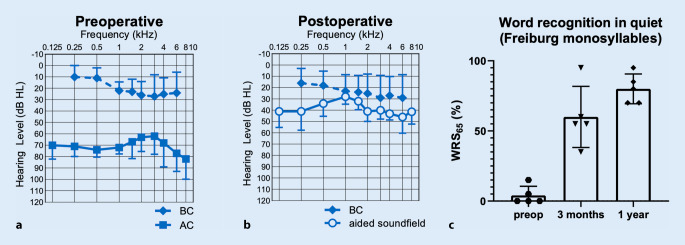
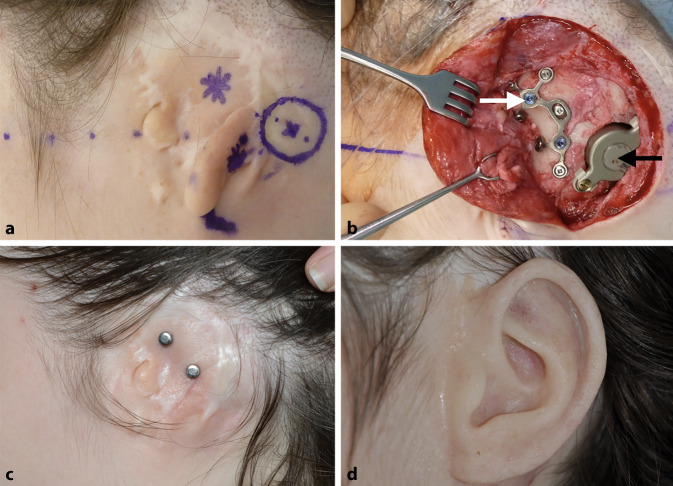
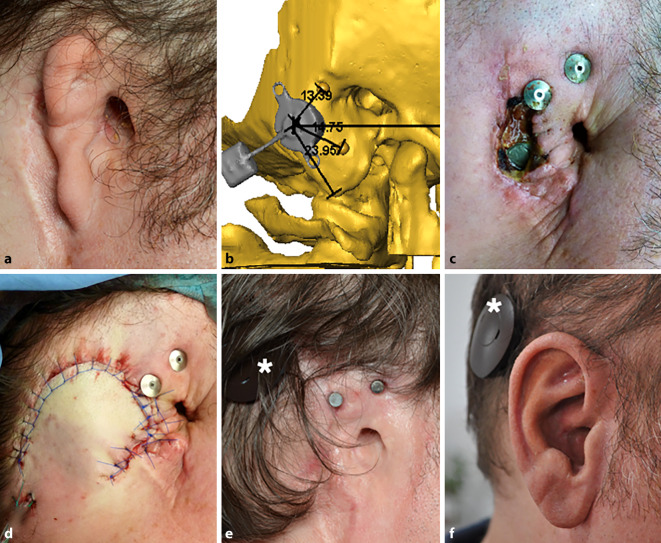
Between 2014 and 2021, a 3D planning of a simultaneous implantation of the Bonebridge with auricular prosthesis anchors was conducted on 6 ears of 5 patients (3 males, 2 females; age range 17-56 years). The individual preoperative planning was considered very useful for the optimal placement of bone anchors in combination with the Bonebridge. Audiological data showed a clear benefit for hearing 3 months and > 11 months after implantation. No adverse interactions between the magnetic prosthesis anchors and the FMT were observed. In two patients, revision surgery was carried out due to skin inflammation or wound healing problems. No long-term complications were observed 3-5 years after surgery.
Preoperative 3D planning represents a clear benefit for the simultaneous audiological and esthetic rehabilitation using the Bonebridge and anchors for auricular prostheses.
同时植入 Bonebridge(MED-EL,因斯布鲁克,奥地利),一种半植入式主动经皮骨导听力装置和耳假体的锚钉,可能具有挑战性,因为这两种植入物都含有磁铁,并且争夺指定植入区域内的狭窄空间。
使用颅骨和植入物的个体化 3D 计算机模型进行术前规划工具(虚拟手术),以找到浮动质量换能器(FMT)和耳假体锚钉的最佳植入位置。通过静态磁力测量了磁性假体锚钉和 FMT 之间的相互作用。进行回顾性数据分析以评估手术和听力学结果。
在 2014 年至 2021 年期间,对 5 名患者(3 名男性,2 名女性;年龄范围 17-56 岁)的 6 只耳朵进行了 Bonebridge 与耳假体锚钉同时植入的 3D 规划。个体化术前规划被认为对骨锚钉与 Bonebridge 联合最佳放置非常有用。听力学数据显示植入后 3 个月和>11 个月听力明显改善。未观察到磁性假体锚钉和 FMT 之间的不良相互作用。在两名患者中,由于皮肤炎症或伤口愈合问题进行了修正手术。手术后 3-5 年未观察到长期并发症。
术前 3D 规划为使用 Bonebridge 和耳假体锚钉进行同时的听觉和美学康复提供了明显的益处。