Rawson James R G, Esteve-Altava Borja, Porro Laura B, Dutel Hugo, Rayfield Emily J
School of Earth Sciences, University of Bristol, Bristol BS8 1RJ, UK.
Institut de Biologia Evolutiva, Departament de Ciències Experimentals i la Salud, Universitat Pompeu Fabra, Barcelona, Spain.
Sci Adv. 2022 Sep 9;8(36):eadc8875. doi: 10.1126/sciadv.adc8875.
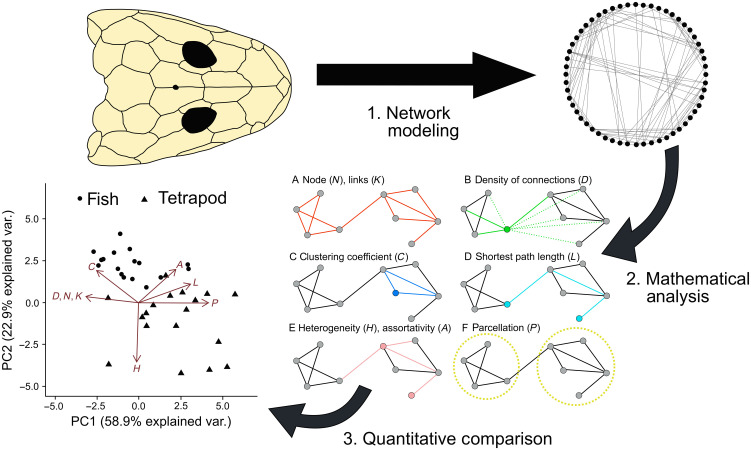
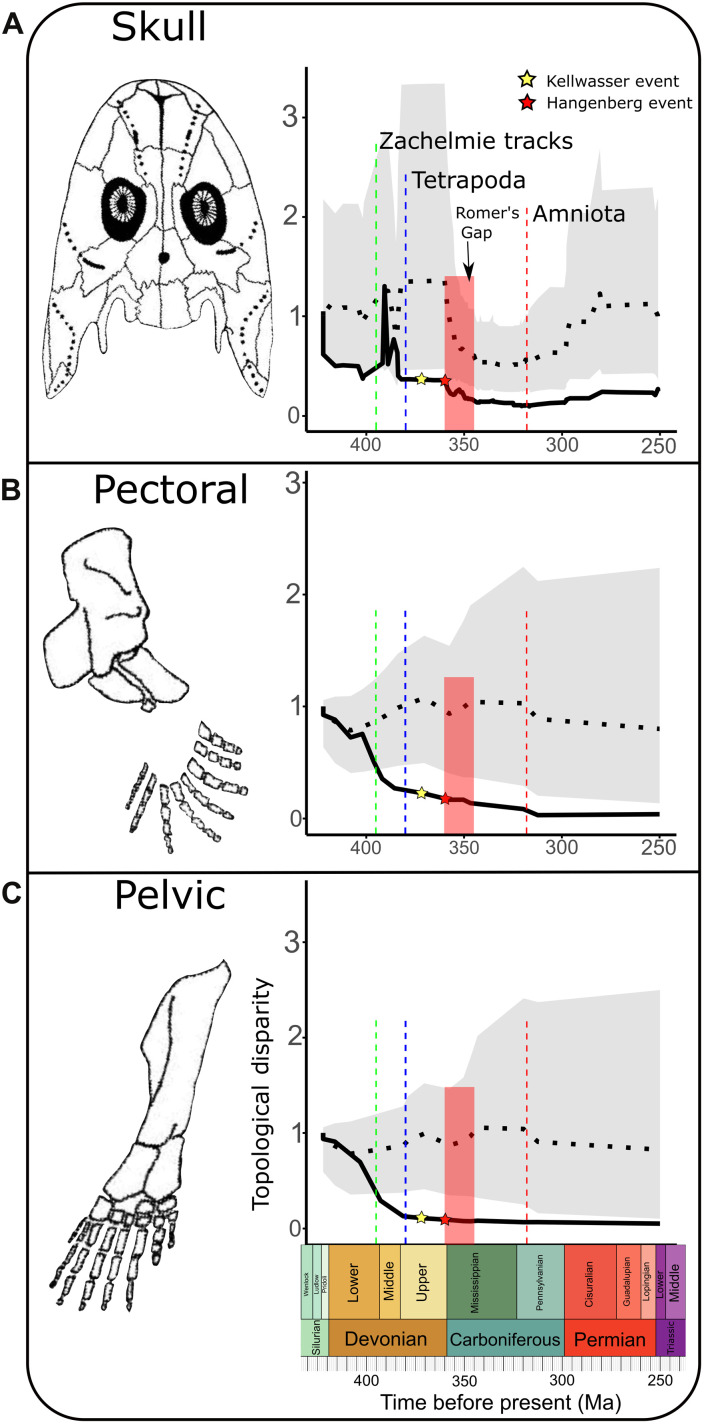
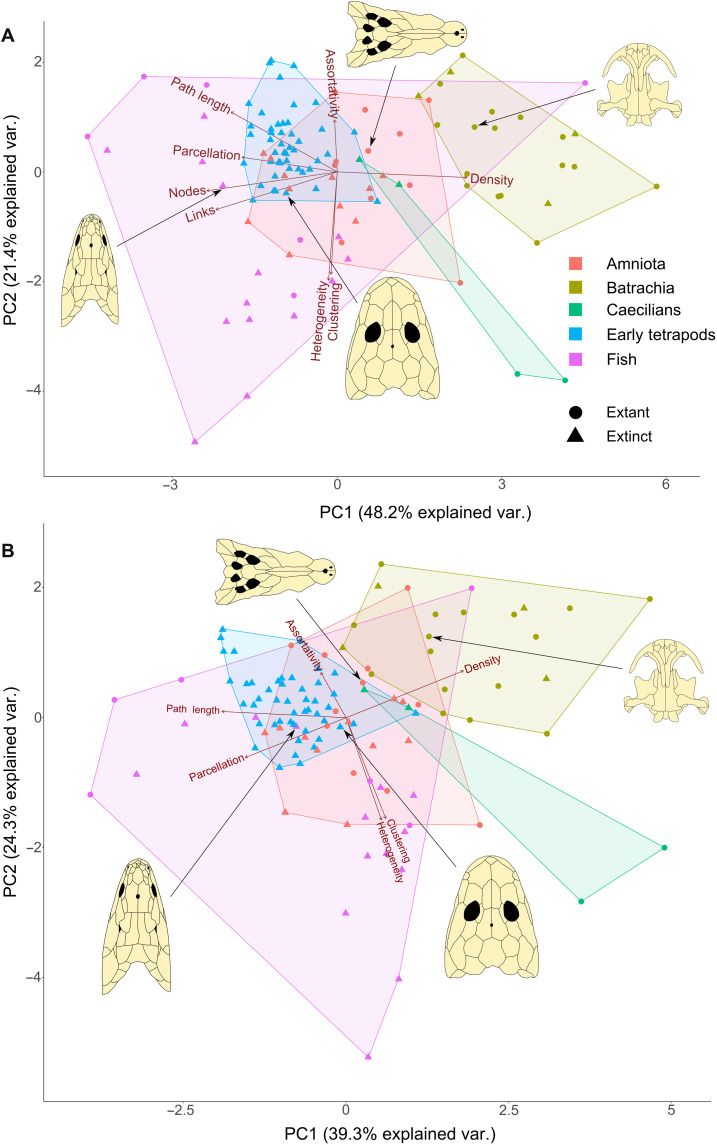
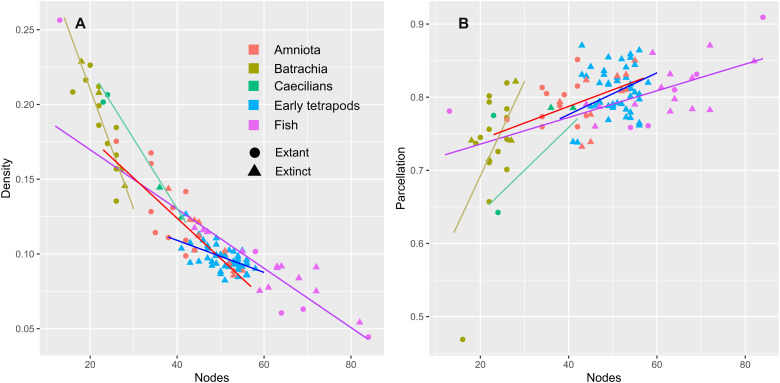
The developmental underpinnings and functional consequences of modifications to the limbs during the origin of the tetrapod body plan are increasingly well characterized, but less is understood about the evolution of the tetrapod skull. Decrease in skull bone number has been hypothesized to promote morphological and functional diversification in vertebrate clades, but its impact during the initial rise of tetrapods is unknown. Here, we test this by quantifying topological changes to cranial anatomy in fossil and living taxa bracketing the fin-to-limb transition using anatomical network analysis. We find that bone loss across the origin of tetrapods is associated not only with increased complexity of bone-to-bone contacts but also with decreasing topological diversity throughout the late Paleozoic, which may be related to developmental and/or mechanical constraints. We also uncover a 10-Ma offset between fin-limb and cranial morphological evolution, suggesting that different evolutionary drivers affected these features during the origin of tetrapods.
在四足动物身体结构起源过程中,肢体变化的发育基础和功能后果已得到越来越充分的描述,但对于四足动物头骨的进化却了解较少。有假说认为,头骨骨骼数量的减少促进了脊椎动物类群的形态和功能多样化,但其在四足动物最初出现时的影响尚不清楚。在这里,我们通过使用解剖网络分析,对处于鳍到肢体过渡阶段的化石和现存类群的颅骨解剖结构进行拓扑变化量化,来验证这一假说。我们发现,整个四足动物起源过程中的骨质流失不仅与骨与骨接触的复杂性增加有关,而且与整个晚古生代拓扑多样性的降低有关,这可能与发育和/或机械限制有关。我们还发现鳍到肢体与颅骨形态进化之间存在1000万年的时间差,这表明在四足动物起源过程中,不同的进化驱动因素影响了这些特征。