Academic Rheumatology, School of Medicine, University of Nottingham, Nottingham, United Kingdom.
Centre for Academic Primary Care, Lifespan and Population Health, School of Medicine, University of Nottingham, Nottingham, United Kingdom.
PLoS One. 2022 Sep 9;17(9):e0267769. doi: 10.1371/journal.pone.0267769. eCollection 2022.
To explore barriers and facilitators to COVID-19, influenza, and pneumococcal vaccine uptake in immunosuppressed adults with immune-mediated inflammatory diseases (IMIDs).
Recruiting through national patient charities and a local hospital, participants were invited to take part in an in-depth, one-to-one, semi-structured interview with a trained qualitative researcher between November 2021 and January 2022. Data were analysed thematically in NVivo, cross-validated by a second coder and mapped to the SAGE vaccine hesitancy matrix.
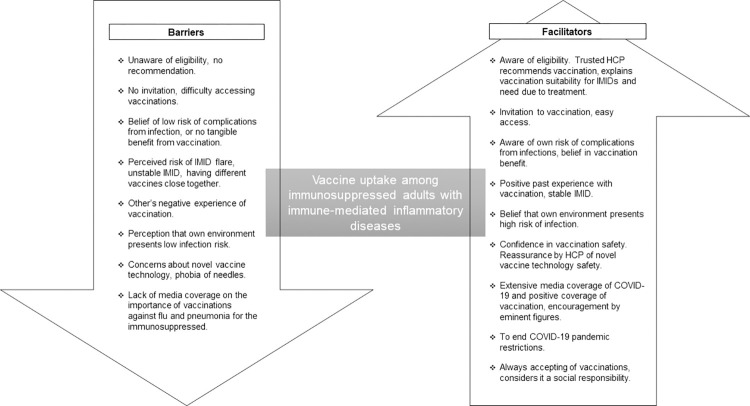
Twenty participants (75% female, 20% non-white) were recruited. Barriers and facilitators spanned contextual, individual/group and vaccine/vaccination-specific factors. Key facilitators to all vaccines were higher perceived infection risk and belief that vaccination is beneficial. Key barriers to all vaccines were belief that vaccination could trigger IMID flare, and active IMID. Key facilitators specific to COVID-19 vaccines included media focus, high incidence, mass-vaccination programme with visible impact, social responsibility, and healthcare professionals' (HCP) confirmation of the new vaccines' suitability for their IMID. Novel vaccine technology was a concern, not a barrier. Key facilitators of influenza/pneumococcal vaccines were awareness of eligibility, direct invitation, and, clear recommendation from trusted HCP. Key barriers of influenza/pneumococcal vaccines were unaware of eligibility, no direct invitation or recommendation from HCP, low perceived infection risk, and no perceived benefit from vaccination.
Numerous barriers and facilitators to vaccination, varying by vaccine-type, exist for immunosuppressed-IMID patients. Addressing vaccine benefits and safety for IMID-patients in clinical practice, direct invitation, and public-health messaging highlighting immunosuppression as key vaccination-eligibility criteria may optimise uptake, although further research should assess this.
探讨免疫抑制的免疫介导的炎症性疾病(IMID)患者对 COVID-19、流感和肺炎球菌疫苗接种的接受障碍和促进因素。
通过国家患者慈善机构和当地医院招募参与者,邀请他们在 2021 年 11 月至 2022 年 1 月期间与经过培训的定性研究人员进行一对一的深入半结构化访谈。在 NVivo 中对数据进行主题分析,由第二位编码员交叉验证,并映射到 SAGE 疫苗犹豫矩阵。
共招募了 20 名参与者(75%为女性,20%为非白人)。障碍和促进因素涵盖了背景、个人/群体和疫苗/接种特异性因素。所有疫苗的主要促进因素是更高的感染风险感知和相信接种疫苗是有益的。所有疫苗的主要障碍是相信接种疫苗会引发 IMID 发作和活动性 IMID。COVID-19 疫苗的主要促进因素包括媒体关注、高发病率、大规模疫苗接种计划以及可见的影响、社会责任和医疗保健专业人员(HCP)对新疫苗适合其 IMID 的确认。新型疫苗技术是一个关注点,而不是障碍。流感/肺炎球菌疫苗的主要促进因素是对资格的认识、直接邀请以及值得信赖的 HCP 的明确推荐。流感/肺炎球菌疫苗的主要障碍是不知道资格、没有来自 HCP 的直接邀请或推荐、对感染风险感知较低以及没有从接种疫苗中获得好处。
免疫抑制的 IMID 患者对疫苗接种存在多种障碍和促进因素,且因疫苗类型而异。在临床实践中解决疫苗对 IMID 患者的益处和安全性问题、直接邀请以及强调免疫抑制作为关键接种资格标准的公共卫生宣传,可能会优化接种率,但需要进一步研究来评估这一点。