School for Policy Studies, University of Bristol, Bristol, United Kingdom.
Department of Translational Research and New Technologies in Medicine and Surgery, University of Pisa, Pisa, Italy.
PLoS One. 2022 Sep 9;17(9):e0267070. doi: 10.1371/journal.pone.0267070. eCollection 2022.
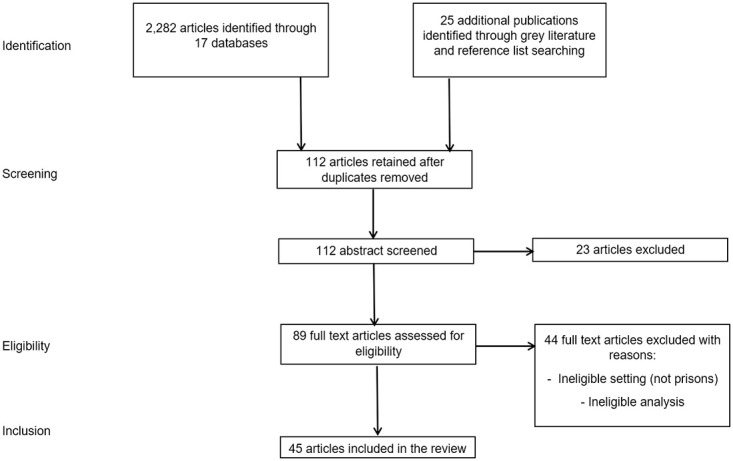
Overcrowding, poor conditions, and high population turnover make prisons highly susceptible to COVID-19. Vaccination is key to controlling COVID-19, yet there is disagreement regarding whether people who live and work in prisons should be prioritised in national vaccination programmes. To help resolve this, we critically examine the extent, nature, and quality of extant literature regarding prioritisation of COVID-19 vaccinations for people who live and work in prisons. Using a scoping review as our methodological framework, we conducted a systematic literature search of 17 databases. From 2,307 potentially eligible articles, we removed duplicates and screened titles and abstracts to retain 45 articles for review and quality appraisal. Findings indicated that while most countries recognise that prisons are at risk of high levels of COVID-19 transmission, only a minority have explicitly prioritised people who live and work in prisons for COVID-19 vaccination. Even among those that have, prioritisation criteria vary considerably. This is set against a backdrop of political barriers, such as politicians questioning the moral deservingness of people in prison; policy barriers, such as the absence of a unified international framework of how vaccine prioritisation should proceed in prisons; logistical barriers regarding vaccine administration in prisons; and behavioural barriers including vaccine hesitancy. We outline five strategies to prioritise people who live and work in prisons in COVID-19 vaccination plans: (1) improving data collection on COVID-19 vaccination, (2) reducing the number of people imprisoned, (3) tackling vaccine populism through advocacy, (4) challenging arbitrary prioritisation processes via legal processes, and (5) conducting more empirical research on COVID-19 vaccination planning, delivery, and acceptability. Implementing these strategies would help to reduce the impact of COVID-19 on the prison population, prevent community transmission, improve vaccine uptake in prisons beyond the current pandemic, foster political accountability, and inform future decision-making.
过度拥挤、恶劣的条件和高人口流动率使监狱极易感染 COVID-19。疫苗接种是控制 COVID-19 的关键,但对于生活和工作在监狱中的人是否应优先纳入国家疫苗接种计划存在分歧。为了帮助解决这个问题,我们批判性地审查了关于为生活和工作在监狱中的人优先接种 COVID-19 疫苗的现有文献的范围、性质和质量。我们使用范围综述作为我们的方法框架,对 17 个数据库进行了系统的文献检索。从 2307 篇潜在的合格文章中,我们删除了重复项,并筛选了标题和摘要,以保留 45 篇文章进行审查和质量评估。研究结果表明,虽然大多数国家都认识到监狱存在 COVID-19 高传播风险,但只有少数国家明确将生活和工作在监狱中的人列为 COVID-19 疫苗接种的优先对象。即使在那些已经这样做的国家中,优先排序标准也有很大差异。这是在政治障碍的背景下发生的,例如政治家质疑监狱中人员的道德应得性;政策障碍,例如缺乏统一的国际框架来规定如何在监狱中进行疫苗优先排序;监狱中疫苗管理的后勤障碍;以及包括疫苗犹豫在内的行为障碍。我们概述了在 COVID-19 疫苗接种计划中优先考虑生活和工作在监狱中的人的五项策略:(1)改善 COVID-19 疫苗接种数据收集,(2)减少被监禁人数,(3)通过宣传来应对疫苗民粹主义,(4)通过法律程序对任意的优先排序过程提出质疑,(5)对 COVID-19 疫苗接种规划、实施和可接受性进行更多的实证研究。实施这些策略将有助于减轻 COVID-19 对监狱人口的影响,防止社区传播,提高监狱中疫苗接种率,促进政治问责制,并为未来的决策提供信息。