Department of Public Health Science, Graduate School of Public Health, Seoul National University, Seoul, Republic of Korea.
Institute of Health and Environment, Seoul National University, Seoul, Republic of Korea.
PLoS One. 2022 Sep 9;17(9):e0274311. doi: 10.1371/journal.pone.0274311. eCollection 2022.
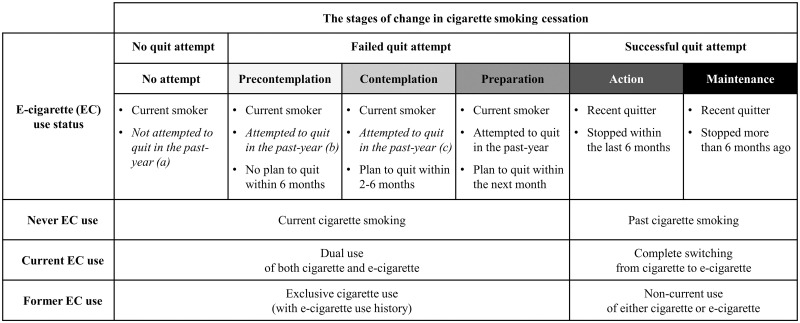
We explored the role of e-cigarette use in smoking cessation based on the stages of change (SOC) model, which is a framework for describing the process of smoking cessation.
We used nationwide, cross-sectional data on adults (19+ years) from the seventh Korea National Health and Nutrition Examination Survey (KNHANES, 2016-2018) and restricted the participants to 3,929 recent smokers, consisting of current smokers and recent quitters (≤2 years). A multinomial logistic regression analysis was performed to reveal the relationships between e-cigarette use and cigarette quitting behaviors (e.g., current quitting status, past quit attempts, intention to quit, and duration of quitting) and all stages in smoking cessation, with adjustment for sociodemographic and smoking-related factors.
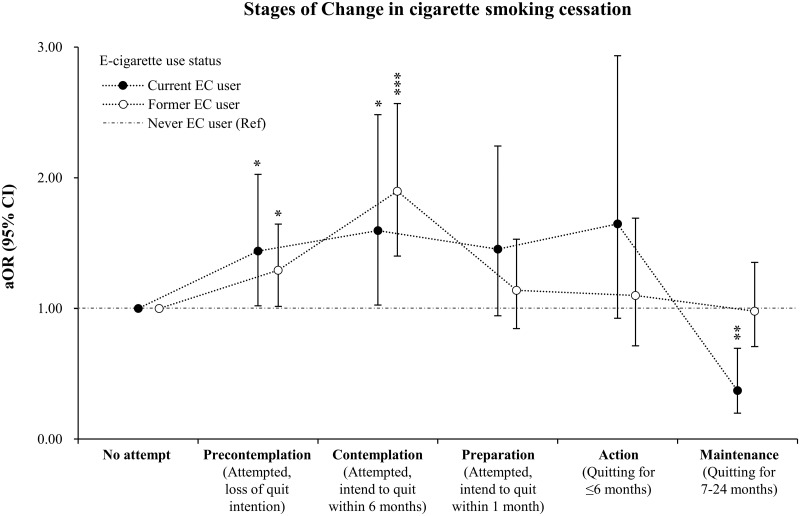
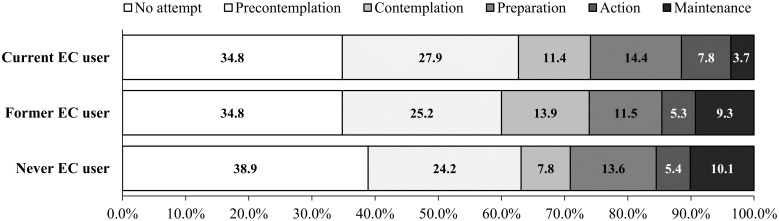
E-cigarette use was positively related to past quit attempts, while not having quit, intention to quit, and longer duration of quitting. Based on the cessation stages, current and former e-cigarette users were significantly more likely to be in the 'Precontemplation' and 'Contemplation' stages than never users, while not to be in the 'Preparation' and 'Action' stages. Current users were particularly less likely to be in the 'Maintenance' stage compared to never users.
E-cigarette use was closely linked with early-stage behavior than late-stage behavior in the smoking cessation process. E-cigarettes might promote quit attempts and short-term quitting in some smokers, but the negative role of inducing smokers to continue cigarette smoking with no immediate quit-intention for future attempts is dominant in the real world.
本研究基于描述戒烟过程的框架——阶段变化模型(SOC),探讨电子烟使用在戒烟中的作用。
我们使用了全国性的、来自于第七次韩国国家健康和营养检查调查(KNHANES,2016-2018)的横断面数据,该调查针对成年人(19 岁及以上),并限制参与者为 3929 名近期吸烟者,包括当前吸烟者和近期戒烟者(≤2 年)。我们采用多分类逻辑回归分析,揭示电子烟使用与戒烟行为(如当前戒烟状态、过去戒烟尝试、戒烟意愿和戒烟持续时间)以及戒烟所有阶段之间的关系,同时调整了社会人口学和吸烟相关因素。
电子烟使用与过去的戒烟尝试呈正相关,而与未戒烟、戒烟意愿和戒烟持续时间较长呈负相关。基于戒烟阶段,当前和曾经的电子烟使用者比从未使用者更有可能处于“未考虑”和“考虑”阶段,而不太可能处于“准备”和“行动”阶段。与从未使用者相比,当前使用者尤其不太可能处于“维持”阶段。
电子烟使用与戒烟过程中的早期行为而非晚期行为密切相关。电子烟可能会促进一些吸烟者的戒烟尝试和短期戒烟,但在现实世界中,诱导吸烟者继续吸烟而没有立即戒烟的意图以进行未来尝试的负面影响占主导地位。