Department of Psychiatry, Icahn School of Medicine at Mount Sinai, New York, NY, USA.
Department of Psychiatry and Behavioral Sciences, Medical University of South Carolina, Charleston, SC, USA.
Dev Cogn Neurosci. 2022 Oct;57:101150. doi: 10.1016/j.dcn.2022.101150. Epub 2022 Sep 1.
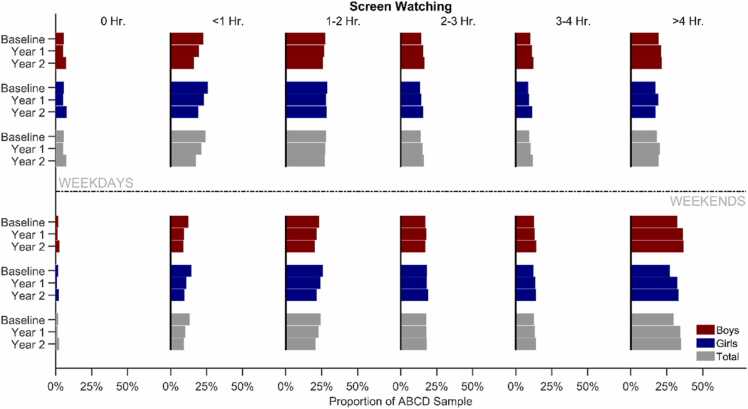
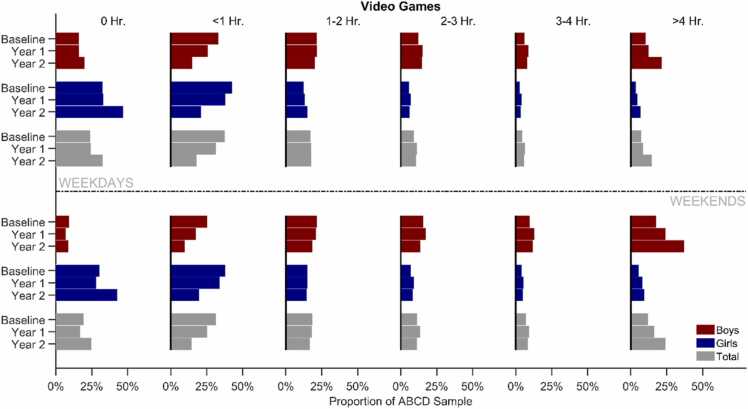
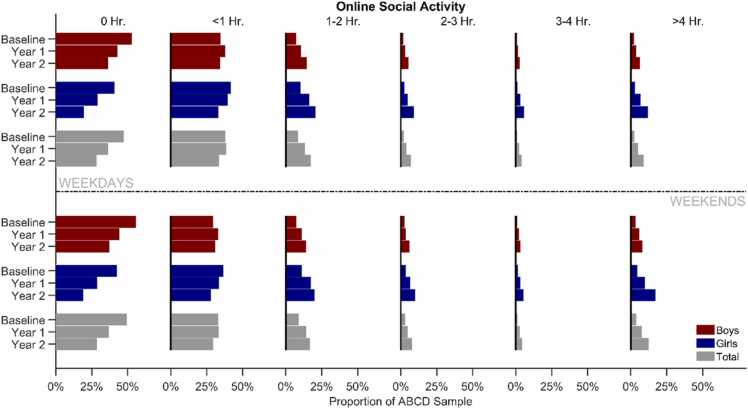
Adolescent screen usage is ubiquitous and influences development and behavior. Longitudinal screen usage data coupled with psychometrically valid constructs of problematic behaviors can provide insights into these relationships. We describe methods by which the screen usage questionnaire was developed in the Adolescent Brain Cognitive Development (ABCD) Study, demonstrate longitudinal changes in screen usage via child report and describe data harmonization baseline-year 2. We further include psychometric analyses of adapted social media and video game addiction scales completed by youth. Nearly 12,000 children ages 9-10 years at baseline and their parents were included in the analyses. The social media addiction questionnaire (SMAQ) showed similar factor structure and item loadings across sex and race/ethnicities, but that item intercepts varied across both sex and race/ethnicity. The videogame addiction questionnaire (VGAQ) demonstrated the same configural, metric and scalar invariance across racial and ethnic groups, however differed across sex. Video gaming and online social activity increased over ages 9/10-11/12 (p's < 0.001). Compared with boys, girls engaged in greater social media use (p < .001) and demonstrated higher ratings on the SMAQ (p < .001). Compared with girls, boys played more video games (p < .001) and demonstrated higher ratings on the VGAQ (p < .001). Time spent playing video games increased more steeply for boys than girls from age 9/10-11/12 years (p < .001). Black youth demonstrated significantly higher SMAQ and VGAQ scores compared to all other racial/ethnic groups. These data show the importance of considering different screen modalities beyond total screen use and point towards clear demographic differences in use patterns. With these comprehensive data, ABCD is poised to address critical questions about screen usage changes across adolescence.
青少年的屏幕使用非常普遍,会影响其发展和行为。将纵向的屏幕使用数据与有充分心理学依据的问题行为结构相结合,可以深入了解这些关系。我们描述了在青少年大脑认知发展(ABCD)研究中开发屏幕使用问卷的方法,通过儿童报告展示了屏幕使用的纵向变化,并描述了数据协调基线 2 年的数据。我们还包括了青少年完成的社交媒体和视频游戏成瘾量表的心理测量分析。基线时有近 12000 名 9-10 岁的儿童及其父母参与了分析。社交媒体成瘾问卷(SMAQ)在性别和种族/民族之间显示出相似的因子结构和项目负荷,但项目截距在性别和种族/民族之间存在差异。视频游戏成瘾问卷(VGAQ)在种族和族裔群体中表现出相同的结构、度量和标度不变性,但在性别上有所不同。视频游戏和在线社交活动的使用随着年龄的增长而增加(p 值均<0.001)。与男孩相比,女孩参与更多的社交媒体使用(p 值均<0.001),并在 SMAQ 上获得更高的评分(p 值均<0.001)。与女孩相比,男孩玩更多的视频游戏(p 值均<0.001),并在 VGAQ 上获得更高的评分(p 值均<0.001)。从 9-10 岁到 11-12 岁,男孩玩视频游戏的时间增加比女孩更为陡峭(p 值均<0.001)。与所有其他种族/民族群体相比,黑人青少年在 SMAQ 和 VGAQ 上的得分明显更高。这些数据表明,除了总屏幕使用量外,还需要考虑不同的屏幕模式,这突显了使用模式方面的明显人口统计学差异。通过这些综合数据,ABCD 有能力解决关于青少年时期屏幕使用变化的关键问题。