Pharmacy Department, Hospital Universitario Virgen de las Nieves, Av. Fuerzas Armadas, 2, 18014, Granada, Spain.
Infectious Disease Department, Hospital Universitario Virgen de las Nieves, Granada, Spain.
Sci Rep. 2022 Sep 10;12(1):15261. doi: 10.1038/s41598-022-19626-2.
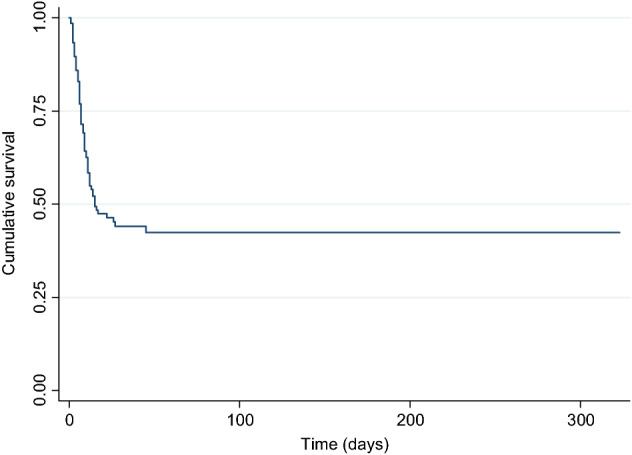
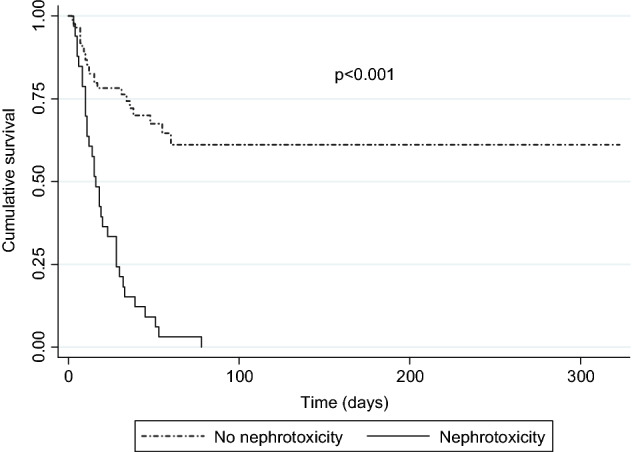
Colistimethate sodium (CMS) is the inactive prodrug of colistin, CMS has a narrow antibacterial spectrum with concentration-dependent bactericidal activity against multidrug-resistant gram-negative bacteria, including Pseudomonas aeruginosa and Acinetobacter baumannii. This study aimed to analyze potential correlations between clinical features and the development of CMS-induced nephrotoxicity. This retrospective cohort study was conducted in a tertiary-care university hospital between 1 January 2015 and 31 December 2019. A total of 163 patients received CMS therapy. 75 patients (46%) developed nephrotoxicity attributable to colistin treatment, although only 14 patients (8.6%) discontinued treatment for this reason. 95.7% of CMS were prescribed as target therapy. Acinetobacter baumannii spp. was the most commonly identified pathogen (72.4%) followed by P. aeruginosa (19.6%). Several risk factors associated with nephrotoxicity were identified, among these were age (HR 1.033, 95%CI 1.016-1.052, p < 0.001), Charlson Index (HR 1.158, 95%CI 1.0462-1.283; p = 0.005) and baseline creatinine level (HR 1.273, 95%CI 1.071-1.514, p = 0.006). In terms of in-hospital mortality, risk factors were age (HR 2.43, 95%CI 1.021-1.065, p < 0.001); Charlson Index (HR 1.274, 95%CI 1.116-1.454, p = 0.043), higher baseline creatinine levels (HR 1.391, 95%CI 1.084-1.785, p = 0.010) and nephrotoxicity due to CMS treatment (HR 5.383, 95%CI 3.126-9.276, p < 0.001). In-hospital mortality rate were higher in patients with nephrotoxicity (log rank test p < 0.001). In conclusion, the nephrotoxicity was reported in almost half of the patients. Its complex management, continuous renal dose adjustment and monitoring creatinine levels at least every 48 h leads to a high percentage of inappropriate use and treatment failure.
黏菌素甲磺酸钠(CMS)是黏菌素的无活性前体药物,CMS 对包括铜绿假单胞菌和鲍曼不动杆菌在内的多种耐药革兰氏阴性菌具有浓度依赖性杀菌作用,抗菌谱较窄。本研究旨在分析临床特征与 CMS 诱导的肾毒性发展之间的潜在相关性。这是一项在 2015 年 1 月 1 日至 2019 年 12 月 31 日期间在一家三级保健大学医院进行的回顾性队列研究。共有 163 名患者接受了 CMS 治疗。尽管只有 14 名患者(8.6%)因此而停止治疗,但有 75 名患者(46%)出现了归因于黏菌素治疗的肾毒性。95.7%的 CMS 被规定为靶向治疗。鲍曼不动杆菌最常被鉴定为病原体(72.4%),其次是铜绿假单胞菌(19.6%)。确定了与肾毒性相关的几个危险因素,其中包括年龄(HR 1.033,95%CI 1.016-1.052,p<0.001)、Charlson 指数(HR 1.158,95%CI 1.0462-1.283;p=0.005)和基线肌酐水平(HR 1.273,95%CI 1.071-1.514,p=0.006)。就院内死亡率而言,危险因素包括年龄(HR 2.43,95%CI 1.021-1.065,p<0.001);Charlson 指数(HR 1.274,95%CI 1.116-1.454,p=0.043)、较高的基线肌酐水平(HR 1.391,95%CI 1.084-1.785,p=0.010)和 CMS 治疗引起的肾毒性(HR 5.383,95%CI 3.126-9.276,p<0.001)。有肾毒性的患者院内死亡率较高(对数秩检验 p<0.001)。总之,近一半的患者出现了肾毒性。其复杂的管理,连续的肾剂量调整和至少每 48 小时监测肌酐水平,导致了高比例的不适当使用和治疗失败。