Fakonti Georgia, Hadjikou Andria, Tzira Eleana, Kyprianidou Maria, Giannakou Konstantinos
Department of Health Sciences, School of Sciences, European University Cyprus, Nicosia, Cyprus.
Front Pediatr. 2022 Aug 25;10:951039. doi: 10.3389/fped.2022.951039. eCollection 2022.
Maternal attitudes and beliefs have been shown to influence childhood vaccination coverage, resulting in under-vaccination, non-vaccination, and vaccination delay. This study aimed to investigate the mothers' attitudes and perceptions about vaccination for their children in Greece.
This was an online cross-sectional study, conducted from 4 April to 8 June 2020. A self-administered questionnaire was used to collect information about mothers' and their children's socio-demographic characteristics, previous vaccination behavior, and mothers' attitudes and perceptions about childhood vaccination. Participants included adult mothers with at least one minor child.
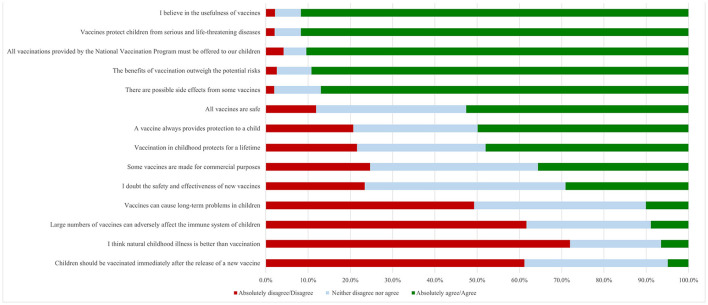
One thousand eight hundred eighty-five mothers participated, with the majority (91.7%) believing in the usefulness of vaccines and that vaccines protect children from serious and life-threatening diseases. A larger percentage of mothers with higher educational attainment agreed/absolutely agreed that all vaccinations provided by the National Vaccination Program must be offered to their children (91.6%) ( = 0.02) and that vaccines protect children from serious and life-threatening diseases (92.9%) ( = 0.01). Significant more married/in cohabitation and not single-parent mothers agreed that vaccines are safe (53.5% and 53.4%, respectively). There were also several significant associations between maternal attitudes toward childhood vaccination and previous maternal vaccination practices [(e.g., adherence to recommended vaccination dosages (all -values < 0.01), vaccination delays (all -values < 0.05), and vaccination during pregnancy (all -values < 0.01)].
Maternal attitudes and perceptions toward childhood vaccination are significantly influenced by sociodemographic factors and maternal vaccination practices. Revealing those is essential for public health officials in developing future strategies to improve childhood vaccination coverage and acceptance of new vaccines such as the COVID-19 vaccine.
研究表明,母亲的态度和观念会影响儿童疫苗接种率,导致疫苗接种不足、未接种以及接种延迟。本研究旨在调查希腊母亲对其子女疫苗接种的态度和看法。
这是一项于2020年4月4日至6月8日进行的在线横断面研究。采用自填式问卷收集母亲及其子女的社会人口学特征、既往疫苗接种行为以及母亲对儿童疫苗接种的态度和看法。参与者包括至少有一名未成年子女的成年母亲。
1885名母亲参与了研究,大多数(91.7%)认为疫苗有用,且疫苗能保护儿童免受严重和危及生命的疾病。受教育程度较高的母亲中,更大比例的人同意/完全同意国家疫苗接种计划提供的所有疫苗都必须给其子女接种(91.6%)(P = 0.02),且疫苗能保护儿童免受严重和危及生命的疾病(92.9%)(P = 0.01)。显著更多已婚/同居而非单亲母亲同意疫苗是安全的(分别为53.5%和53.4%)。母亲对儿童疫苗接种的态度与既往母亲疫苗接种行为之间也存在若干显著关联[例如,遵守推荐的疫苗接种剂量(所有P值<0.01)、接种延迟(所有P值<0.05)以及孕期接种(所有P值<0.01)]。
母亲对儿童疫苗接种的态度和看法受社会人口学因素和母亲疫苗接种行为的显著影响。揭示这些因素对于公共卫生官员制定未来策略以提高儿童疫苗接种率和接受新冠疫苗等新疫苗至关重要。