Key Laboratory of Infection and Immunity of Shandong Province, Department of Immunology, School of Basic Medical Sciences, Cheeloo College of Medicine, Shandong University, Jinan, China.
Front Immunol. 2022 Aug 24;13:998947. doi: 10.3389/fimmu.2022.998947. eCollection 2022.
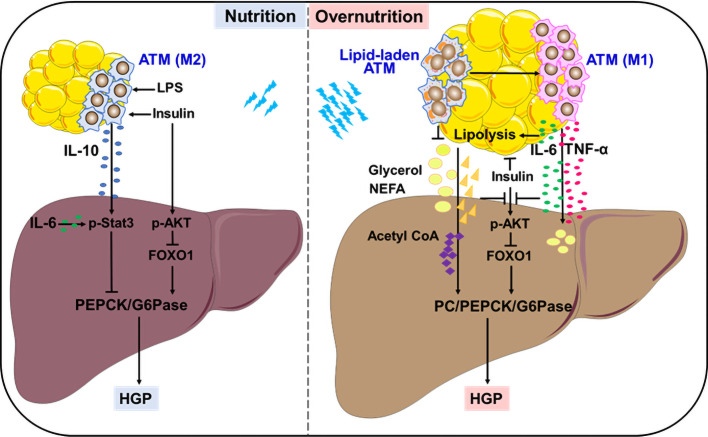
Hepatic glucose production (HGP) is fine-regulated glycogenolysis or gluconeogenesis to maintain physiological concentration of blood glucose during fasting-feeding cycle. Aberrant HGP leads to hyperglycemia in obesity-associated diabetes. Adipose tissue cooperates with the liver to regulate glycolipid metabolism. During these processes, adipose tissue macrophages (ATMs) change their profiles with various physio-pathological settings, producing diverse effects on HGP. Here, we briefly review the distinct phenotypes of ATMs under different nutrition states including feeding, fasting or overnutrition, and detail their effects on HGP. We discuss several pathways by which ATMs regulate hepatic gluconeogenesis or glycogenolysis, leading to favorable or unfavorable metabolic consequences. Furthermore, we summarize emerging therapeutic targets to correct metabolic disorders in morbid obesity or diabetes based on ATM-HGP axis. This review puts forward the importance and flexibility of ATMs in regulating HGP, proposing ATM-based HGP modulation as a potential therapeutic approach for obesity-associated metabolic dysfunction.
肝脏葡萄糖生成(HGP)通过糖原分解或糖异生精细调节,以在禁食-进食循环中维持血糖的生理浓度。异常的 HGP 导致肥胖相关糖尿病中的高血糖。脂肪组织与肝脏合作调节糖脂代谢。在这些过程中,脂肪组织巨噬细胞(ATMs)根据各种生理病理状态改变其表型,对 HGP 产生不同的影响。在这里,我们简要回顾了在不同营养状态下 ATMs 的不同表型,包括进食、禁食或营养过剩,并详细说明了它们对 HGP 的影响。我们讨论了 ATMs 调节肝糖异生或糖原分解的几种途径,导致有利或不利的代谢后果。此外,我们总结了基于 ATM-HGP 轴纠正病态肥胖或糖尿病代谢紊乱的新兴治疗靶点。本综述提出了 ATMs 在调节 HGP 中的重要性和灵活性,提出基于 ATM 的 HGP 调节作为肥胖相关代谢功能障碍的潜在治疗方法。