Pan Yan, Shao Shijie, Sun Hang, Zhu Huafeng, Fang Haixing
Department of Integrative Oncology, The First People's Hospital of Fuyang, Fuyang First Hospital Affiliated to Zhejiang Chinese Medical University, Hangzhou, China.
Department of Oncological Surgery, The First People's Hospital of Fuyang, Fuyang First Hospital Affiliated to Zhejiang Chinese Medical University, Hangzhou, China.
Front Oncol. 2022 Aug 24;12:985089. doi: 10.3389/fonc.2022.985089. eCollection 2022.
Cholangiocarcinoma (CCA) is one of the most aggressive malignancies, lacking novel diagnostic and prognostic biomarkers. Exosome noncoding RNAs (ncRNA) were previously proposed as a potential source of biomarkers in several cancers. This study aimed to interpret the value of specific bile-derived ncRNA as predictors for early diagnosis and prognosis of CCA.
We recruited 100 patients who received endoscopic retrograde cholangiopancreatography at our hospital for bile duct obstruction due to CCA (n = 50) and biliary stone (n = 50). They were further divided into training set and validation set (3:2). A panel of CCA-specific ncRNAs including 5 miRNAs (PMID: 30165035) and 2 lncRNAs (PMID: 29050258) were detected in both serum and bile exosomes. The diagnostic accuracy was assessed using the area under the receiver operating characteristic curve. Logistic analysis was used to classify the potential predictors of CCA and further establish the diagnostic model. And the prognostic value of the ncRNAs was also assessed.
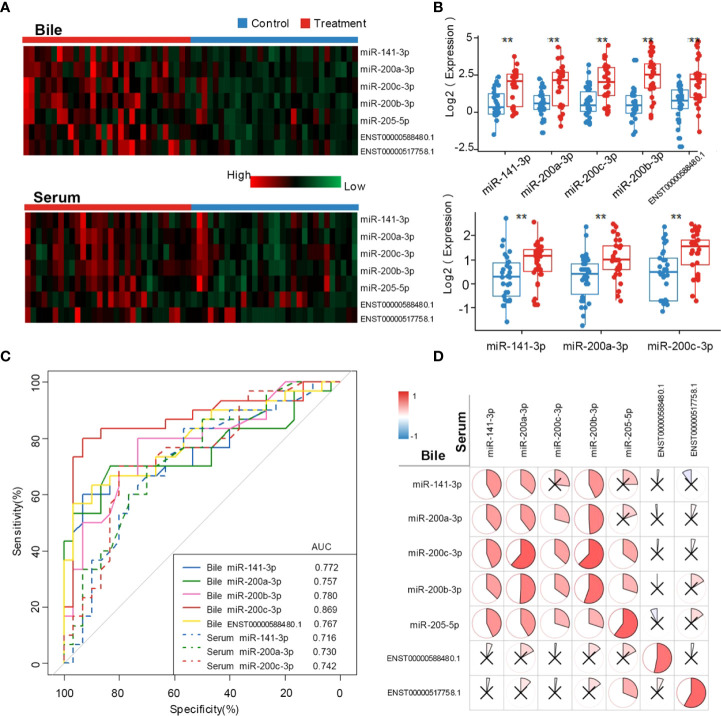
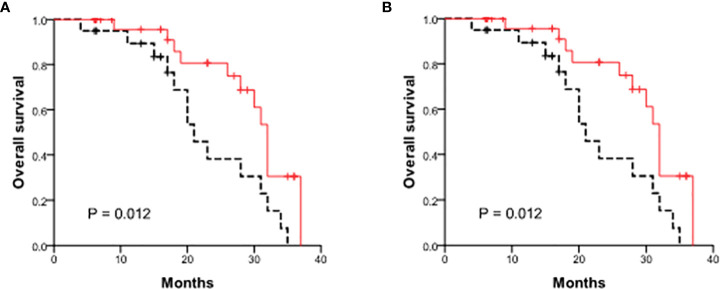
Exosomes were successfully collected from bile and serum. Exosomal miR-141-3p, miR-200a-3p, miR-200c-3p in serum and bile, as well as miR-200b-3p and ENST00000588480.1 in bile showed AUCs of >0.70 in the diagnosis of CCA. Bile exosomal miR-200c-3p displayed the best diagnostic value with the AUC of 0.87. The combination of serum CA19-9 into the model could increase the AUC to 0.906. Bile exosomal miR-200a-3p and miR-200c-3p were found to be independent predictors of CCA. Among exosomal ncRNAs in human bile and blood, 3 (serum and bile exosomal miR-200c-3p, bile exosomal miR-200a-3p) showed significant value in predicting cancer recurrence and 1 (serum exosomal miR-200c-3p) had great predictive ability of cancer death. High levels of serum exosomal miR-200c-3p showed unfavorable tumor-free survival and overall survival.
The bile exosomal miR-200 family, particularly miR-200c-3p, was verified to be a potential biomarker for the early detection of CCA. The diagnostic ability of exosomal ncRNAs in human bile is better than that in blood. Moreover, high levels of bile exosomal miR-200a-3p, miR-200c-3p, and serum exosomal miR-200c-3p represented adverse clinical outcomes.
胆管癌(CCA)是最具侵袭性的恶性肿瘤之一,缺乏新的诊断和预后生物标志物。外泌体非编码RNA(ncRNA)此前被认为是几种癌症中生物标志物的潜在来源。本研究旨在阐明特定胆汁来源的ncRNA作为CCA早期诊断和预后预测指标的价值。
我们招募了100例因CCA(n = 50)和胆结石(n = 50)导致胆管梗阻而在我院接受内镜逆行胰胆管造影的患者。他们被进一步分为训练集和验证集(3:2)。在血清和胆汁外泌体中检测了一组CCA特异性ncRNA,包括5种miRNA(PMID:30165035)和2种lncRNA(PMID:29050258)。使用受试者操作特征曲线下面积评估诊断准确性。采用逻辑分析对CCA的潜在预测指标进行分类,并进一步建立诊断模型。同时评估了ncRNA的预后价值。
成功从胆汁和血清中收集到外泌体。血清和胆汁中的外泌体miR-141-3p、miR-200a-3p、miR-200c-3p,以及胆汁中的miR-200b-3p和ENST00000588480.1在CCA诊断中的曲线下面积>0.70。胆汁外泌体miR-200c-3p的诊断价值最佳,曲线下面积为0.87。将血清CA19-9纳入模型可使曲线下面积增加至0.906。发现胆汁外泌体miR-200a-3p和miR-200c-3p是CCA的独立预测指标。在人胆汁和血液中的外泌体ncRNA中,3种(血清和胆汁外泌体miR-200c-3p、胆汁外泌体miR-200a-3p)在预测癌症复发方面具有显著价值,1种(血清外泌体miR-200c-3p)对癌症死亡具有较强的预测能力。血清外泌体miR-200c-3p水平高显示无瘤生存期和总生存期不佳。
胆汁外泌体miR-200家族,尤其是miR-200c-3p,被证实是早期检测CCA的潜在生物标志物。人胆汁中外泌体ncRNA的诊断能力优于血液中的。此外,胆汁外泌体miR-200a-3p、miR-200c-3p以及血清外泌体miR-200c-3p水平高代表不良临床结局。