Deng Xiangyang, Yang Xionggang, Yang Chunlei, Chen Kezhu, Ren Junwei, Zeng Jun, Zhang Quan, Li Tianwen, Tang Qisheng, Zhu Jianhong
Department of Neurosurgery, Huashan Hospital, Shanghai Medical College, Fudan University, National Center for Neurological Disorders, National Key Lab. for Medical Neurobiology, Institutes of Brain Science, Shanghai Key Lab. of Brain Function and Regeneration, Institute of Neurosurgery, MOE Frontiers Center for Brain Science, Shanghai, China.
Department of Orthopaedics Surgery, Fudan University Huashan Hospital, Shanghai, China.
Front Oncol. 2022 Aug 26;12:929585. doi: 10.3389/fonc.2022.929585. eCollection 2022.
To our knowledge, the impact of area-level socioeconomic status (SES) has not yet been described in primary central nervous system lymphomas (PCNSLs). Current study sought to explore the association of socioeconomic deprivation, measured using the Area Deprivation Index (ADI), with PCNSL outcomes.
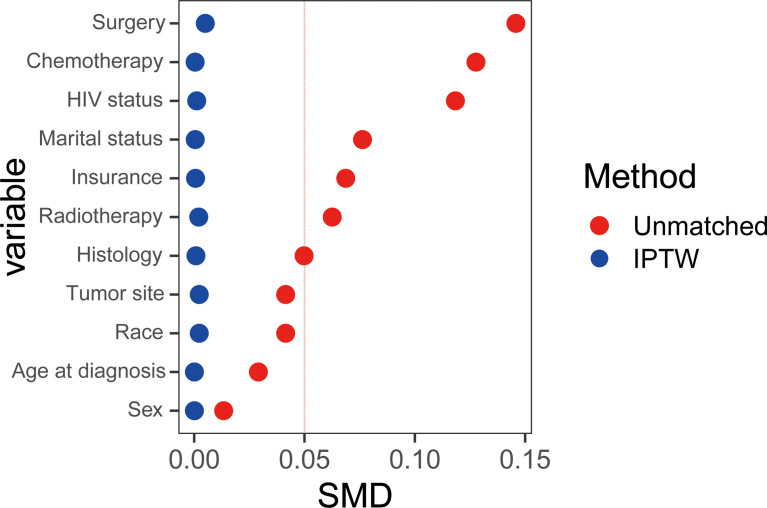
The Surveillance, Epidemiology, and End Results (SEER) database was used to identify PCNSL patients diagnosed between 2006 and 2015 for our analyses. The impact of ADI on overall survival (OS) and cancer-specific survival (CSS) were investigated. Survival analyses were conducted using Kaplan-Meier method with log-rank tests. The Inverse Probability Weighting (IPW) analysis and multivariate cox proportional hazards regression analysis were employed to make covariate adjustments. Multiple mediation analysis (MMA) was performed to estimate the mediating effects.
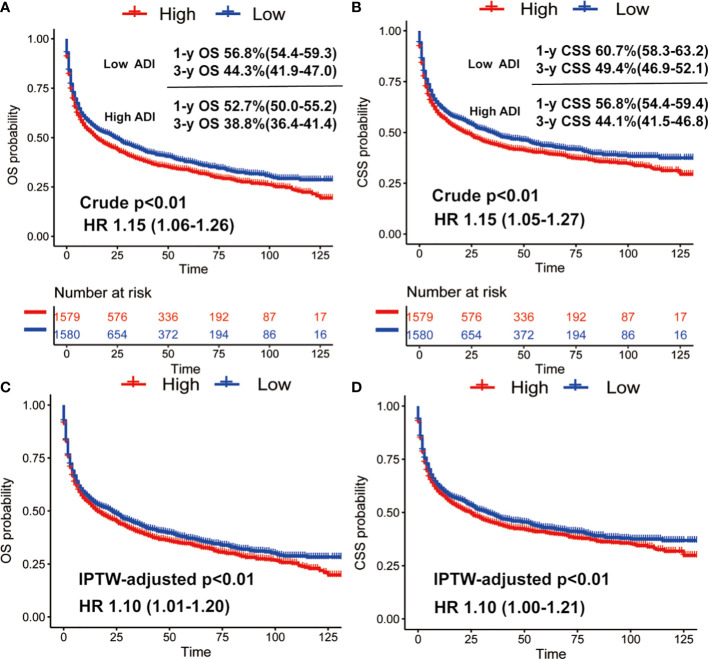
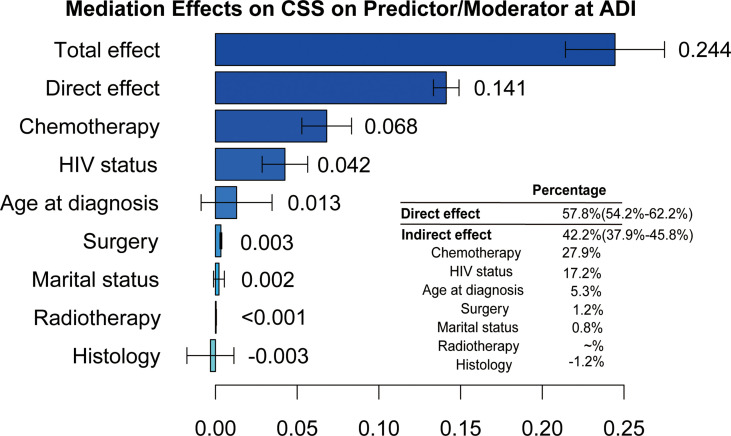
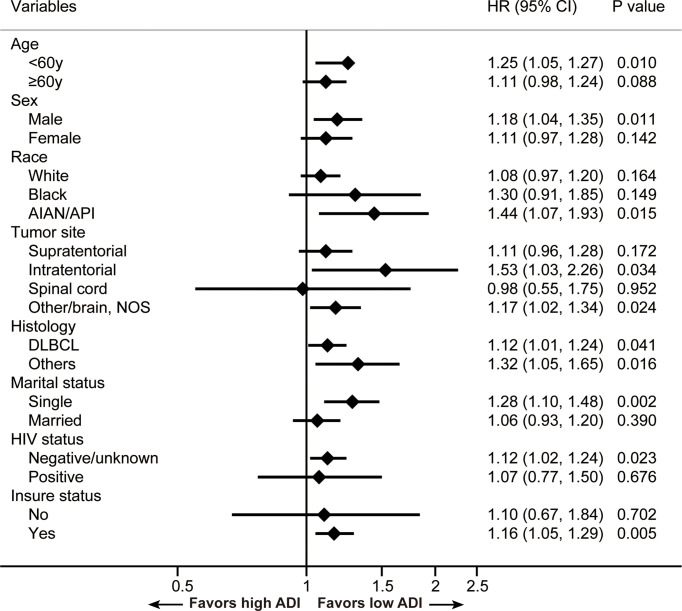
A total of 3159 PCNSL patients classified into low and high ADI subgroups according to the median ADI score were studied. The Kaplan-Meier analyses showed that low ADI was significantly associated with higher OS rates (HR 1.15, 95%CI 1.06-1.26, P<0.01) and CSS rates (HR 1.15, 95%CI 1.05-1.27, P<0.01). Similar results were observed in analyses adjusted IPW and multivariate cox methods. Subgroup analyses revealed that ADI could remain a prognostic indictor among different subsets. MMA revealed that several factors including chemotherapy and HIV status making up about 40% of the overall effect, mediated PCNSL survival disparities related to the ADI. Finally, multivariable logistic regression analysis showed that ADI as well as several other factors were independently related to receipt of chemotherapy.
Our study highlights the role of area-level SES in prognosis of PCNSLs. And several factors including chemotherapy and HIV status of PCNSL patents contributed to the CSS disparities between ADI subgroups were uncovered by MMA. Such relationships would highlight the importance of policies development to enhance healthcare delivery and promote awareness of HIV prevention and treatment in low-resource neighborhoods.
据我们所知,区域层面的社会经济地位(SES)对原发性中枢神经系统淋巴瘤(PCNSL)的影响尚未得到描述。本研究旨在探讨使用区域剥夺指数(ADI)衡量的社会经济剥夺与PCNSL预后之间的关联。
利用监测、流行病学和最终结果(SEER)数据库确定2006年至2015年间诊断为PCNSL的患者进行分析。研究了ADI对总生存期(OS)和癌症特异性生存期(CSS)的影响。采用Kaplan-Meier法和对数秩检验进行生存分析。采用逆概率加权(IPW)分析和多变量cox比例风险回归分析进行协变量调整。进行多重中介分析(MMA)以估计中介效应。
根据ADI中位数得分将3159例PCNSL患者分为低ADI和高ADI亚组进行研究。Kaplan-Meier分析表明,低ADI与较高的OS率(HR 1.15,95%CI 1.06-1.26,P<0.01)和CSS率(HR 1.15,95%CI 1.05-1.27,P<0.01)显著相关。在IPW调整分析和多变量cox方法分析中也观察到类似结果。亚组分析显示,ADI在不同亚组中仍可作为预后指标。MMA显示,包括化疗和HIV状态在内的几个因素约占总体效应的40%,介导了与ADI相关的PCNSL生存差异。最后,多变量逻辑回归分析表明,ADI以及其他几个因素与化疗的接受独立相关。
我们的研究强调了区域层面SES在PCNSL预后中的作用。MMA发现,包括化疗和PCNSL患者的HIV状态在内的几个因素导致了ADI亚组之间的CSS差异。这种关系将凸显制定政策以加强医疗服务提供以及提高资源匮乏社区对HIV预防和治疗认识的重要性。