School of Public Administration, Hunan University, Changsha, China.
School of Economics, Sichuan Agricultural University, Ya'an, China.
Front Public Health. 2022 Aug 25;10:950870. doi: 10.3389/fpubh.2022.950870. eCollection 2022.
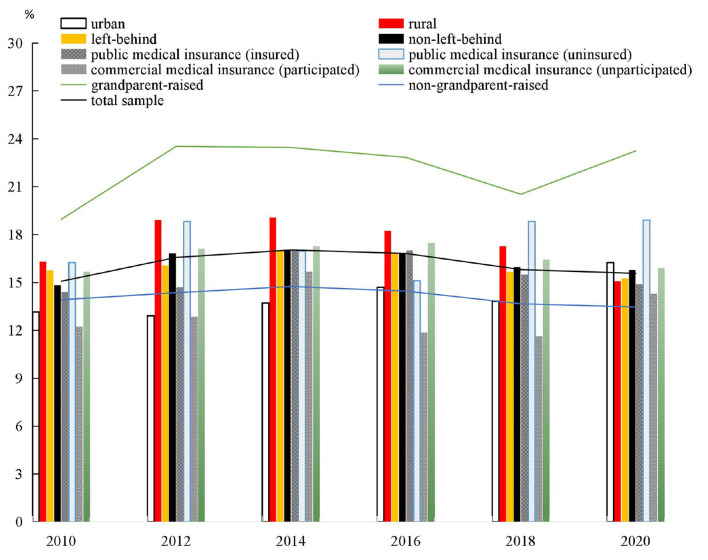
This study examines the influences of grandchild care and medical insurance on childhood obesity. Nationally representative longitudinal data-from the China Family Panel Studies 2010-2020-of 26,902 school-age children and adolescents aged 6-16 years and China's new reference standard ("WS/T586-2018") are used to identify a child's obesity status. Using binary mixed-effects logistic regression models and the Blinder-Oaxaca decomposition method, this study explores the roots of obesity inequalities and finds that at least 15% of Chinese children aged 6-16 were obese in the 2010s. The logistic regression analysis results indicate that grandchild care, public medical insurance, and commercial medical insurance are key risk factors of child obesity. However, the influences are heterogeneous in different groups: Grandchild care and public medical insurance increase urban-rural obesity inequalities because of a distribution effect, and grandchild care may also exacerbate children obesity inequalities between left-behind and non-left-behind children owing to the event shock of parental absence. Inequalities in socioeconomic status (SES) factors such as income, education, and region also cause obesity inequalities. These results indicate that child obesity and its inequalities are rooted in multidimensional environmental inequalities, including medical protection policies and its benefit incidence; intergenerational behavior and family SES factors; and urban-rural and left-behind risk shocks. This study provides new evidence for the development of population-based interventions and equitable medical insurance policies to prevent the deterioration of child obesity among Chinese school-age children and adolescents.
本研究考察了隔代照料和医疗保险对儿童肥胖的影响。使用全国代表性的纵向数据——中国家庭追踪调查 2010-2020 年的数据,以及中国新的参考标准(“WS/T586-2018”),对 26902 名 6-16 岁的学龄儿童和青少年进行了研究,以确定儿童的肥胖状况。本研究采用二元混合效应逻辑回归模型和布伦纳-奥克萨卡分解方法,探讨了肥胖不平等的根源,发现至少有 15%的 6-16 岁中国儿童在 2010 年代肥胖。逻辑回归分析结果表明,隔代照料、公共医疗保险和商业医疗保险是儿童肥胖的关键风险因素。然而,这些影响在不同群体中存在异质性:隔代照料和公共医疗保险由于分配效应增加了城乡肥胖不平等,而隔代照料也可能由于父母缺失的事件冲击,加剧了留守儿童和非留守儿童之间的儿童肥胖不平等。社会经济地位(SES)因素,如收入、教育和地区的不平等也导致了肥胖的不平等。这些结果表明,儿童肥胖及其不平等现象根植于多维环境不平等之中,包括医疗保护政策及其受益范围;代际行为和家庭 SES 因素;城乡和留守儿童风险冲击。本研究为制定基于人口的干预措施和公平的医疗保险政策提供了新的证据,以防止中国学龄儿童和青少年肥胖状况的恶化。