Department of Clinical Science, Intervention and Technology, Karolinska Institutet, Stockholm, Sweden.
Department of Medicine Solna, Karolinska Institutet, Stockholm, Sweden.
BMJ Open. 2021 Mar 11;11(3):e040432. doi: 10.1136/bmjopen-2020-040432.
Children with obesity achieve lower educational level compared with normal-weight peers. Parental socioeconomic status (SES) impacts both a child's academic achievement and risk of obesity. The degree to which the association between obesity and education depends on parental SES is unclear. Therefore, the primary aim is to investigate if individuals with obesity in childhood are less likely to complete ≥12 years of schooling, independently of parental SES. The secondary aim is to study how weight loss, level of education and parental SES are associated.
Nationwide prospective cohort study.
Swedish national register data.
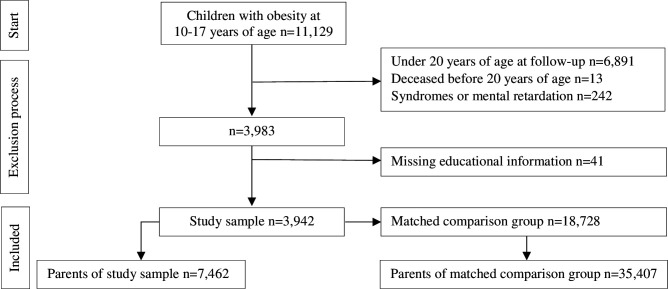
Children aged 10-17 years, recorded in the Swedish Childhood Obesity Treatment Register, and aged 20 years or older at follow-up were included (n=3942). A comparison group was matched by sex, year of birth and living area (n=18 728). Parental SES was based on maternal and paternal level of education, income and occupational status.
Completion of ≥12 years of schooling was analysed with conditional logistic regression, and adjusted for group, migration background, attention deficit disorder with or without hyperactivity, anxiety/depression and parental SES.
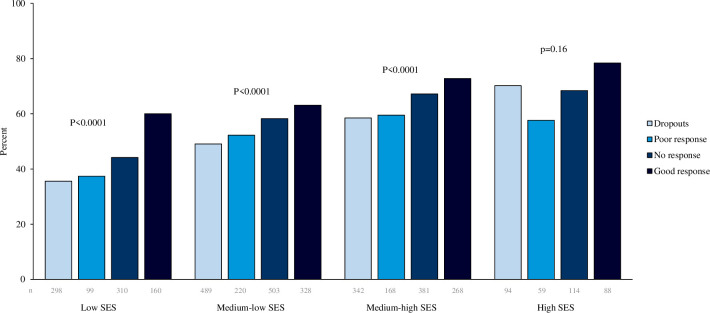
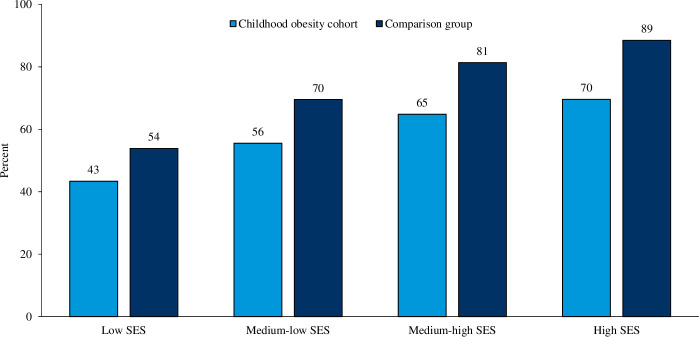
Among those with obesity in childhood, 56.7% completed ≥12 school years compared with 74.4% in the comparison group (p<0.0001). High parental SES compared with low SES was strongly associated with attained level of education in both children with and without obesity, adjusted OR (OR) (99% CI)=5.40 (4.45 to 6.55). However, obesity in childhood remains a strong risk factor of not completing ≥12 school years, independently of parental SES, OR=0.57 (0.51 to 0.63). Successful obesity treatment increased the odds of completing ≥12 years in school even when taking parental SES into account, OR=1.34 (1.04 to 1.72).
Individuals with obesity in childhood have lower odds of completing ≥12 school years, independently of parental SES. Optimised obesity treatment may improve school results in this group.
与正常体重的同龄人相比,肥胖儿童的受教育程度较低。父母的社会经济地位(SES)既影响孩子的学业成绩,也影响肥胖的风险。肥胖与教育之间的关联在多大程度上取决于父母 SES 尚不清楚。因此,主要目的是调查儿童期肥胖是否独立于父母 SES,与完成≥12 年学业的可能性降低有关。次要目的是研究体重减轻、教育程度和父母 SES 之间的关系。
全国性前瞻性队列研究。
瑞典国家登记数据。
在瑞典儿童肥胖治疗登记处登记年龄为 10-17 岁且随访时年龄为 20 岁或以上的儿童(n=3942),并按性别、出生年份和居住地区与对照组相匹配(n=18728)。父母 SES 基于母亲和父亲的教育程度、收入和职业状况。
通过条件逻辑回归分析完成≥12 年学业的情况,并根据组别、移民背景、伴或不伴多动的注意力缺陷障碍、焦虑/抑郁和父母 SES 进行调整。
在儿童肥胖组中,56.7%的人完成了≥12 年的学业,而对照组中这一比例为 74.4%(p<0.0001)。高 SES 父母与低 SES 父母相比,与肥胖儿童和非肥胖儿童的受教育程度均有强烈关联,调整后的比值比(OR)(99%可信区间)=5.40(4.45 至 6.55)。然而,儿童肥胖仍然是未完成≥12 年学业的一个强烈危险因素,独立于父母 SES,OR=0.57(0.51 至 0.63)。即使考虑到父母 SES,肥胖治疗成功也会增加完成≥12 年学业的几率,OR=1.34(1.04 至 1.72)。
儿童肥胖者完成≥12 年学业的几率较低,独立于父母 SES。优化肥胖治疗可能会改善这一人群的学业成绩。