Maheen Farah, Asif Muhammad, Ahmad Haseeb, Ahmad Shahbaz, Alturise Fahad, Asiry Othman, Ghadi Yazeed Yasin
Department of Computer Science, National Textile University, Faisalabad, Pakistan.
Department of Computer, College of Science and Arts in Ar Rass, Qassim University, Ar Rass, Qassim, Saudi Arabia.
PeerJ Comput Sci. 2022 Aug 16;8:e1010. doi: 10.7717/peerj-cs.1010. eCollection 2022.
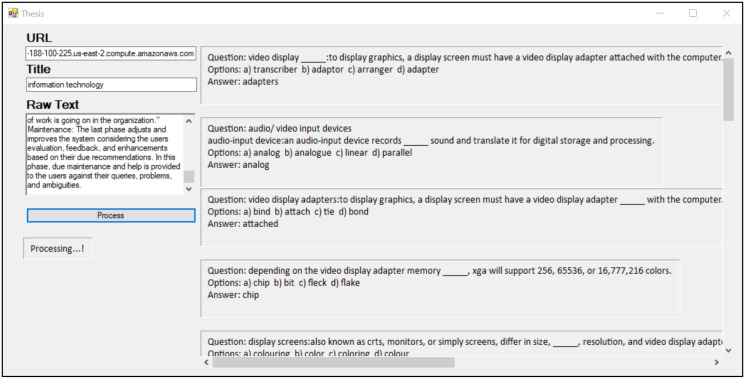
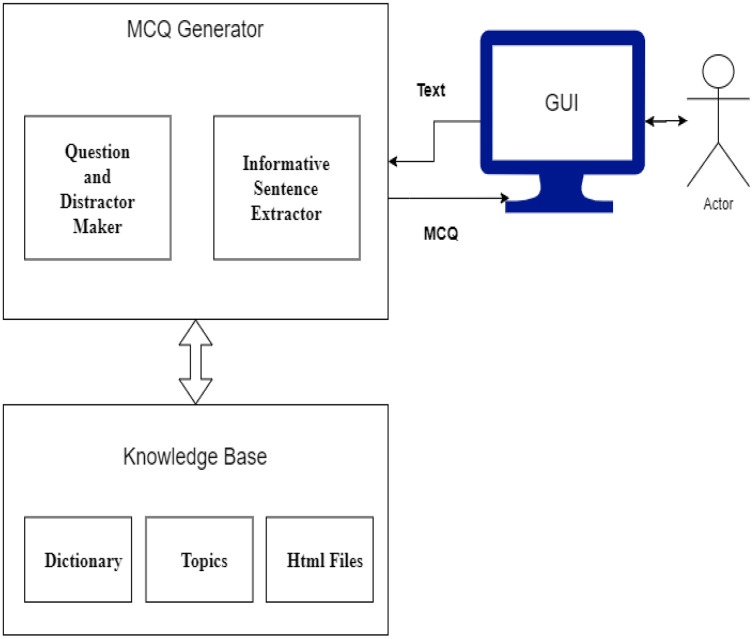
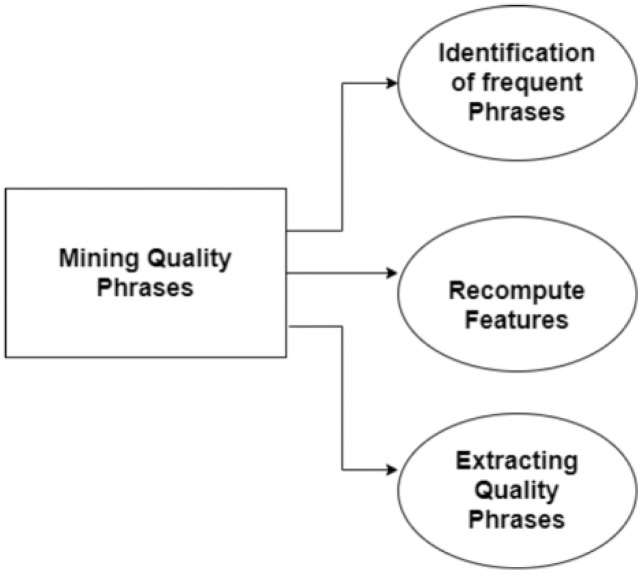
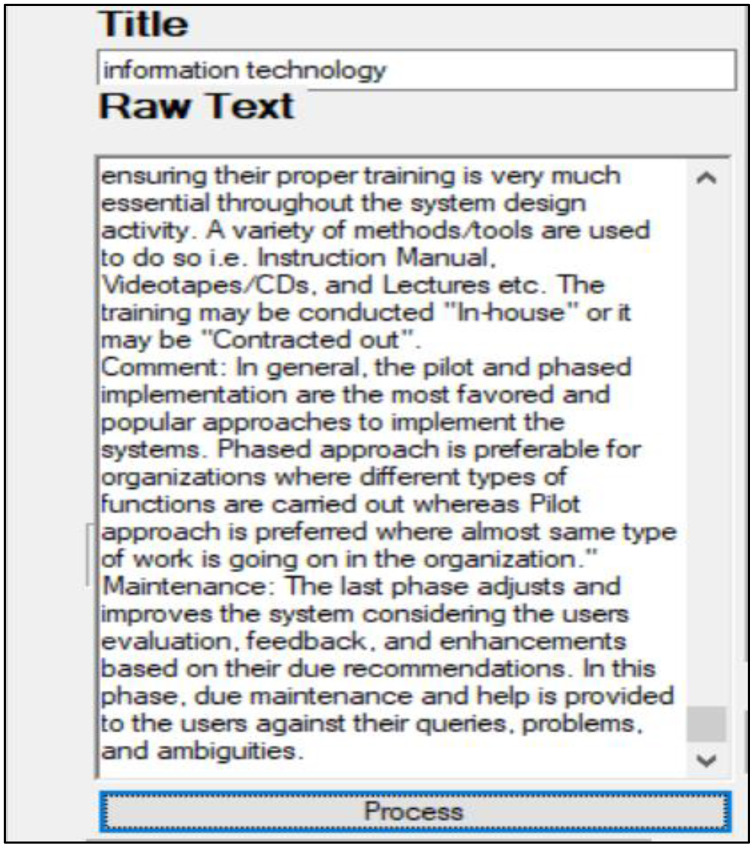
Students require continuous feedback for effective learning. Multiple choice questions (MCQs) are extensively used among various assessment methods to provide such feedback. However, manual MCQ generation is a tedious task that requires significant effort, time, and domain knowledge. Therefore, a system must be present that can automatically generate MCQs from the given text. The automatic generation of MCQs can be carried out by following three sequential steps: extracting informative sentences from the textual data, identifying the key, and determining distractors. The dataset comprising of various topics from the 9th and 11th-grade computer science course books are used in this work. Moreover, TF-IDF, Jaccard similarity, quality phrase mining, K-means, and bidirectional encoder representation from transformers techniques are utilized for automatic MCQs generation. Domain experts validated the generated MCQs with 83%, 77%, and 80% accuracy, key generation, and distractor generation, respectively. The overall MCQ generation achieved 80% accuracy through this system by the experts. Finally, a desktop app was developed that takes the contents in textual form as input, processes it at the backend, and visualizes the generated MCQs on the interface. The presented solution may help teachers, students, and other stakeholders with automatic MCQ generation.
学生需要持续的反馈以实现有效的学习。在各种评估方法中,多项选择题(MCQs)被广泛用于提供此类反馈。然而,手动生成多项选择题是一项繁琐的任务,需要大量的精力、时间和领域知识。因此,必须有一个系统能够从给定文本中自动生成多项选择题。多项选择题的自动生成可以通过以下三个连续步骤进行:从文本数据中提取信息性句子、识别关键内容并确定干扰项。这项工作使用了包含来自九年级和十一年级计算机科学课程书籍的各种主题的数据集。此外,还利用了词频 - 逆文档频率(TF-IDF)、杰卡德相似度、高质量短语挖掘、K均值算法以及来自Transformer技术的双向编码器表示来自动生成多项选择题。领域专家分别以83%、77%和80%的准确率验证了生成的多项选择题、关键内容生成和干扰项生成。通过该系统,专家们实现了整体多项选择题生成80%的准确率。最后,开发了一个桌面应用程序,它以文本形式接收内容作为输入,在后端进行处理,并在界面上可视化生成的多项选择题。所提出的解决方案可能会帮助教师、学生和其他利益相关者进行多项选择题的自动生成。