Mensky Gilad, Pillay Tristan, von Klemperer Alexander, Tsitsi Merika J, Venter Michelle, Menezes Colin N, van Blydenstein Sarah A
Department of Internal Medicine, Chris Hani Baragwanath Academic Hospital, Faculty of Health, University of the Witwatersrand, Johannesburg, South Africa.
School of Clinical Medicine, Faculty of Health Sciences, University of the Witwatersrand, Johannesburg, South Africa.
S Afr J Infect Dis. 2022 Aug 31;37(1):431. doi: 10.4102/sajid.v37i1.431. eCollection 2022.
Different diagnostic tools could improve early detection of coronavirus disease 2019 (COVID-19). A number of antibody-based serological point-of-care tests have been developed to supplement real-time reverse transcriptase polymerase chain reaction (RT-PCR)-based diagnosis. This study describes the validity of an antibody test, namely the immunoglobulin G (IgG)/immunoglobulin M (IgM) Rapid Test Cassette (BNCP - 402 and BNCP402), manufactured by Spring Healthcare Services.
A prospective cohort validation study was undertaken at Chris Hani Baragwanath Academic Hospital between 16 July 2020 and 12 August 2020. A total of 101 patients admitted as COVID-19 cases under investigation were included in the study. They were divided into two categories depending on time since symptom onset: testing performed within seven days (early cohort) and after seven days (late cohort). The rapid antibody test was compared to the RT-PCR.
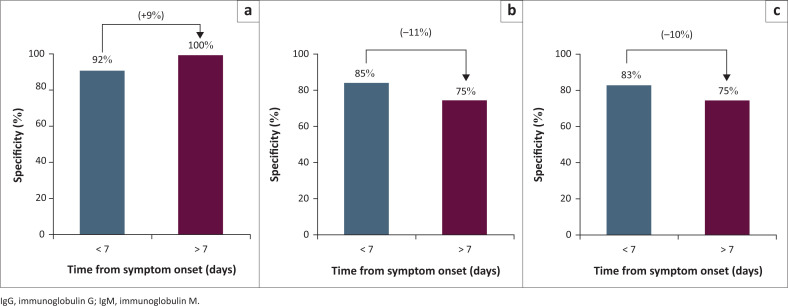
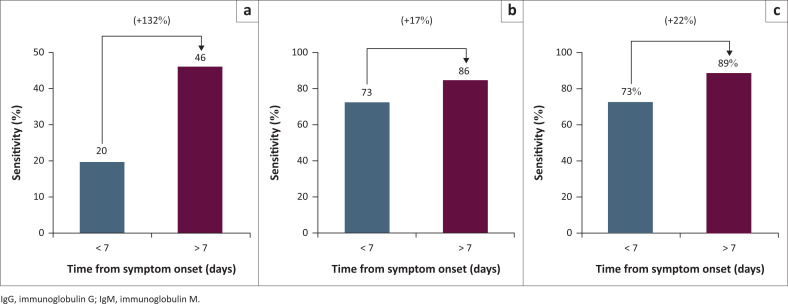
Overall, the test has a sensitivity and specificity of 85.2% and 80.0%, respectively, for a combination of IgG and IgM. Sensitivity and specificity of IgG testing alone were 81.5% and 85%. Sensitivity improved for testing with increasing time from symptom onset; however, specifity was not significantly different.
The study data adds to the body of evidence that because of relatively low sensitivity and specificity, there is a limited role for antibody-based point-of-care testing in the acute phase of COVID-19 infection, as was the case with this IgG/IgM Rapid Test Cassette (BNCP - 402 and BNCP402). There may exist a role for such testing in patients recovered from prior COVID-19 infection or in seroprevalence studies; however, additional evaluations at later timepoints from symptom onset are required.
不同的诊断工具可提高对2019冠状病毒病(COVID-19)的早期检测。已开发出多种基于抗体的即时检验血清学检测方法,以补充基于实时逆转录聚合酶链反应(RT-PCR)的诊断。本研究描述了由Spring Healthcare Services生产的一种抗体检测方法,即免疫球蛋白G(IgG)/免疫球蛋白M(IgM)快速检测试剂盒(BNCP - 402和BNCP402)的有效性。
于2020年7月16日至2020年8月12日在克里斯·哈尼·巴拉干纳特学术医院进行了一项前瞻性队列验证研究。共有101例被收治为正在接受调查的COVID-19病例的患者纳入研究。根据症状出现后的时间将他们分为两类:在七天内进行检测(早期队列)和七天后进行检测(晚期队列)。将快速抗体检测与RT-PCR进行比较。
总体而言,对于IgG和IgM联合检测,该检测方法的灵敏度和特异性分别为85.2%和80.0%。单独IgG检测的灵敏度和特异性分别为81.5%和85%。随着症状出现时间的增加,检测的灵敏度有所提高;然而,特异性没有显著差异。
研究数据进一步证明,由于灵敏度和特异性相对较低,基于抗体的即时检验检测在COVID-19感染急性期的作用有限,本研究中的这种IgG/IgM快速检测试剂盒(BNCP - 402和BNCP402)就是如此。这种检测方法在既往COVID-19感染康复的患者或血清流行率研究中可能有一定作用;然而,需要在症状出现后的更晚时间点进行额外评估。