Treadwell Marsha J, Du Lisa, Bhasin Neha, Marsh Anne M, Wun Theodore, Bender M A, Wong Trisha E, Crook Nicole, Chung Jong H, Norman Shannon, Camilo Nicolas, Cavazos Judith, Nugent Diane
Division of Hematology, Department of Pediatrics, University of California, San Francisco, San Francisco, CA, United States.
UCSF Benioff Children's Hospital Oakland, Oakland, CA, United States.
Front Genet. 2022 Aug 26;13:921432. doi: 10.3389/fgene.2022.921432. eCollection 2022.
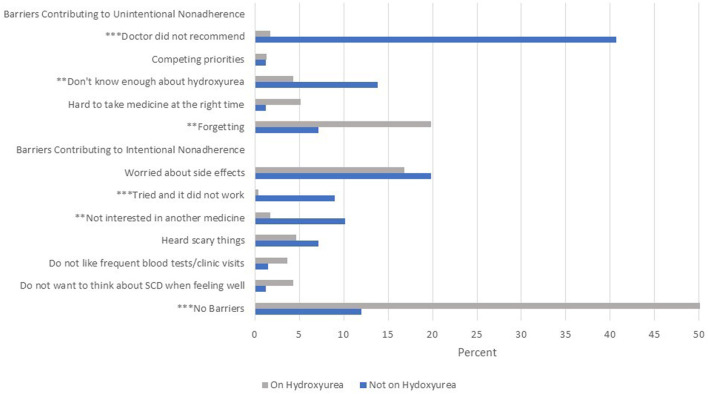
Sickle cell disease (SCD) is an inherited blood disorder that affects about 100,000 people in the U.S., primarily Blacks/African-Americans. A multitude of complications negatively impacts quality of life. Hydroxyurea has been FDA approved since 1998 as a disease-modifying therapy for SCD, but is underutilized. Negative and uninformed perceptions of hydroxyurea and barriers to its use hinder adherence and promotion of the medication. As the largest real-world study to date that assessed hydroxyurea use for children and adults with SCD, we gathered and analyzed perspectives of providers, individuals with SCD, and families. Participants provided information about socio-demographics, hospital and emergency admissions for pain, number of severe pain episodes interfering with daily activities, medication adherence, and barriers to hydroxyurea. Providers reported on indications for hydroxyurea, reasons not prescribed, and current laboratory values. We found that hydroxyurea use was reported in over half of eligible patients from this large geographic region in the U.S., representing a range of sickle cell specialty clinical settings and practices. Provider and patient/caregiver reports about hydroxyurea use were consistent with one another; adults 26 years and older were least likely to be on hydroxyurea; and the likelihood of being on hydroxyurea decreased with one or more barriers. Using the intentional and unintentional medication nonadherence framework, we found that, even for patients on hydroxyurea, challenges to taking the medicine at the right time and forgetting were crucial unintentional barriers to adherence. Intentional barriers such as worry about side effects and "tried and it did not work" were important barriers for young adults and adults. For providers, diagnoses other than HgbSS or HgbS-β0 thalassemia were associated with lower odds of prescribing, consistent with evidence-based guidelines. Our results support strengthening provider understanding and confidence in implementing existing SCD guidelines, and the importance of shared decision making. Our findings can assist providers in understanding choices and decisions of families; guide individualized clinical discussions regarding hydroxyurea therapy; and help with developing tailored interventions to address barriers. Addressing barriers to hydroxyurea use can inform strategies to minimize similar barriers in the use of emerging and combination therapies for SCD.
镰状细胞病(SCD)是一种遗传性血液疾病,在美国约有10万人受其影响,主要是黑人/非裔美国人。多种并发症对生活质量产生负面影响。自1998年以来,羟基脲已获美国食品药品监督管理局(FDA)批准,作为一种改善SCD病情的疗法,但未得到充分利用。对羟基脲的负面和无知看法以及其使用障碍阻碍了药物的依从性和推广。作为迄今为止评估羟基脲用于SCD儿童和成人的最大规模真实世界研究,我们收集并分析了医疗服务提供者、SCD患者及家庭的观点。参与者提供了有关社会人口统计学、因疼痛住院和急诊情况、干扰日常活动的严重疼痛发作次数、药物依从性以及羟基脲使用障碍等信息。医疗服务提供者报告了羟基脲的使用指征、未开具处方的原因以及当前实验室值。我们发现,在美国这个广大地理区域内,超过一半的符合条件患者报告使用了羟基脲,涵盖了一系列镰状细胞专科临床机构和诊疗实践。医疗服务提供者与患者/护理人员关于羟基脲使用情况的报告相互一致;26岁及以上的成年人使用羟基脲的可能性最小;存在一个或多个障碍会降低使用羟基脲的可能性。使用有意和无意药物不依从框架,我们发现,即使对于使用羟基脲的患者,在正确时间服药的挑战和遗忘也是导致依从性的关键无意障碍。诸如担心副作用和“试过但没效果”等有意障碍,是年轻成年人及成年人的重要障碍。对于医疗服务提供者而言,除血红蛋白SS(HgbSS)或血红蛋白S-β0地中海贫血(HgbS-β0 thalassemia)以外的诊断与开具处方的几率较低相关,这与循证指南相符。我们的结果支持加强医疗服务提供者对实施现有SCD指南的理解和信心,以及共同决策的重要性。我们的研究结果可帮助医疗服务提供者理解家庭的选择和决策;指导关于羟基脲治疗的个体化临床讨论;并有助于制定针对性干预措施以消除障碍。解决羟基脲使用障碍可为尽量减少SCD新兴疗法和联合疗法使用中类似障碍的策略提供参考。