Departamento de Patología, Escuela de Medicina Veterinaria, Universidad Nacional, Heredia, Costa Rica.
Institute of Veterinary Pathology, Vetsuisse Faculty, University of Zurichgrid.7400.3, Zurich, Switzerland.
Microbiol Spectr. 2022 Oct 26;10(5):e0170522. doi: 10.1128/spectrum.01705-22. Epub 2022 Sep 12.
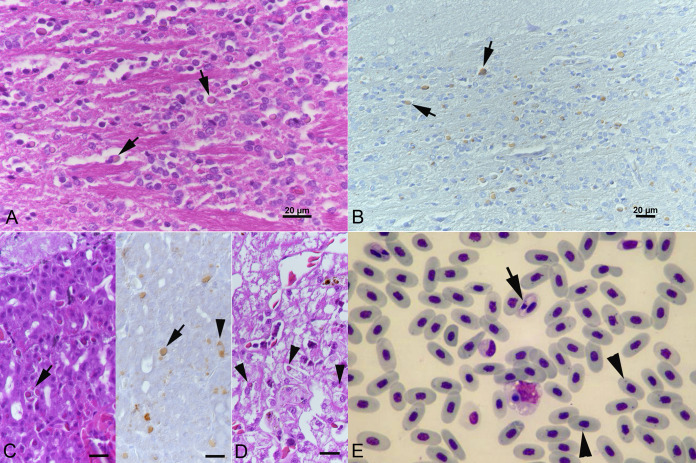
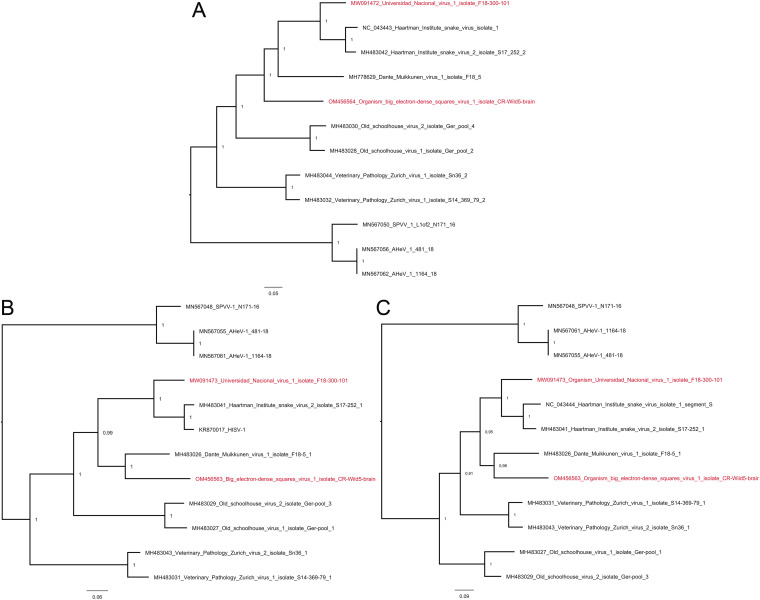
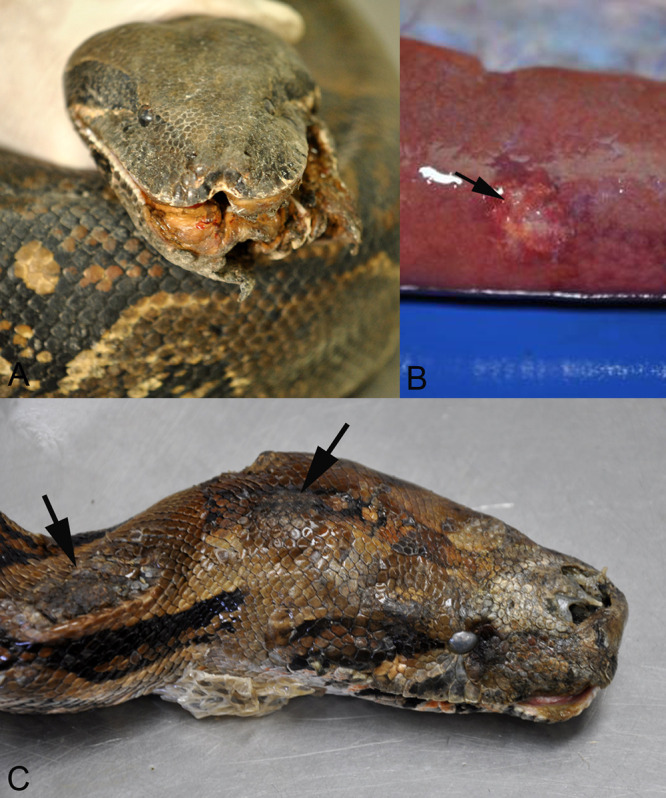
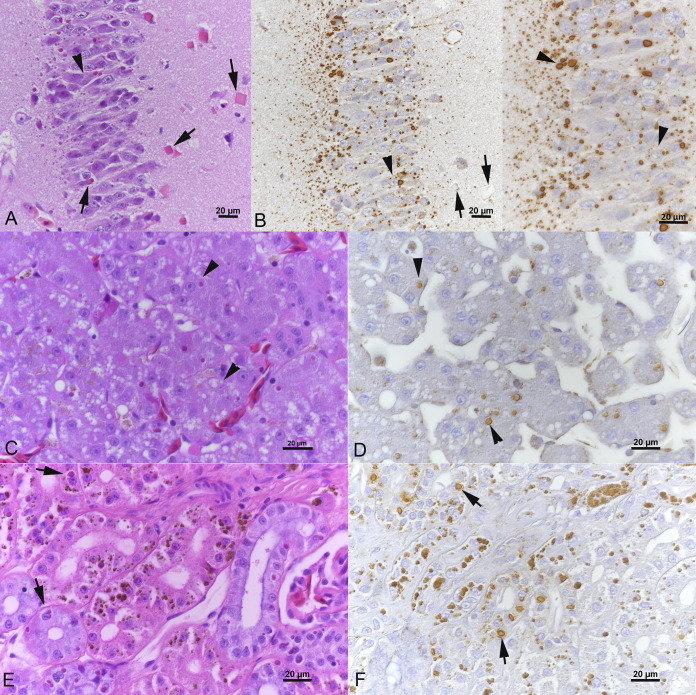
Reptarenaviruses cause boid inclusion body disease (BIBD), a potentially fatal disease, occurring in captive constrictor snakes boas and pythons worldwide. Classical BIBD, characterized by the formation of pathognomonic cytoplasmic inclusion bodies (IBs), occurs mainly in boas, whereas in pythons, for example, reptarenavirus infection most often manifests as central nervous system signs with limited IB formation. The natural hosts of reptarenaviruses are unknown, although free-ranging/wild constrictor snakes are among the suspects. Here, we report BIBD with reptarenavirus infection in indigenous captive and wild boid snakes in Costa Rica using histology, immunohistology, transmission electron microscopy, and next-generation sequencing (NGS). The snakes studied represented diagnostic postmortem cases of captive and wild-caught snakes since 1989. The results from NGS on archival paraffin blocks confirm that reptarenaviruses were already present in wild boa constrictors in Costa Rica in the 1980s. Continuous sequences that were assembled from the low-quality RNA obtained from paraffin-embedded tissue allowed the identification of a distinct pair of reptarenavirus S and L segments in all studied animals; in most cases, reference assembly could recover almost complete segments. Sampling of three prospective cases in 2018 allowed an examination of fresh blood or tissues and resulted in the identification of additional reptarenavirus segments and hartmanivirus coinfection. Our results show that BIBD is not only a disease of captive snakes but also occurs in indigenous wild constrictor snakes in Costa Rica, suggesting boa constrictors to play a role in natural reptarenavirus circulation. The literature describes cases of boid inclusion body disease (BIBD) in captive snakes since the 1970s, and in the 2010s, others and ourselves identified reptarenaviruses as the causative agent. BIBD affects captive snakes globally, but the origin and the natural host of reptarenaviruses remain unknown. In this report, we show BIBD and reptarenavirus infections in two native Costa Rican constrictor snake species, and by studying archival samples, we show that both the viruses and the disease have been present in free-ranging/wild snakes in Costa Rica at least since the 1980s. The diagnosis of BIBD in wild boa constrictors suggests that this species plays a role in the circulation of reptarenaviruses. Additional sample collection and analysis would help to clarify this role further and the possibility of, e.g., vector transmission from an arthropod host.
晰蜴肝肠病毒会引起包含体病(BIBD),这是一种潜在致命的疾病,发生于全球范围内的圈养蟒科和蚺科蛇类中。具有特征性的细胞质包含体(IB)形成的经典 BIBD 主要发生于蟒科,而在蚺科中,晰蜴肝肠病毒感染通常表现为中枢神经系统症状,伴随有限的包含体形成。晰蜴肝肠病毒的自然宿主尚不清楚,尽管自由放养/野生蟒科蛇类是怀疑对象之一。在此,我们通过组织病理学、免疫组织化学、透射电子显微镜和下一代测序(NGS),报告了哥斯达黎加本土圈养和野生蟒科蛇类中的 BIBD 与晰蜴肝肠病毒感染。所研究的蛇类代表了自 1989 年以来圈养和野生捕获蛇类的诊断性尸检病例。NGS 对存档石蜡块的结果证实,20 世纪 80 年代晰蜴肝肠病毒已经存在于哥斯达黎加的野生蟒中。从石蜡包埋组织中获得的低质量 RNA 组装的连续序列,使得在所有研究的动物中均鉴定出一对独特的晰蜴肝肠病毒 S 和 L 片段;在大多数情况下,参考组装几乎可以恢复完整的片段。2018 年对三个前瞻性病例的采样允许检查新鲜血液或组织,并鉴定出额外的晰蜴肝肠病毒片段和哈特曼尼病毒合并感染。我们的结果表明,BIBD 不仅是圈养蛇类的疾病,而且也发生于哥斯达黎加本土野生蟒科蛇类中,这表明蟒可能在晰蜴肝肠病毒的自然循环中发挥作用。文献描述了自 20 世纪 70 年代以来圈养蛇类的 BIBD 病例,21 世纪 10 年代,其他人包括我们自己都将晰蜴肝肠病毒鉴定为致病因子。BIBD 影响全球范围内的圈养蛇类,但晰蜴肝肠病毒的起源和自然宿主仍不清楚。在本报告中,我们展示了哥斯达黎加的两种本土蟒科蛇类中的 BIBD 和晰蜴肝肠病毒感染,通过研究存档样本,我们表明,自 20 世纪 80 年代以来,自由放养/野生蛇类中就已经存在病毒和疾病。在野生蟒中诊断出 BIBD 表明该物种在晰蜴肝肠病毒的循环中发挥作用。进一步的样本采集和分析将有助于进一步阐明这种作用,以及是否可能存在节肢动物宿主的媒介传播。