
自体外周血单个核细胞为基础的人源化癌症模型的评价。
Critical evaluation of an autologous peripheral blood mononuclear cell-based humanized cancer model.
机构信息
Michael E. DeBakey Department of Surgery, Baylor College of Medicine, Houston, Texas, United States of America.
Molecular and Systems Pharmacology, Emory University, Atlanta, GA, United States of America.
出版信息
PLoS One. 2022 Sep 12;17(9):e0273076. doi: 10.1371/journal.pone.0273076. eCollection 2022.
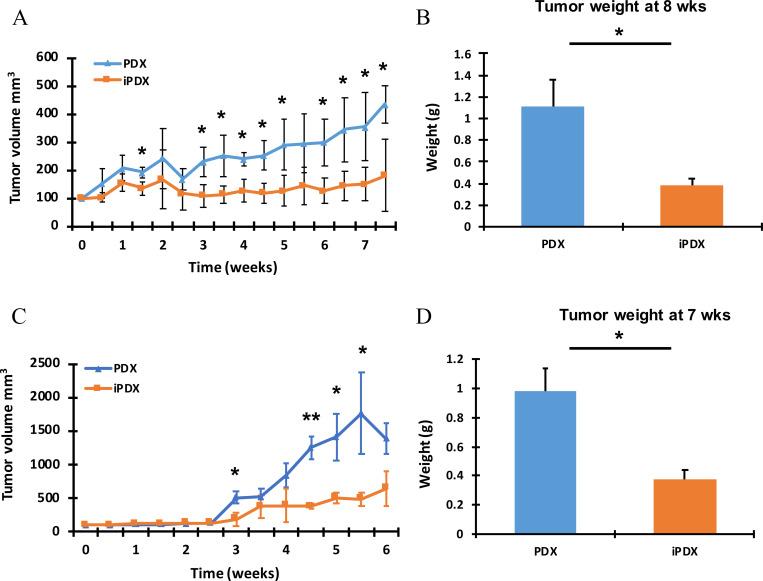
The use of humanized mouse models for oncology is rapidly expanding. Autologous patient-derived systems are particularly attractive as they can model the human cancer's heterogeneity and immune microenvironment. In this study, we developed an autologous humanized mouse cancer model by engrafting NSG mice with patient-derived xenografts and infused matched peripheral blood mononuclear cells (PBMCs). We first defined the time course of xenogeneic graft-versus-host-disease (xGVHD) and determined that only minimal xGVHD was observed for up to 8 weeks. Next, colorectal and pancreatic cancer patient-derived xenograft bearing NSG mice were infused with 5x10⁶ human PBMCS for development of the humanized cancer models (iPDX). Early after infusion of human PBMCs, iPDX mice demonstrated engraftment of human CD4+ and CD8+ T cells in the blood of both colorectal and pancreatic cancer patient-derived models that persisted for up to 8 weeks. At the end of the experiment, iPDX xenografts maintained the features of the primary human tumor including tumor grade and cell type. The iPDX tumors demonstrated infiltration of human CD3+ cells with high PD-1 expression although we observed significant intra and inter- model variability. In summary, the iPDX models reproduced key features of the corresponding human tumor. The observed variability and high PD-1 expression are important considerations that need to be addressed in order to develop a reproducible model system.
肿瘤学中使用人源化小鼠模型正在迅速发展。自体患者来源的系统特别有吸引力,因为它们可以模拟人类癌症的异质性和免疫微环境。在这项研究中,我们通过将患者来源的异种移植物植入 NSG 小鼠并输注匹配的外周血单核细胞(PBMC)来开发自体人源化小鼠癌症模型。我们首先定义了异种移植物抗宿主病(xGVHD)的时间过程,并确定最多 8 周内仅观察到最小的 xGVHD。接下来,将结直肠癌和胰腺癌患者来源的异种移植物荷瘤 NSG 小鼠输注 5x10⁶ 个人类 PBMC,以开发人源化癌症模型(iPDX)。在输注人类 PBMC 后早期,iPDX 小鼠的血液中显示出结直肠癌和胰腺癌患者来源模型中 CD4+和 CD8+T 细胞的植入,持续长达 8 周。在实验结束时,iPDX 异种移植物保持了原发性人类肿瘤的特征,包括肿瘤分级和细胞类型。iPDX 肿瘤表现出浸润性人类 CD3+细胞,高表达 PD-1,尽管我们观察到明显的模型内和模型间变异性。总之,iPDX 模型再现了相应人类肿瘤的关键特征。观察到的变异性和高 PD-1 表达是需要解决的重要考虑因素,以开发可重复的模型系统。


 Zotero 插件