Department of Colorectal Surgery, Affiliated Jinhua Hospital, Zhejiang University School of Medicine, Jinhua, China.
Key Laboratory of Gastroenterology of Zhejiang Province, Zhejiang Provincial People's Hospital, People's Hospital of Hangzhou Medical College, Hangzhou, China.
Cancer Sci. 2021 Jul;112(7):2592-2606. doi: 10.1111/cas.14934. Epub 2021 Jun 5.
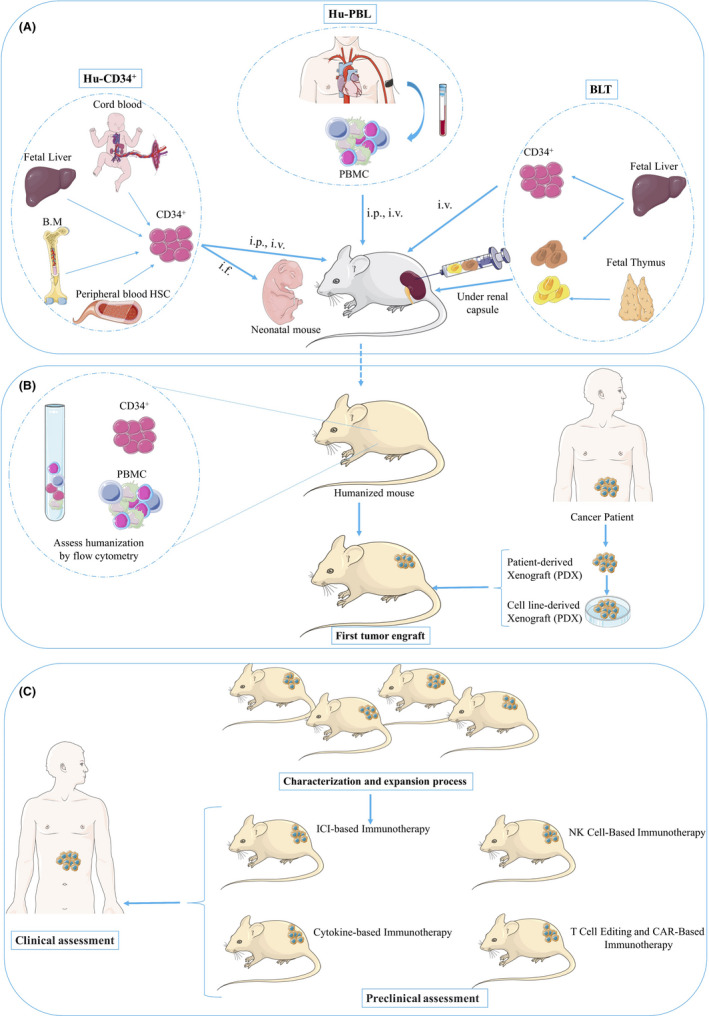
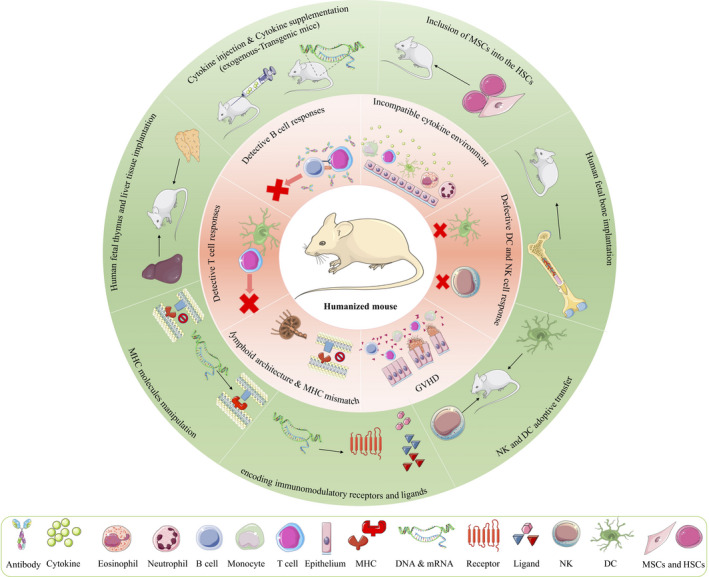
Immunotherapy has revolutionized cancer treatment, however, not all tumor types and patients are completely responsive to this approach. Establishing predictive pre-clinical models would allow for more accurate and practical immunotherapeutic drug development. Mouse models are extensively used as in vivo system for biomedical research. However, due to the significant differences between rodents and human, it is impossible to translate most of the findings from mouse models to human. Pharmacological development and advancing personalized medicine using patient-derived xenografts relies on producing mouse models in which murine cells and genes are substituted with their human equivalent. Humanized mice (HM) provide a suitable platform to evaluate xenograft growth in the context of a human immune system. In this review, we discussed recent advances in the generation and application of HM models. We also reviewed new insights into the basic mechanisms, pre-clinical evaluation of onco-immunotherapies, current limitations in the application of these models as well as available improvement strategies. Finally, we pointed out some issues for future studies.
免疫疗法已经彻底改变了癌症治疗,然而,并非所有肿瘤类型和患者对这种方法都完全有反应。建立预测性的临床前模型将有助于更准确和实际的免疫治疗药物的开发。小鼠模型被广泛用作生物医学研究的体内系统。然而,由于啮齿动物和人类之间存在显著差异,将大多数从小鼠模型中获得的发现转化到人类身上是不可能的。利用患者来源的异种移植物进行药物开发和推进个性化医疗,依赖于产生这样的小鼠模型,其中鼠类细胞和基因被其人类对应物取代。人源化小鼠(HM)提供了一个合适的平台,可在人类免疫系统的背景下评估异种移植物的生长。在这篇综述中,我们讨论了 HM 模型的最新进展及其应用。我们还回顾了对基本机制的新见解,对肿瘤免疫治疗的临床前评估,以及这些模型应用的当前局限性和现有的改进策略。最后,我们指出了未来研究的一些问题。