Department of Biochemistry and Biophysics, Stockholm University, Stockholm 10691, Sweden.
Institute of Biotechnology, University of Helsinki, 00014 Helsinki, Finland.
Proc Natl Acad Sci U S A. 2022 Sep 20;119(38):e2207761119. doi: 10.1073/pnas.2207761119. Epub 2022 Sep 12.
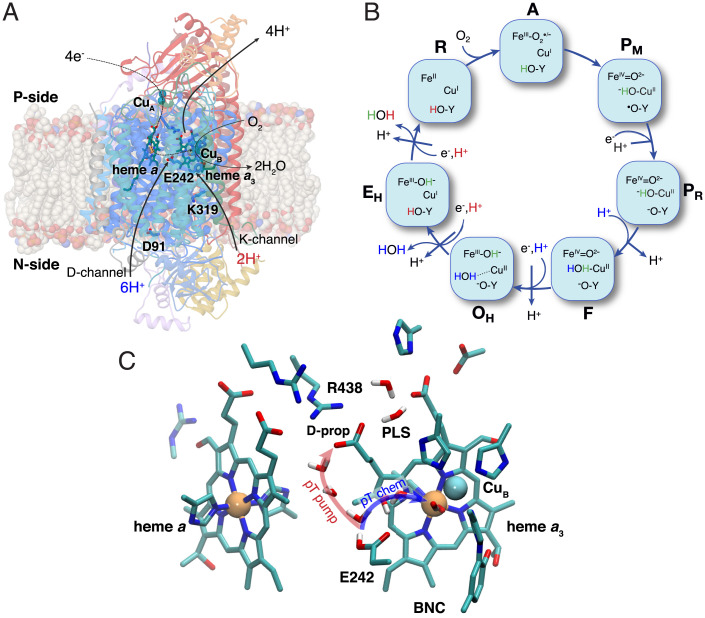
Aerobic life is powered by membrane-bound enzymes that catalyze the transfer of electrons to oxygen and protons across a biological membrane. Cytochrome oxidase (CO) functions as a terminal electron acceptor in mitochondrial and bacterial respiratory chains, driving cellular respiration and transducing the free energy from O reduction into proton pumping. Here we show that CO creates orientated electric fields around a nonpolar cavity next to the active site, establishing a molecular switch that directs the protons along distinct pathways. By combining large-scale quantum chemical density functional theory (DFT) calculations with hybrid quantum mechanics/molecular mechanics (QM/MM) simulations and atomistic molecular dynamics (MD) explorations, we find that reduction of the electron donor, heme , leads to dissociation of an arginine (Arg438)-heme D-propionate ion-pair. This ion-pair dissociation creates a strong electric field of up to 1 V Å along a water-mediated proton array leading to a transient proton loading site (PLS) near the active site. Protonation of the PLS triggers the reduction of the active site, which in turn aligns the electric field vectors along a second, "chemical," proton pathway. We find a linear energy relationship of the proton transfer barrier with the electric field strength that explains the effectivity of the gating process. Our mechanism shows distinct similarities to principles also found in other energy-converting enzymes, suggesting that orientated electric fields generally control enzyme catalysis.
有氧生活由膜结合酶驱动,这些酶催化电子在生物膜上向氧和质子的转移。细胞色素氧化酶(CO)在线粒体和细菌呼吸链中作为末端电子受体发挥作用,驱动细胞呼吸,并将 O 还原的自由能转化为质子泵。在这里,我们表明 CO 在活性位点附近的非极性空腔周围产生定向电场,建立了一种分子开关,该开关沿不同的路径引导质子。通过将大规模量子化学密度泛函理论(DFT)计算与混合量子力学/分子力学(QM/MM)模拟和原子分子动力学(MD)探索相结合,我们发现电子供体血红素的还原导致精氨酸(Arg438)-血红素 D-丙酸离子对的解离。这种离子对的解离在水介导的质子阵列中产生高达 1 V Å的强电场,导致活性位点附近的瞬态质子加载位点(PLS)。PLS 的质子化触发活性位点的还原,这反过来又使电场矢量沿第二条“化学”质子路径对齐。我们发现质子转移势垒与电场强度之间存在线性能量关系,这解释了门控过程的有效性。我们的机制与其他能量转换酶中发现的原理具有明显的相似性,表明定向电场通常控制酶催化。