Department of Molecular Membrane Biology, Max Planck Institute of Biophysics, D-60438, Frankfurt/Main, Germany.
Institute of Pharmaceutical Chemistry, Phillips University Marburg, D-35032, Marburg, Germany.
Nat Commun. 2021 Nov 25;12(1):6903. doi: 10.1038/s41467-021-27174-y.
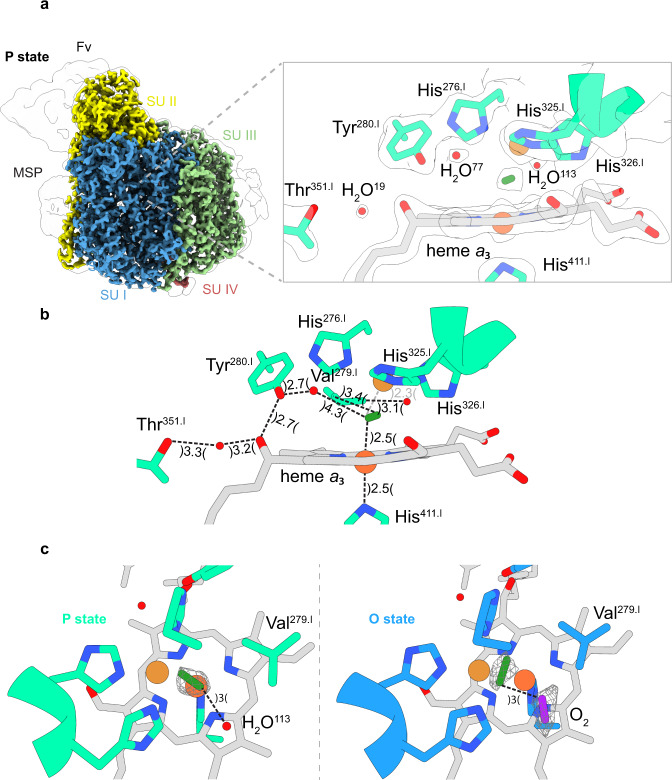
Cytochrome c oxidases are among the most important and fundamental enzymes of life. Integrated into membranes they use four electrons from cytochrome c molecules to reduce molecular oxygen (dioxygen) to water. Their catalytic cycle has been considered to start with the oxidized form. Subsequent electron transfers lead to the E-state, the R-state (which binds oxygen), the P-state (with an already split dioxygen bond), the F-state and the O-state again. Here, we determined structures of up to 1.9 Å resolution of these intermediates by single particle cryo-EM. Our results suggest that in the O-state the active site contains a peroxide dianion and in the P-state possibly an intact dioxygen molecule, the F-state may contain a superoxide anion. Thus, the enzyme's catalytic cycle may have to be turned by 180 degrees.
细胞色素 c 氧化酶是生命中最重要和最基本的酶之一。它们整合到膜中,利用细胞色素 c 分子中的四个电子将分子氧(氧气)还原为水。它们的催化循环被认为从氧化形式开始。随后的电子转移导致 E 态、R 态(与氧结合)、P 态(已经分裂的氧键)、F 态和 O 态再次出现。在这里,我们通过单颗粒 cryo-EM 确定了这些中间体高达 1.9Å分辨率的结构。我们的结果表明,在 O 态下,活性位点含有过氧二阴离子,在 P 态下可能含有完整的氧气分子,F 态可能含有超氧阴离子。因此,酶的催化循环可能需要旋转 180 度。