Clinic for Transplantation Immunology and Nephrology, University Hospital Basel, University of Basel, Basel, Switzerland.
Faculty of Medicine, University of Zurich, Zurich, Switzerland.
Kidney Int. 2022 Dec;102(6):1409-1419. doi: 10.1016/j.kint.2022.08.021. Epub 2022 Sep 10.
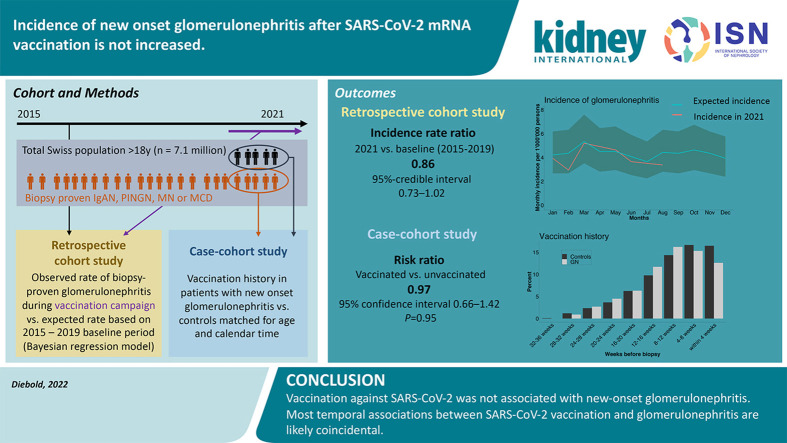
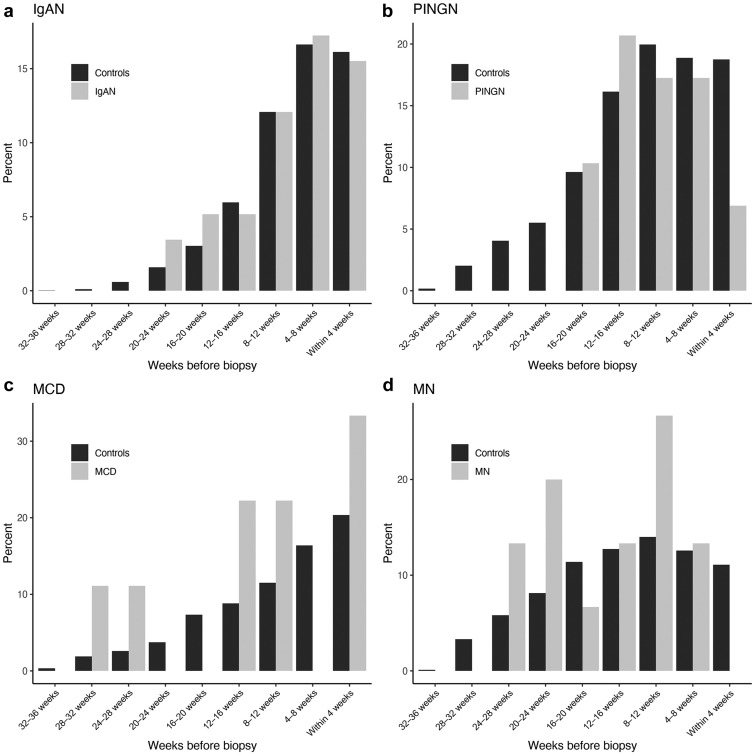
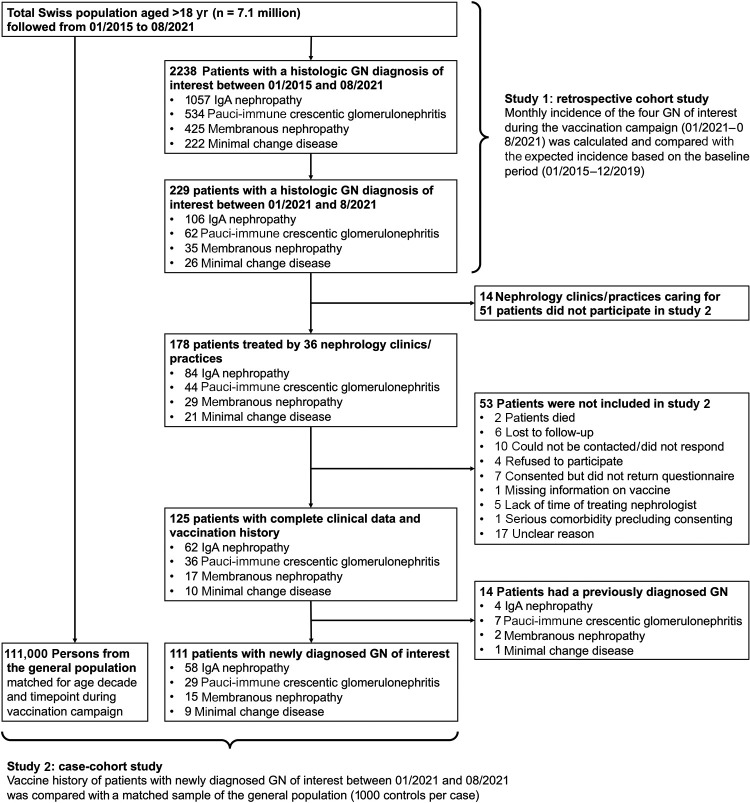
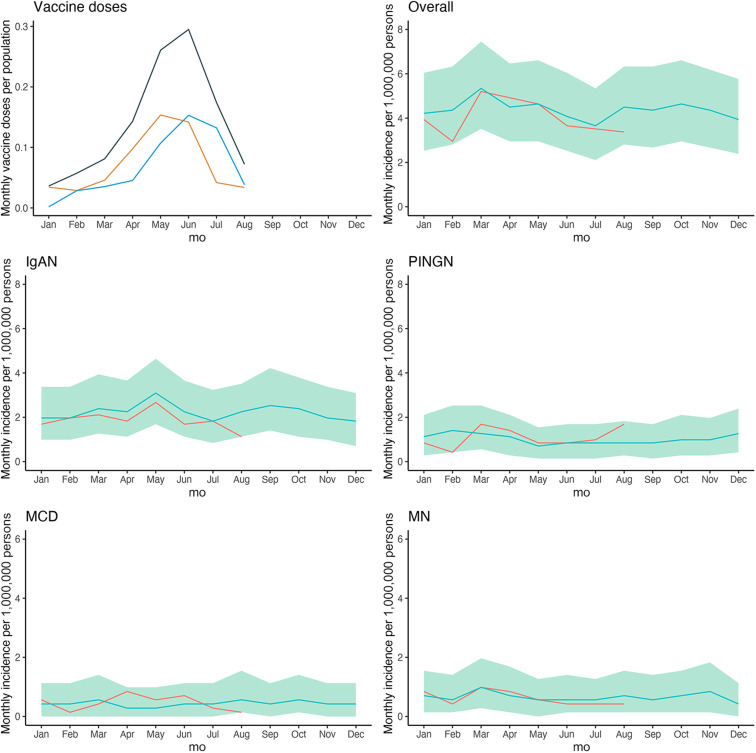
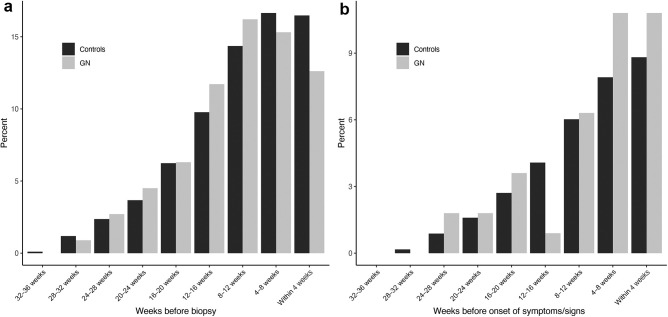
Numerous cases of glomerulonephritis manifesting shortly after SARS-CoV-2 vaccination have been reported, but causality remains unproven. Here, we studied the association between mRNA-based SARS-CoV-2 vaccination and new-onset glomerulonephritis using a nationwide retrospective cohort and a case-cohort design. Data from all Swiss pathology institutes processing native kidney biopsies served to calculate incidence of IgA nephropathy, pauci-immune necrotizing glomerulonephritis, minimal change disease, and membranous nephropathy in the adult Swiss population. The observed incidence during the vaccination campaign (January to August 2021) was not different from the expected incidence calculated using a Bayesian model based on the years 2015 to 2019 (incidence rate ratio 0.86, 95% credible interval 0.73-1.02) and did not cross the upper boundary of the 95% credible interval for any month. Among 111 patients 18 years and older with newly diagnosed glomerulonephritis between January and August 2021, 38.7% had received at least one vaccine dose before biopsy, compared to 39.5% of the general Swiss population matched for age and calendar-time. The estimated risk ratio for the development of new-onset biopsy-proven glomerulonephritis was not significant at 0.97 (95% confidence interval 0.66-1.42) in vaccinated vs. unvaccinated individuals. Patients with glomerulonephritis manifesting within four weeks after vaccination did not differ clinically from those manifesting temporally unrelated to vaccination. Thus, vaccination against SARS-CoV-2 was not associated with new-onset glomerulonephritis in these two complementary studies with most temporal associations between SARS-CoV-2 vaccination and glomerulonephritis likely coincidental.
大量的肾小球肾炎病例在接种 SARS-CoV-2 疫苗后不久就出现了,但因果关系尚未得到证实。在这里,我们使用全国性回顾性队列和病例对照设计研究了基于 mRNA 的 SARS-CoV-2 疫苗接种与新发性肾小球肾炎之间的关联。所有处理原发性肾脏活检的瑞士病理学研究所的数据用于计算成人瑞士人群中 IgA 肾病、少免疫性坏死性肾小球肾炎、微小病变和膜性肾病的发病率。在疫苗接种活动期间(2021 年 1 月至 8 月)观察到的发病率与基于 2015 年至 2019 年的贝叶斯模型计算得出的预期发病率没有差异(发病率比为 0.86,95%可信区间为 0.73-1.02),并且在任何一个月都没有超过 95%可信区间的上限。在 2021 年 1 月至 8 月期间被诊断为新发性肾小球肾炎的 111 名 18 岁及以上的患者中,有 38.7%的患者在活检前至少接受了一剂疫苗,而与年龄和日历时间相匹配的普通瑞士人群中这一比例为 39.5%。在接种疫苗和未接种疫苗的个体中,新发经活检证实的肾小球肾炎的估计风险比为 0.97(95%置信区间为 0.66-1.42),无统计学意义。在接种疫苗后四周内出现肾小球肾炎的患者与在时间上与接种疫苗无关的患者在临床上没有差异。因此,在这两项具有最紧密时间关联的补充研究中,SARS-CoV-2 疫苗接种与肾小球肾炎之间的关联可能是偶然的,SARS-CoV-2 疫苗接种与新发性肾小球肾炎无关。