Pulmonary Department, Hospital Clinico, INCLIVA, Valencia, Spain.
Bioinformatics and Biostatistics Unit, INCLIVA, Valencia, Spain.
Respir Res. 2022 Sep 12;23(1):242. doi: 10.1186/s12931-022-02166-8.
The coronavirus disease (COVID-19) pandemic has already affected more than 400 million people, with increasing numbers of survivors. These data indicate that a myriad of people may be affected by pulmonary sequelae of the infection. The aim of this study was to evaluate pulmonary sequelae in patients with bilateral COVID-19 pneumonia according to severity 1 year after hospital discharge.
COVID-FIBROTIC is a multicenter prospective observational cohort study for admitted patients with bilateral COVID-19 pneumonia. Pulmonary functional outcomes and chest computed tomography sequelae were analyzed 12 months after hospital discharge and we classified patients into three groups according to severity. A post hoc analysis model was designed to establish how functional test changed between groups and over time. A multivariable logistic regression model was created to study prognostic factors for lung diffusion impairment and radiological fibrotic-like changes at 12 months.
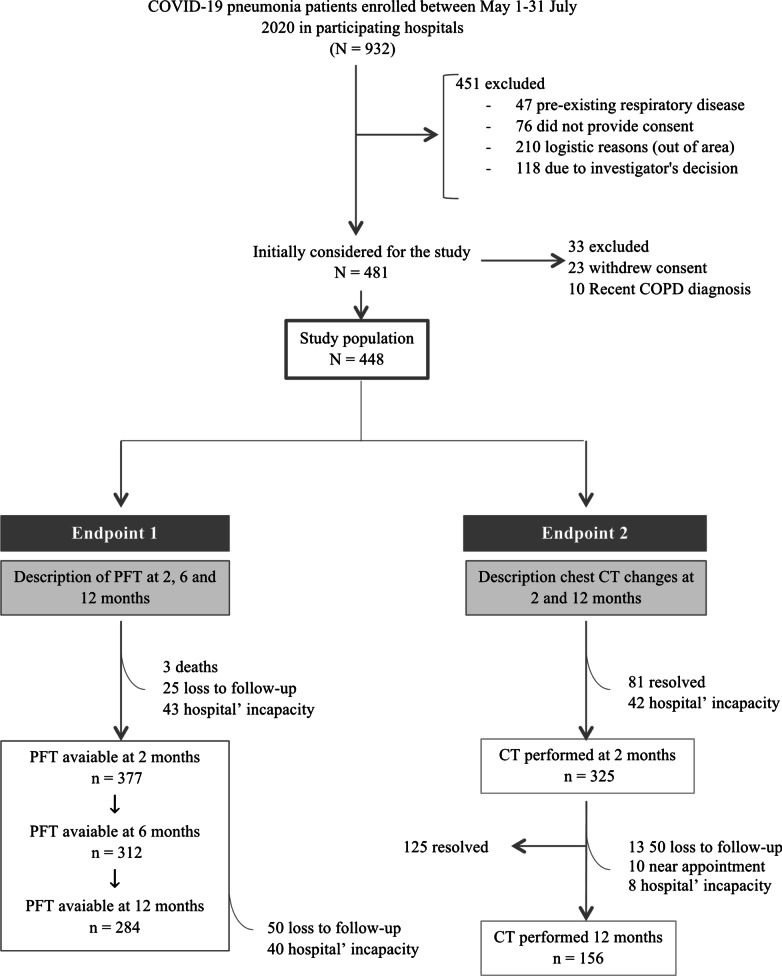
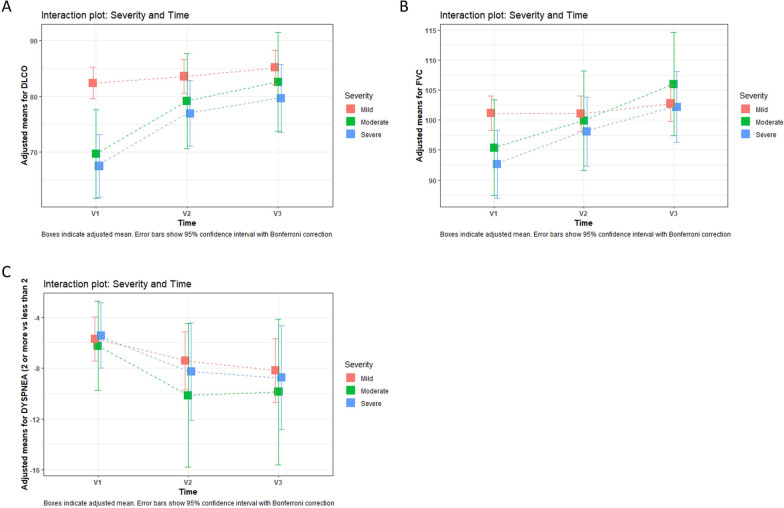
Among 488 hospitalized patients with COVID-19 pneumonia, 284 patients had completed the entire evaluation at 12 months. Median age was 60.5 ± 11.9 and 55.3% were men. We found between-group differences in male sex, length of hospital stay, radiological involvement and inflammatory laboratory parameters. The functional evaluation of pulmonary sequelae showed that severe patients had statistically worse levels of lung diffusion at 2 months but no between group differences were found in subsequent controls. At 12-month follow up, however, we found impaired lung diffusion in 39.8% unrelated to severity. Radiological fibrotic-like changes at 12 months were reported in 22.7% of patients (102/448), only associated with radiological involvement at admission (OR: 1.55, 95% CI 1.06-2.38; p = 0.02) and LDH (OR: 0.99, 95% CI 0.98-0.99; p = 0.046).
Our data suggest that a significant percentage of individuals would develop pulmonary sequelae after COVID 19 pneumonia, regardless of severity of the acute process. Trial registration clinicaltrials.gov NCT04409275 (June 1, 2020).
冠状病毒病(COVID-19)大流行已经影响了超过 4 亿人,且幸存者人数不断增加。这些数据表明,可能有无数人受到感染后的肺部后遗症影响。本研究的目的是评估 COVID-19 肺炎双侧肺炎患者在出院后 1 年时的肺部后遗症,根据严重程度进行分组。
COVID-FIBROTIC 是一项多中心前瞻性观察队列研究,针对的是患有双侧 COVID-19 肺炎的住院患者。在出院后 12 个月时分析肺功能结果和胸部计算机断层扫描后遗症,并根据严重程度将患者分为三组。设计了一个事后分析模型来确定功能测试在组间和随时间的变化。创建了一个多变量逻辑回归模型来研究 12 个月时肺扩散障碍和放射纤维化样改变的预后因素。
在 488 例 COVID-19 肺炎住院患者中,284 例完成了 12 个月的全部评估。中位年龄为 60.5±11.9 岁,55.3%为男性。我们发现组间存在性别、住院时间、影像学受累和炎症实验室参数的差异。肺部后遗症的功能评估显示,严重组患者在 2 个月时的肺扩散功能明显较差,但在随后的对照组中没有发现组间差异。然而,在 12 个月的随访中,我们发现 39.8%的患者肺扩散功能受损与严重程度无关。12 个月时报告有 22.7%的患者存在放射纤维化样改变(102/448),仅与入院时的放射学受累(OR:1.55,95%CI 1.06-2.38;p=0.02)和乳酸脱氢酶(OR:0.99,95%CI 0.98-0.99;p=0.046)有关。
我们的数据表明,COVID-19 肺炎后,相当一部分人会出现肺部后遗症,无论急性过程的严重程度如何。试验注册临床Trials.gov NCT04409275(2020 年 6 月 1 日)。