Department of Medicine, Faculty of Medicine and Health Science, University Malaysia Sarawak, Kota Samarahan, Sarawak, Malaysia.
Department of Internal Medicine, Faculty of Medicine, University Technology MARA, Sungai Buloh, Selangor, Malaysia.
Sci Rep. 2024 Jul 16;14(1):16413. doi: 10.1038/s41598-024-67536-2.
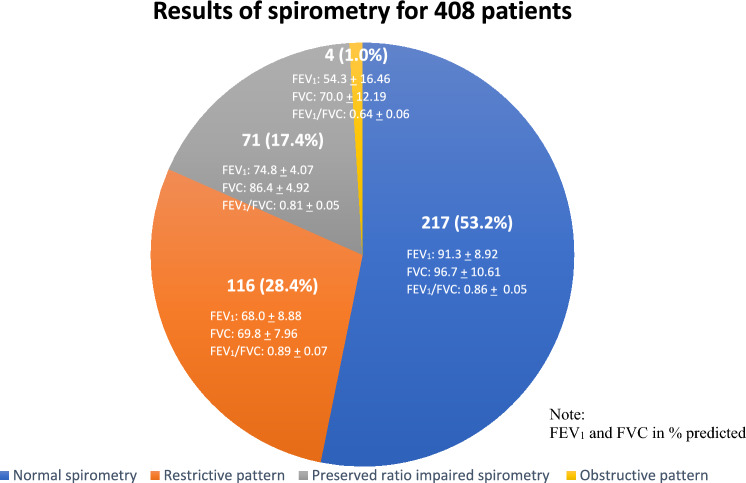
Understanding the prevalence of abnormal lung function and its associated factors among patients recovering from COVID-19 is crucial for enhancing post-COVID care strategies. This study primarily aimed to determine the prevalence and types of spirometry abnormalities among post-COVID-19 patients in Malaysia, with a secondary objective of identifying its associated factors. Conducted at the COVID-19 Research Clinic, Faculty of Medicine, University Technology MARA, from March 2021 to December 2022, this study included patients at least three months post-discharge from hospitals following moderate-to-critical COVID-19. Of 408 patients studied, abnormal spirometry was found in 46.8%, with 28.4% exhibiting a restrictive pattern, 17.4% showing preserved ratio impaired spirometry (PRISm), and 1.0% displaying an obstructive pattern. Factors independently associated with abnormal spirometry included consolidation on chest X-ray (OR 8.1, 95% CI 1.75-37.42, p = 0.008), underlying cardiovascular disease (OR 3.5, 95% CI 1.19-10.47, p = 0.023), ground-glass opacity on chest X-ray (OR 2.6, 95% CI 1.52-4.30, p < 0.001), and oxygen desaturation during the 6-min walk test (OR 1.9, 95% CI 1.20-3.06, p = 0.007). This study highlights that patients recovering from moderate-to-critical COVID-19 often exhibit abnormal spirometry, notably a restrictive pattern and PRISm. Routine spirometry screening for high-risk patients is recommended.
了解 COVID-19 康复患者的肺功能异常流行情况及其相关因素对于增强 COVID-19 后护理策略至关重要。本研究主要旨在确定马来西亚 COVID-19 后患者的肺量计异常流行率和类型,次要目标是确定其相关因素。该研究于 2021 年 3 月至 2022 年 12 月在马来西亚大学技术医学学院 COVID-19 研究诊所进行,纳入至少在中度至重度 COVID-19 住院治疗后三个月出院的患者。在 408 名研究患者中,发现肺量计异常的占 46.8%,其中 28.4%表现为限制性模式,17.4%表现为比值保留性受损的肺量计异常(PRISm),1.0%表现为阻塞性模式。与肺量计异常独立相关的因素包括胸部 X 射线上的实变(OR 8.1,95%CI 1.75-37.42,p=0.008)、心血管疾病(OR 3.5,95%CI 1.19-10.47,p=0.023)、胸部 X 射线上的磨玻璃影(OR 2.6,95%CI 1.52-4.30,p<0.001)和 6 分钟步行试验期间的血氧饱和度下降(OR 1.9,95%CI 1.20-3.06,p=0.007)。本研究表明,从中度至重度 COVID-19 中康复的患者常表现出肺量计异常,主要为限制性模式和 PRISm。建议对高危患者进行常规肺量计筛查。