Department of Physiotherapy, Exercise and Sports, LUNEX International University of Health, 4671, Differdange, Luxembourg.
Luxembourg Health & Sport Sciences Research Institute A.S.B.L., 50, Avenue du Parc des Sports, 4671, Differdange, Luxembourg.
Chiropr Man Therap. 2022 Sep 12;30(1):38. doi: 10.1186/s12998-022-00449-x.
High-velocity low-amplitude thrust spinal manipulation (SM) is a recommended and commonly used manual therapy intervention in physiotherapy. Beliefs surrounding the safety and effectiveness of SM have challenged its use, and even advocated for its abandonment. Our study aimed to investigate the knowledge and beliefs surrounding SM by Italian physiotherapists compared with similar practitioners in other countries.
An online survey with 41 questions was adapted from previous surveys and was distributed via a mailing list of the Italian Physiotherapists Association (March 22-26, 2020). The questionnaire was divided into 4 sections to capture information on participant demographics, utilization, potential barriers, and knowledge about SM. Questions were differentiated between spinal regions. Attitudes towards different spinal regions, attributes associated with beliefs, and the influence of previous educational background were each evaluated.
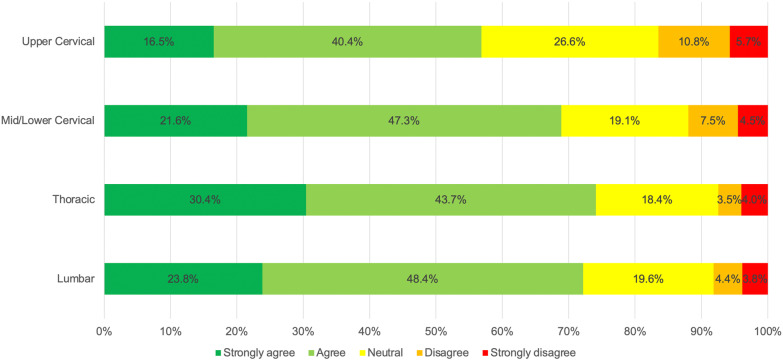
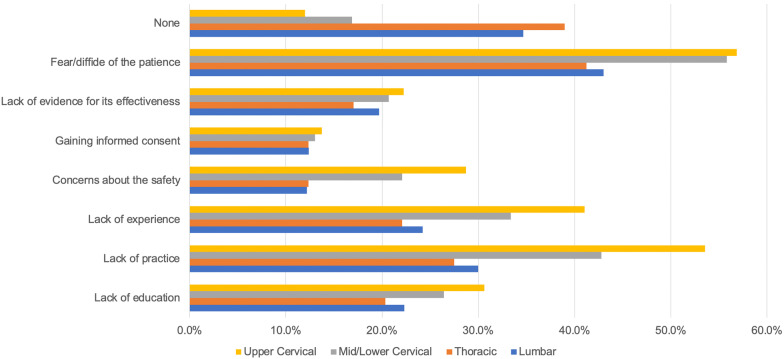
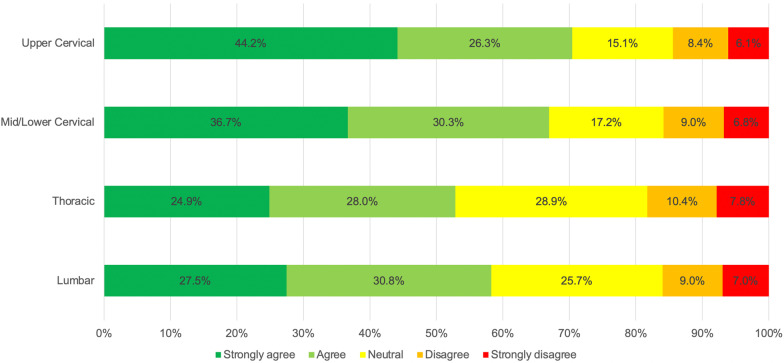
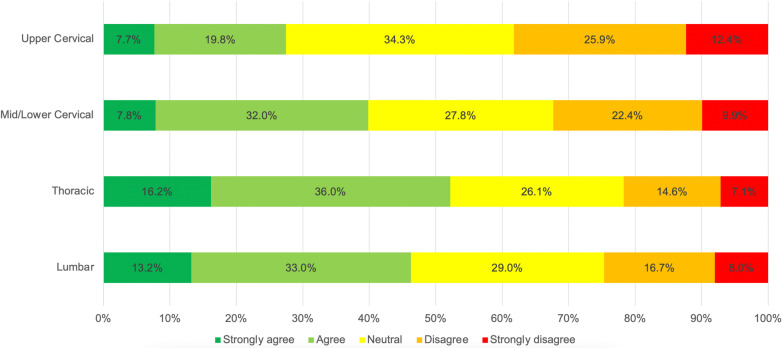
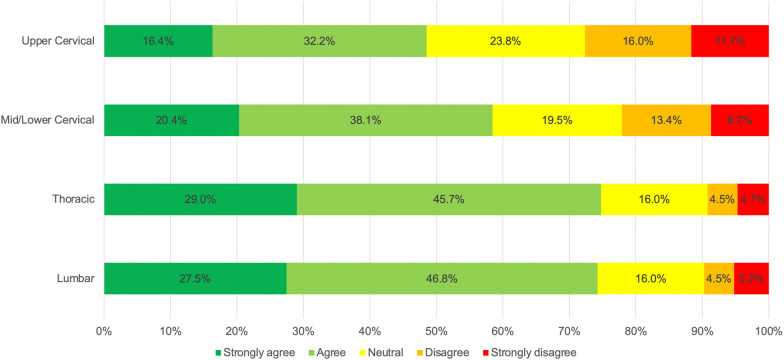
Of the 7398 registered physiotherapists, 575 (7.8%) completed the survey and were included for analysis. The majority of respondents perceived SM as safe and effective when applied to the thoracic (74.1%) and lumbar (72.2%) spines; whereas, a smaller proportion viewed SM to the upper cervical spine (56.8%) as safe and effective. Respondents reported they were less likely to provide and feel comfortable with upper cervical SM (respectively, 27.5% and 48.5%) compared to the thoracic (respectively, 52.2% and 74.8%) and lumbar spines (respectively, 46.3% and 74.3%). Most physiotherapists (70.4%) agreed they would perform additional screening prior to upper cervical SM compared to other spinal regions. Respondents who were aware of clinical prediction rules were more likely to report being comfortable with SM (OR 2.38-3.69) and to perceive it as safe (OR 1.75-3.12). Finally, physiotherapists without musculoskeletal specialization, especially those with a traditional manual therapy background, were more likely to perform additional screening prior to SM, use SM less frequently, report being less comfortable performing SM, and report upper cervical SM as less safe (p < 0.001).
The beliefs and attitudes of physiotherapists surrounding the use of SM are significantly different when comparing the upper cervical spine to other spinal regions. An educational background in traditional manual therapy significantly influences beliefs and attitudes. We propose an updated framework on evidence-based SM.
高速低幅推力脊柱手法(SM)是物理治疗中推荐和常用的一种手法治疗干预措施。围绕 SM 的安全性和有效性的观念对其使用提出了挑战,甚至主张放弃使用。我们的研究旨在调查与其他国家的物理治疗师相比,意大利物理治疗师对 SM 的认识和观念。
对意大利物理治疗师协会的邮寄名单进行了一项在线调查,调查包括 41 个问题,该调查改编自以前的调查(2020 年 3 月 22 日至 26 日)。问卷分为 4 个部分,以获取有关参与者人口统计学、利用情况、潜在障碍和 SM 知识的信息。问题根据脊柱区域进行区分。分别评估了对不同脊柱区域的态度、与信念相关的属性以及以前教育背景的影响。
在注册的 7398 名物理治疗师中,有 575 名(7.8%)完成了调查并被纳入分析。大多数受访者认为 SM 在治疗胸椎(74.1%)和腰椎(72.2%)时是安全有效的;而认为 SM 在上颈椎(56.8%)是安全有效的比例较小。受访者报告说,与治疗胸椎(分别为 52.2%和 74.8%)和腰椎(分别为 46.3%和 74.3%)相比,他们提供和感到舒适的上颈椎 SM 的可能性较小(分别为 27.5%和 48.5%)。大多数物理治疗师(70.4%)表示,与其他脊柱区域相比,他们更有可能在上颈椎 SM 前进行额外的筛查。知晓临床预测规则的受访者更有可能报告对 SM 感到舒适(OR 2.38-3.69),并认为 SM 是安全的(OR 1.75-3.12)。最后,没有肌肉骨骼专业知识的物理治疗师,尤其是那些有传统手法治疗背景的物理治疗师,更有可能在上颈椎 SM 前进行额外的筛查,更频繁地使用 SM,报告对 SM 不太舒适,并且报告上颈椎 SM 安全性较低(p<0.001)。
与其他脊柱区域相比,物理治疗师在使用 SM 时的信念和态度有显著差异。传统手法治疗的教育背景对信念和态度有重大影响。我们提出了一个基于循证 SM 的更新框架。