Developmental Biology Program, Sloan Kettering Institute, Memorial Sloan Kettering Cancer Center, New York, NY 10065, USA; Weill Cornell/Rockefeller/Sloan Kettering Tri-Institutional MD-PhD Program, New York, NY 10065, USA; Biochemistry Cell and Molecular Biology Program, Weill Cornell Graduate School of Medical Sciences, Cornell University, New York, NY 10065, USA.
Developmental Biology Program, Sloan Kettering Institute, Memorial Sloan Kettering Cancer Center, New York, NY 10065, USA; Biochemistry Cell and Molecular Biology Program, Weill Cornell Graduate School of Medical Sciences, Cornell University, New York, NY 10065, USA.
STAR Protoc. 2022 Sep 16;3(3):101660. doi: 10.1016/j.xpro.2022.101660. Epub 2022 Sep 7.
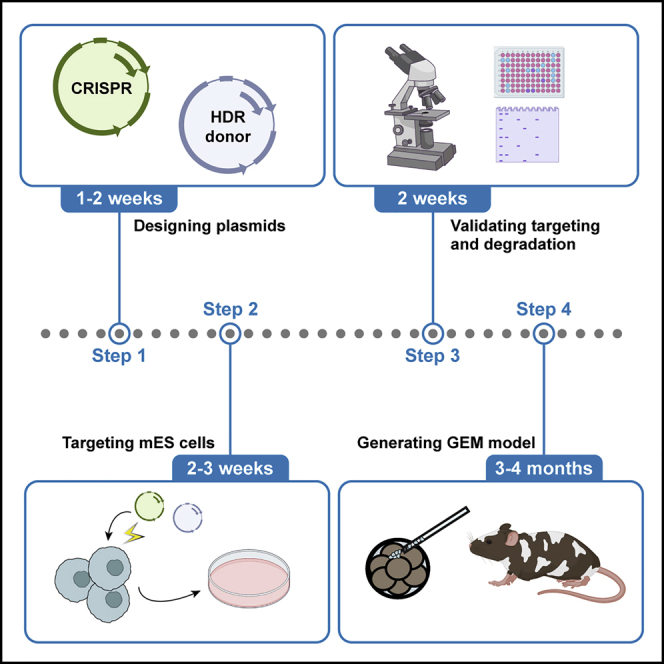
Controlling the abundance of a protein of interest in vivo is crucial to study its function. Here, we provide a step-by-step protocol for generating genetically engineered mouse (GEM) models harboring a degradation tag (dTAG) fused to endogenous proteins to enable their degradation. We discuss considerations for the overall design and details for vectors generation. Then, we include steps for generation and validations of edited mouse embryonic stem cells followed by mouse colony establishment via chimeric mouse generation. For complete details on the use and execution of this protocol, please refer to Abuhashem et al. (2022c).
在体内控制目的蛋白的丰度对于研究其功能至关重要。在这里,我们提供了一个逐步的方案,用于生成携带内源性蛋白融合降解标签(dTAG)的基因工程小鼠(GEM)模型,以实现其降解。我们讨论了总体设计的注意事项和载体生成的详细信息。然后,我们包括编辑的小鼠胚胎干细胞的生成和验证步骤,随后通过嵌合小鼠的生成建立小鼠品系。有关该方案的使用和执行的完整详细信息,请参阅 Abuhashem 等人(2022c)。