Wu Anette, Xiao Que Yun, McWatt Sean, Utomo Rachel, Talis Austin, Saraci Kerstin, Brassett Cecilia, Sagoo Mandeep Gill, Wingate Richard, Chien Chung-Liang, Traxler Hannes, Waschke Jens, Vielmuth Franziska, Yamada Yukari, Sakurai Takeshi, Zeroual Mina, Olsen Jorgen, El-Batti Salma, Viranta-Kovanen Suvi, Keay Kevin, Stewart William, Kunzel Carol, Bernd Paulette, Kielstein Heike, Noël Geoffroy P J C
Department of Medicine and Pathology and Cell Biology, Vagelos College of Physicians and Surgeons, Columbia University, New York, NY USA.
Department of Anatomy and Cell Biology, McGill University, Montreal, Canada.
Med Sci Educ. 2022 Sep 8;32(5):1033-1044. doi: 10.1007/s40670-022-01609-7. eCollection 2022 Oct.
During the COVID-19 pandemic, in-person cadaveric dissection laboratories for teaching anatomy were omitted by many schools around the world. While knowledge domains can be easily evaluated via remote exams, non-traditional discipline-independent skills such as those encouraged through reflection on the topic of death are often overlooked. This study investigated how different anatomy course formats played a role in initiating students' reflections on death during the COVID-19 pandemic.
In fall 2020, 217 medical, dental, premedical, and health sciences students from 13 international universities discussed differences in their anatomy courses online. Formats of anatomy courses ranged from dissection-based, prosection-based, hybrid (combination of dissection and prosection) to no laboratory exposure at all. Students' responses to the question, "Did/does your anatomy course initiate your thinking about life's passing?" were collected, and they self-reported themes that were present in their reflections on death using a multiple-choice prompt. Statistical analyses to detect differences between students with and without exposure to cadavers were performed using the chi-squared test.
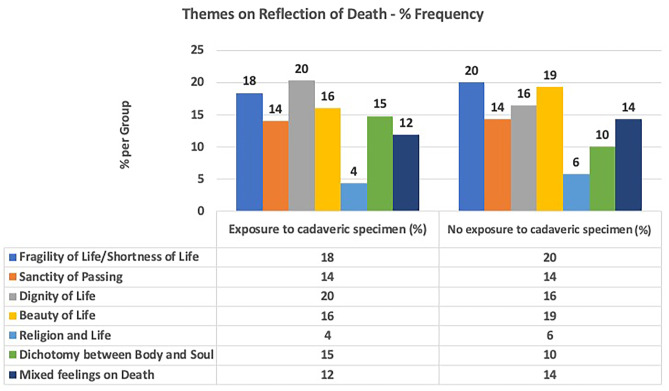
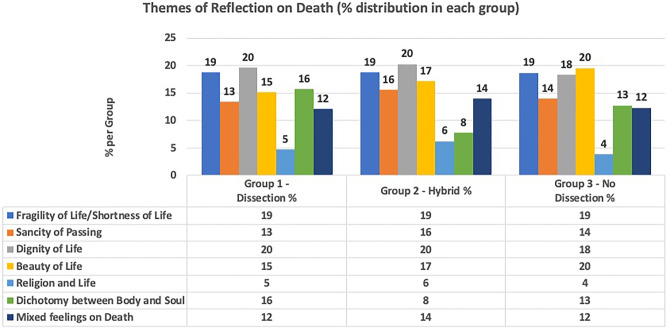
When comparing students who had exposure to human anatomical specimens to those who had no exposure, the majority of students with exposure thought that the course did initiate thoughts about life's passing, compared to students without exposure ( < 0.05). Reflection themes were consistent across groups.
These findings indicate that anatomy dissection courses are important for the initiation of students' feelings about the topic of death. Omission of cadaveric dissection- or prosection-based laboratories will decrease the likelihood that students initiate reflection on this topic and gain important transferable skills.
在新冠疫情期间,全球许多学校取消了用于解剖学教学的实体尸体解剖实验室。虽然知识领域可以通过远程考试轻松评估,但诸如通过对死亡主题的反思所培养的非传统学科独立技能往往被忽视。本研究调查了在新冠疫情期间,不同的解剖学课程形式如何在引发学生对死亡的反思中发挥作用。
2020年秋季,来自13所国际大学的217名医学、牙科、医学预科和健康科学专业的学生在线讨论了他们解剖学课程的差异。解剖学课程形式从基于解剖的、基于断层解剖的、混合式(解剖与断层解剖相结合)到完全没有实验室实践。收集了学生对“你的解剖学课程是否引发了你对生命流逝的思考?”这一问题的回答,并使用多项选择题提示让他们自行报告在对死亡的反思中出现的主题。使用卡方检验对接触过尸体和未接触过尸体的学生之间的差异进行统计分析。
将接触过人体解剖标本的学生与未接触过的学生进行比较时,与未接触过标本的学生相比,大多数接触过标本的学生认为该课程确实引发了对生命流逝的思考(<0.05)。各小组的反思主题一致。
这些发现表明,解剖学解剖课程对于引发学生对死亡主题的感受很重要。取消基于尸体解剖或断层解剖的实验室将降低学生开始对该主题进行反思并获得重要可转移技能的可能性。