Rehabilitation Sciences Institute, University of Toronto, Toronto, Ontario, Canada.
Heart and Stroke Foundation Canadian Partnership for Stroke Recovery, Sunnybrook Research Institute, Toronto, Ontario, Canada.
PLoS One. 2022 Sep 13;17(9):e0269851. doi: 10.1371/journal.pone.0269851. eCollection 2022.
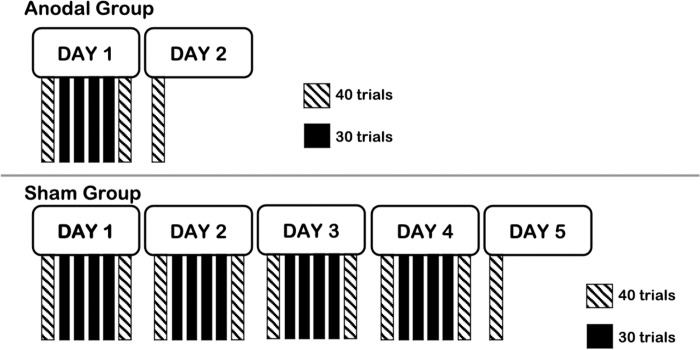
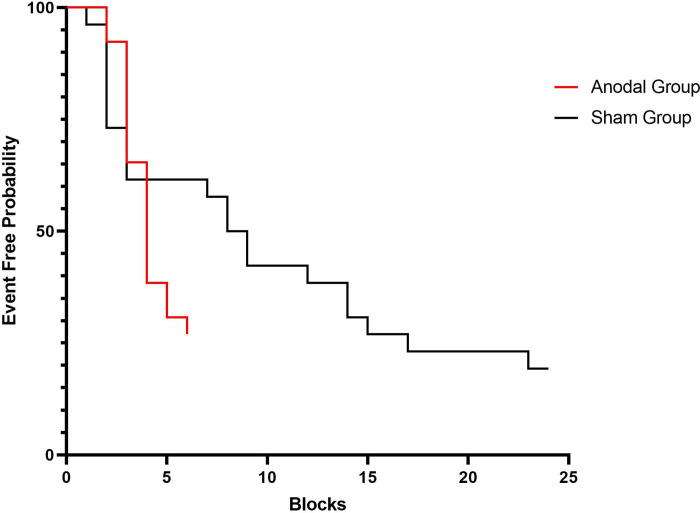
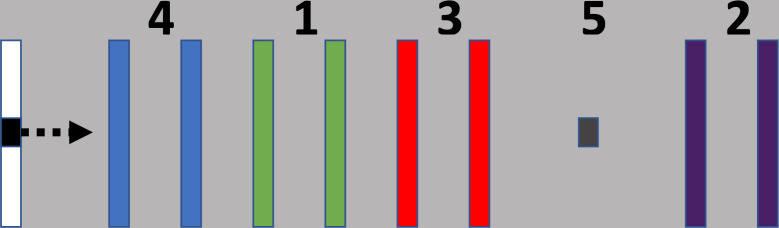
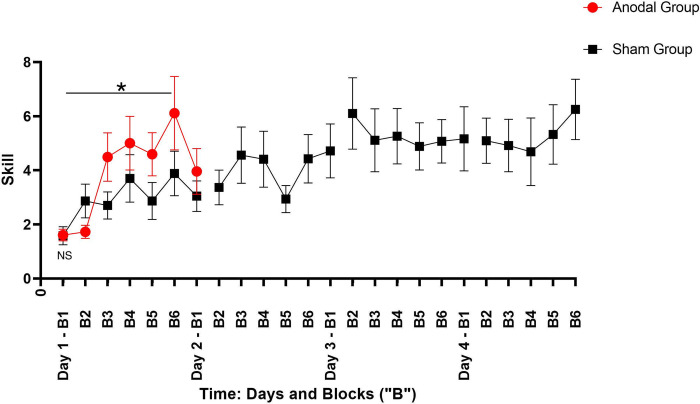
Practice is required to improve one's shooting technique in basketball or to play a musical instrument well. Learning these motor skills may be further enhanced by transcranial direct current stimulation (tDCS). We aimed to investigate whether tDCS leads to faster attainment of a motor skill, and to confirm prior work showing it improves skill acquisition and retention performance. Fifty-two participants were tested; half received tDCS with the anode on primary motor cortex and cathode on the contralateral forehead while concurrently practicing a sequential visuomotor isometric pinch force task on Day 1, while the other half received sham tDCS during practice. On Day 2, retention of the skill was tested. Results from a Kaplan-Meier survival analysis showed that participants in the anodal group attained a pre-defined target level of skill faster than participants in the sham group (χ2 = 9.117, p = 0.003). Results from a nonparametric rank-based regression analysis showed that the rate of improvement was greater in the anodal versus sham group during skill acquisition (F(1,249) = 5.90, p = 0.016), but there was no main effect of group or time. There was no main effect of group or time, or group by time interaction when comparing performance at the end of acquisition to retention. These findings suggest anodal tDCS improves performance more quickly during skill acquisition but does not have additional benefits on motor learning after a period of rest.
实践是提高篮球投篮技术或演奏乐器水平的必要条件。经颅直流电刺激(tDCS)可以进一步提高这些运动技能的学习效果。我们旨在研究 tDCS 是否能更快地掌握运动技能,并验证先前的研究表明其可以提高技能的习得和保持表现。共有 52 名参与者接受了测试;一半的参与者在第 1 天接受了阳极置于初级运动皮层、阴极置于对侧额头上的 tDCS,同时在进行顺序视觉运动等长捏力任务的练习,而另一半参与者在练习过程中接受了假 tDCS。第 2 天,测试了技能的保持情况。Kaplan-Meier 生存分析的结果表明,与假刺激组相比,阳极刺激组的参与者更快地达到了预先设定的技能水平(χ2=9.117,p=0.003)。非参数等级回归分析的结果表明,在技能习得过程中,阳极刺激组的改善速度快于假刺激组(F(1,249)=5.90,p=0.016),但组间或时间无主效应。在比较习得结束时的表现与保持时,组间或时间均无主效应,也无组间-时间交互效应。这些发现表明,阳极 tDCS 在技能习得过程中可以更快地提高表现,但在一段时间的休息后,对运动学习没有额外的益处。