Department of Conservative Dentistry, College of Dentistry, University of Mosul, Mosul, Iraq.
Clin Exp Dent Res. 2022 Dec;8(6):1413-1420. doi: 10.1002/cre2.658. Epub 2022 Sep 13.
Mechanical properties are cardinal for the long-term clinical success of laminate veneer restorations but the selection of new restorative materials should ideally be based on clinical evidence, therefore, in vitro testing of dental materials is a good alternative to evaluate their properties and understand their behavior so this study aimed to compare and evaluate the effect of two different thicknesses and yttria percentage on the fracture resistance of laminate veneer zirconia restorations.
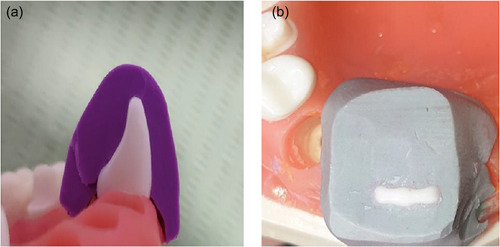
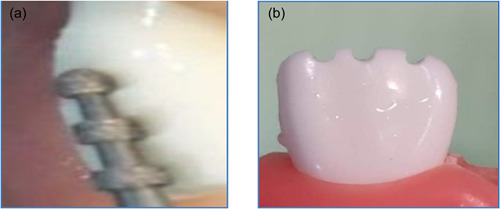
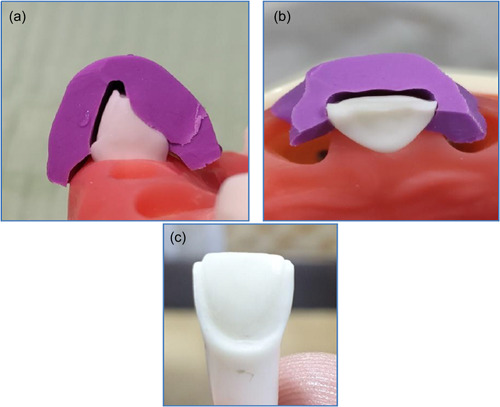
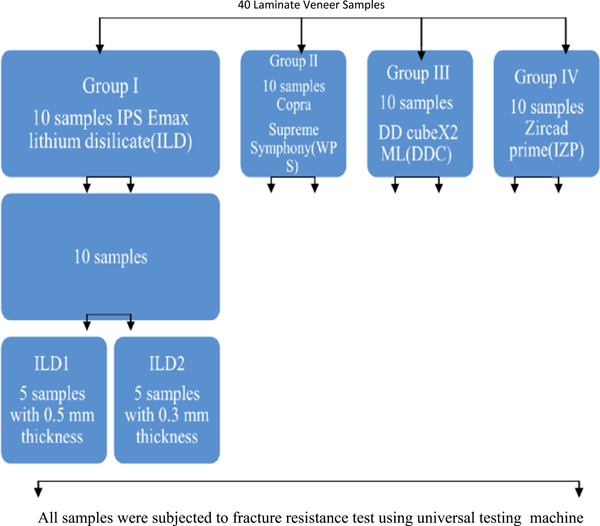
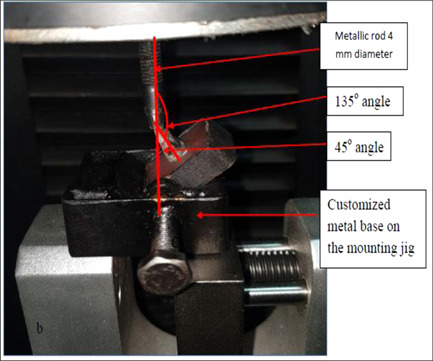
Forty laminate veneer restoration prepared from partial sintering zirconia of 3Y (yttria), 5Y (yttria), combined 3Y&5Y (yttria), and lithium disilicate. Specimens were assigned into four main groups according to their percentage of yttria content (n = 10) and subgrouped into two thicknesses (0.5 mm thickness and 0.3 mm thickness) (n = 5) as follows: Group I, II, III, and IV (Group I for lithium disilicate (control), Group II for 3Y zirconia, Group III for 5Y zirconia, and Group IV for combined 3Y&5Y zirconia), each of them subdivided according to their thickness into two subgroups (n = 5 for each one) and resistance to fracture for each restoration was evaluated using a universal testing machine. Data were analyzed using a one-way analysis of variance and Duncan's tests at a 5% level of significance.
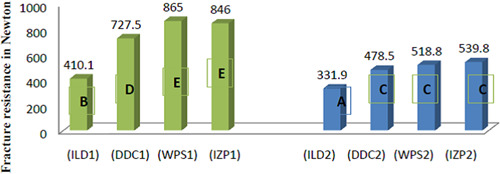
The thickness of laminate veneer restoration significantly affects the fracture resistance value of all type of laminate veneers restorations (fracture resistance mean value was highest for 0.5 mm thickness and lower for 0.3 mm thickness restorations) and yttria percentage significantly affect fracture resistance value of zirconia laminate veneer restorations (fracture resistance mean value was highest for 0.5 mm thickness of 3Y zirconia [865 N] and combined 3Y&5Y zirconia [846 N]).
Reducing the thickness of laminate zirconia veneer restorations to 0.3 mm reduces its fracture resistance and increasing yttria percentage had an adverse effect on fracture resistance of zirconia laminate veneer restorations.
机械性能是层压贴面修复体长期临床成功的关键,但新修复材料的选择理想情况下应基于临床证据,因此,牙科材料的体外测试是评估其性能和了解其行为的良好替代方法,因此本研究旨在比较和评估两种不同厚度和氧化钇百分比对层压贴面氧化锆修复体抗断裂能力的影响。
从部分烧结氧化锆 3Y(氧化钇)、5Y(氧化钇)、3Y&5Y(氧化钇)和锂硅二酸盐中制备了 40 个层压贴面修复体。根据氧化钇含量的百分比(n=10),将样本分为四个主要组,并按两个厚度(0.5mm 厚度和 0.3mm 厚度)(n=5)分为亚组:第 I、II、III 和 IV 组(第 I 组为锂硅二酸盐(对照),第 II 组为 3Y 氧化锆,第 III 组为 5Y 氧化锆,第 IV 组为 3Y&5Y 氧化锆),每组根据厚度进一步分为两个亚组(每组 n=5),并使用万能试验机评估每种修复体的断裂阻力。使用单向方差分析和邓肯检验在 5%的显著水平下对数据进行分析。
层压贴面修复体的厚度显著影响所有类型层压贴面修复体的断裂阻力值(0.5mm 厚度的修复体断裂阻力平均值最高,0.3mm 厚度的修复体断裂阻力平均值较低),氧化钇百分比显著影响氧化锆层压贴面修复体的断裂阻力值(0.5mm 厚度的 3Y 氧化锆[865N]和 3Y&5Y 氧化锆[846N]的断裂阻力平均值最高)。
将层压氧化锆贴面修复体的厚度减少到 0.3mm 会降低其断裂阻力,而增加氧化钇百分比会对氧化锆层压贴面修复体的断裂阻力产生不利影响。