Department of Pulmonary and Critical Care Medicine, The Third Affiliated Hospital of Sun Yat-Sen University, Institute of Respiratory Disease of Sun Yat-Sen University, NO.600 Tianhe Road, Guangzhou, 510630, Guangdong, China.
Respir Res. 2022 Sep 13;23(1):244. doi: 10.1186/s12931-022-02167-7.
Epithelial-mesenchymal transition (EMT) is one of the mechanisms of airway remodeling in chronic asthma. Interleukin (IL)-24 has been implicated in the promotion of tissue fibrosis, and increased IL-24 levels have been observed in the nasal secretions and sputum of asthmatic patients. However, the role of IL-24 in asthmatic airway remodeling, especially in EMT, remains largely unknown. We aimed to explore the effect and mechanism of IL-24 on EMT and to verify whether IL-37 could alleviate IL-24-induced EMT in chronic asthma.
BEAS-2B cells were exposed to IL-24, and cell migration was assessed by wound healing and Transwell assays. The expression of EMT-related biomarkers (E-cadherin, vimentin, and α-SMA) was evaluated after the cells were stimulated with IL-24 with or without IL-37. A murine asthma model was established by intranasal administration of house dust mite (HDM) extracts for 5 weeks, and the effects of IL-24 and IL-37 on EMT and airway remodeling were investigated by intranasal administration of si-IL-24 and rhIL-37.
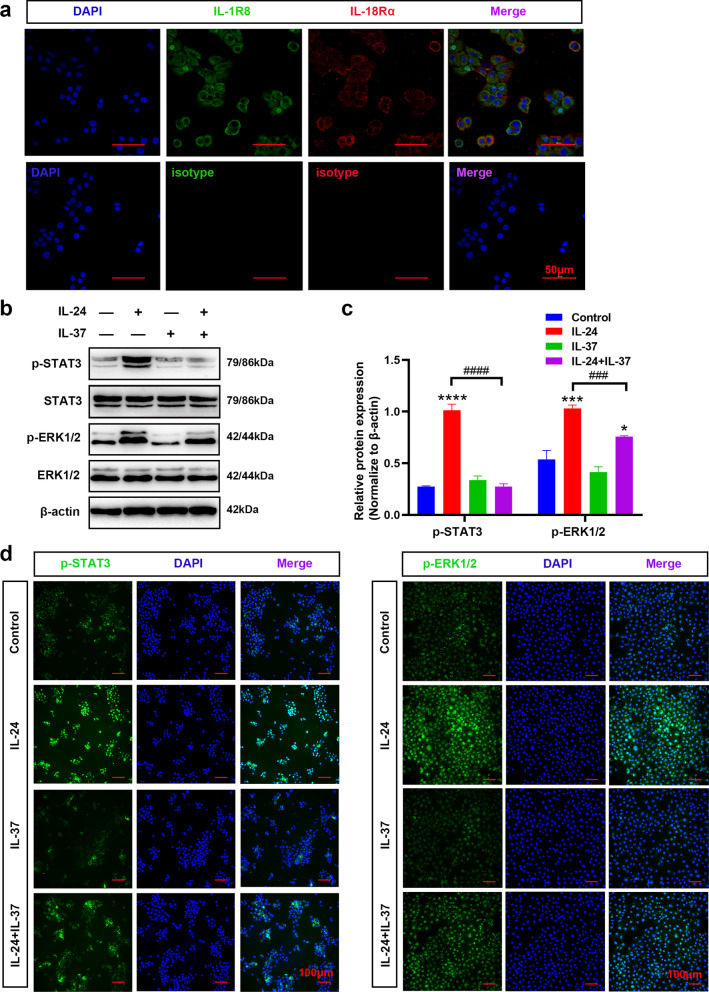
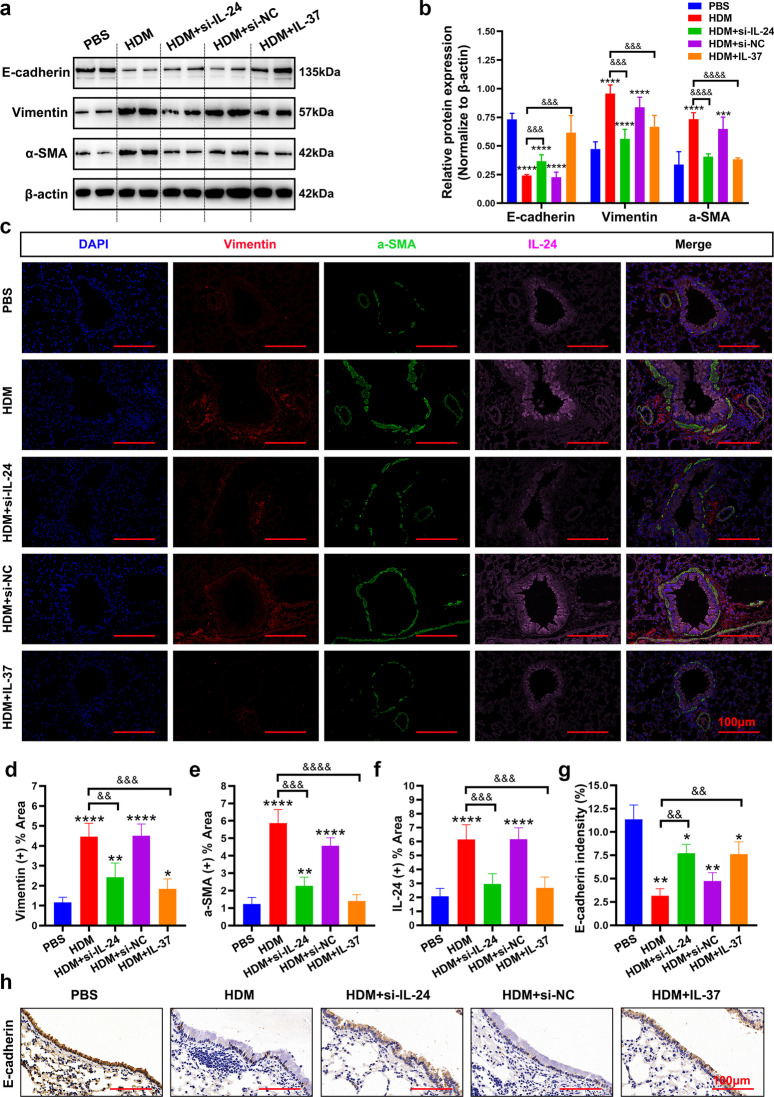
We observed that IL-24 significantly enhanced the migration of BEAS-2B cells in vitro. IL-24 promoted the expression of the EMT biomarkers vimentin and α-SMA via the STAT3 and ERK1/2 pathways. In addition, we found that IL-37 partially reversed IL-24-induced EMT in BEAS-2B cells by blocking the ERK1/2 and STAT3 pathways. Similarly, the in vivo results showed that IL-24 was overexpressed in the airway epithelium of an HDM-induced chronic asthma model, and IL-24 silencing or IL-37 treatment could reverse EMT biomarker expression.
Overall, these findings indicated that IL-37 mitigated HDM-induced airway remodeling by inhibiting IL-24-mediated EMT via the ERK1/2 and STAT3 pathways, thereby providing experimental evidence for IL-24 as a novel therapeutic target and IL-37 as a promising agent for treating severe asthma.
上皮-间充质转化(EMT)是慢性哮喘气道重塑的机制之一。白细胞介素(IL)-24 已被牵涉到组织纤维化的促进中,并且在哮喘患者的鼻分泌物和痰液中观察到 IL-24 水平升高。然而,IL-24 在哮喘气道重塑中的作用,特别是 EMT 方面,仍然很大程度上未知。我们旨在探讨 IL-24 对 EMT 的影响和机制,并验证 IL-37 是否可以缓解慢性哮喘中 IL-24 诱导的 EMT。
BEAS-2B 细胞暴露于 IL-24 中,并通过划痕愈合和 Transwell 测定评估细胞迁移。在用或不用 IL-37 刺激细胞后,评估 EMT 相关生物标志物(E-钙粘蛋白、波形蛋白和α-SMA)的表达。通过鼻腔内给予屋尘螨(HDM)提取物 5 周建立小鼠哮喘模型,并通过鼻腔内给予 si-IL-24 和 rhIL-37 研究 IL-24 和 IL-37 对 EMT 和气道重塑的影响。
我们观察到 IL-24 显著增强了 BEAS-2B 细胞的体外迁移。IL-24 通过 STAT3 和 ERK1/2 途径促进 EMT 生物标志物 vimentin 和 α-SMA 的表达。此外,我们发现 IL-37 通过阻断 ERK1/2 和 STAT3 途径部分逆转了 BEAS-2B 细胞中 IL-24 诱导的 EMT。同样,体内结果表明,IL-24 在 HDM 诱导的慢性哮喘模型的气道上皮中过度表达,IL-24 沉默或 IL-37 治疗可逆转 EMT 生物标志物的表达。
总体而言,这些发现表明,IL-37 通过抑制 IL-24 介导的 EMT 来减轻 HDM 诱导的气道重塑,通过 ERK1/2 和 STAT3 途径,从而为 IL-24 作为一种新的治疗靶标和 IL-37 作为一种治疗严重哮喘的有前途的药物提供了实验证据。