Hew Khe Foon, Huang Weijiao, Du Jiahui, Jia Chengyuan
The University of Hong Kong, Pokfulam Road, Hong Kong, SAR China.
College of Education, Zhejiang University, Hangzhou, China.
J Comput High Educ. 2023;35(1):40-68. doi: 10.1007/s12528-022-09338-x. Epub 2022 Sep 9.
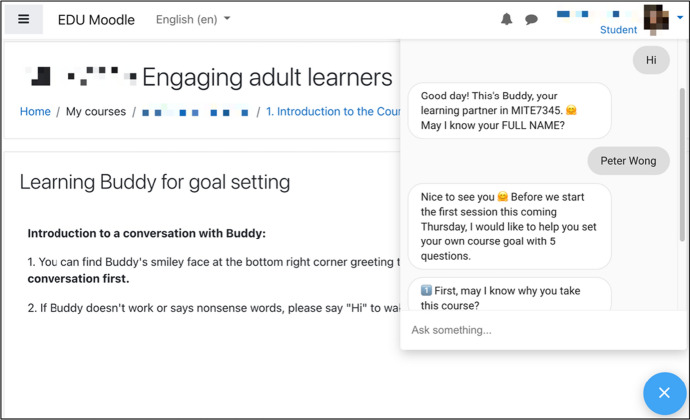
Although fully online learning is now the 'new normal' in many parts of the world, its implementation is often beset by challenges such as the lack of student self-regulation, and the sense of isolation. In this paper, we explored the use of chatbots to support student goal setting (Study 1) and social presence (Study 2) in online activities. In Study 1, participants in a fully online course were invited to complete a goal setting activity prior to attending class via a chatbot. The chatbot engaged participants with five questions developed based on the SMART (specific, measurable, achievable, realistic, and timely) goal setting framework. In Study 2, English-as-Foreign-Language participants in a fully online course were tasked to complete listening practices. The chatbot was designed based on the social presence framework (interpersonal communication, open communication, cohesive communication) to guide students through listening exercises. In both Study 1 and 2, we evaluated participants' behavioral engagement by measuring their conversation records with the chatbots, as well as participants' perceived usefulness and ease of use of the chatbots. We also gathered in-depth interview data concerning the participants' perceptions of interacting with the chatbots. Overall, our findings found positive learner experiences with both chatbots with regard to the chatbots' perceived usefulness and perceived ease of use. We also provided suggestions for instructors to apply chatbots in teaching and learning.
尽管如今在世界许多地方,完全在线学习已成为“新常态”,但其实施往往受到诸多挑战困扰,比如学生缺乏自我管理能力以及孤独感。在本文中,我们探讨了使用聊天机器人来支持在线活动中的学生目标设定(研究1)和社交临场感(研究2)。在研究1中,邀请一门完全在线课程的参与者在上课前通过聊天机器人完成一项目标设定活动。该聊天机器人通过基于SMART(具体、可衡量、可实现、现实和及时)目标设定框架开发的五个问题与参与者互动。在研究2中,要求一门完全在线课程中的非英语母语参与者完成听力练习。聊天机器人基于社交临场感框架(人际沟通、开放沟通、凝聚性沟通)设计,以引导学生完成听力练习。在研究1和研究2中,我们通过测量参与者与聊天机器人的对话记录来评估他们的行为参与度,以及参与者对聊天机器人的感知有用性和易用性。我们还收集了有关参与者对与聊天机器人互动的看法的深度访谈数据。总体而言,我们的研究结果发现,参与者在聊天机器人的感知有用性和感知易用性方面对这两种聊天机器人都有积极的学习体验。我们还为教师在教学中应用聊天机器人提供了建议。