Pediatric Infectious and Tropical Diseases Department, Hospital Universitario La Paz, Institute for Health Research IdiPAZ, Translational Research Network in Pediatric Infectious Diseases (RITIP), Center for Biomedical Network Research On Rare Diseases (CIBERER U767, Instituto de Salud Carlos III), Madrid, Spain.
Pediatric Infectious and Tropical Diseases Department, Hospital Universitario La Paz, Madrid, Spain.
Eur J Pediatr. 2022 Nov;181(11):3889-3898. doi: 10.1007/s00431-022-04614-5. Epub 2022 Sep 14.
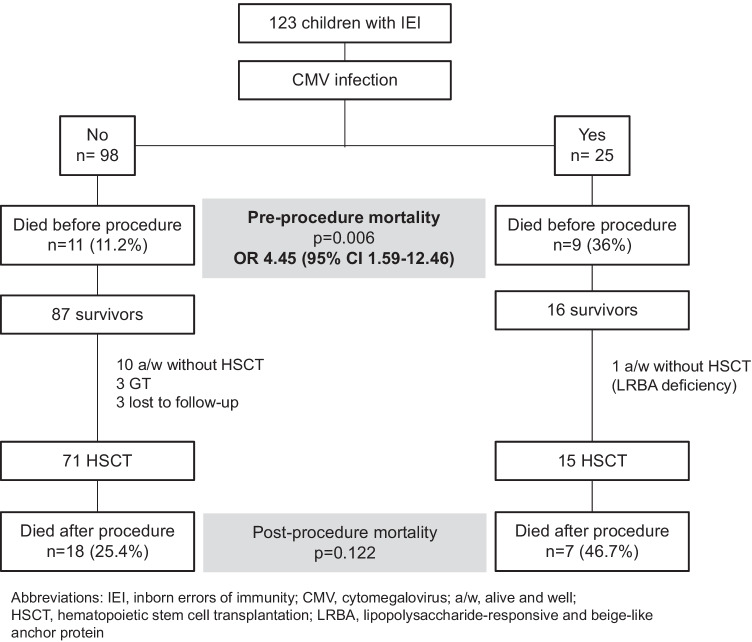
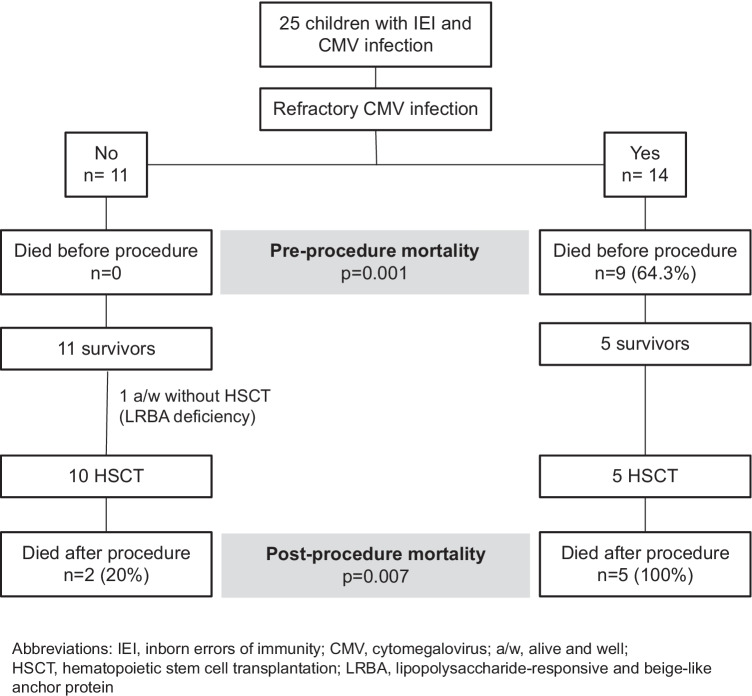
The presence of active viral infections has an impact on the prognosis of patients undergoing hematopoietic stem cell transplantation (HSCT). Nevertheless, the number of reports of cytomegalovirus infection in patients with inborn errors of immunity (IEI) who undergo HSCT is relatively low. To analyze the effect of cytomegalovirus infection acquired prior to curative treatment on patient survival in 123 children with IEI. An observational and retrospective study was performed with patients younger than 18 years diagnosed with IEI who were candidates for HSCT, gene therapy, or thymus transplantation at five hospitals in Spain between 2008 and 2019. We included 123 children, 25 infected by cytomegalovirus prior to undergoing curative treatment (20.3%). At IEI diagnosis, 24 of the patients were already infected, 21 of whom had symptomatic cytomegalovirus disease (87%), while the other three patients developed disease before undergoing curative treatment. The patients with cytomegalovirus infection had higher mortality than those without (p = 0.006). Fourteen patients developed refractory cytomegalovirus infection (56%), all of whom died, while no patients with non-refractory infection died (p = 0.001) All deaths that occurred before curative treatment and three of the five after the treatment were attributed to cytomegalovirus. Patients with refractory cytomegalovirus disease had the highest pre-HSCT mortality rate (64.3%), compared with the non-infected children and those with non-refractory cytomegalovirus disease (10.1%) (p < 0.0001).
Prevention and prompt control of cytomegalovirus infection, together with early HSCT/gene therapy, are crucial for improving the prognosis in children with IEI.
• Cytomegalovirus is the most frequent viral infection in children with inborn errors of immunity who are candidates to hematopoietic stem cell transplantation (HSCT). • Active viral infections at the time of HSCT lead to worse prognosis.
• In children with inborn errors of immunity and indication of HSCT, refractory cytomegalovirus disease is associated with a very high mortality rate, compared with non-infected children and those with non-refractory cytomegalovirus disease. • In patients with novel transplantation indications, the presence and treatment response of CMV infection should be considered to decide the best possible moment for HSCT.
病毒感染的存在会影响接受造血干细胞移植(HSCT)的患者的预后。然而,在接受 HSCT 的先天性免疫缺陷(IEI)患者中,巨细胞病毒(CMV)感染的报告数量相对较少。分析 123 例 IEI 患者在根治性治疗前获得的 CMV 感染对患者生存的影响。在西班牙五家医院对 2008 年至 2019 年期间接受 HSCT、基因治疗或胸腺移植候选的年龄小于 18 岁的 IEI 诊断为 IEI 的患者进行了一项观察性和回顾性研究。我们纳入了 123 例儿童,其中 25 例在接受根治性治疗前被 CMV 感染(20.3%)。在 IEI 诊断时,24 例患者已被感染,其中 21 例有症状性 CMV 疾病(87%),而其他 3 例在接受根治性治疗前出现疾病。CMV 感染患者的死亡率高于未感染者(p=0.006)。14 例患者发生难治性 CMV 感染(56%),均死亡,而非难治性感染患者无死亡(p=0.001)。所有发生在根治性治疗前的死亡和治疗后的 5 例死亡均归因于 CMV。难治性 CMV 疾病患者在 HSCT 前的死亡率最高(64.3%),高于未感染者和非难治性 CMV 疾病患者(10.1%)(p<0.0001)。
预防和及时控制 CMV 感染,以及早期进行 HSCT/基因治疗,对于改善 IEI 儿童的预后至关重要。
CMV 是候选造血干细胞移植(HSCT)的先天性免疫缺陷(IEI)儿童中最常见的病毒感染。HSCT 时的活动性病毒感染会导致预后较差。
在有 IEI 且有 HSCT 指征的儿童中,与未感染者和非难治性 CMV 疾病患者相比,难治性 CMV 疾病与极高的死亡率相关。在具有新移植指征的患者中,应考虑 CMV 感染的存在和治疗反应,以确定 HSCT 的最佳时机。