• 文献检索
  • 文档翻译
  • 深度研究
  • 学术资讯
  • Suppr Zotero 插件Zotero 插件
  • 邀请有礼
  • 套餐&价格
  • 历史记录
应用&插件
Suppr Zotero 插件Zotero 插件浏览器插件Mac 客户端Windows 客户端微信小程序
定价
高级版会员购买积分包购买API积分包
服务
文献检索文档翻译深度研究API 文档MCP 服务
关于我们
关于 Suppr公司介绍联系我们用户协议隐私条款
关注我们

Suppr 超能文献

核心技术专利:CN118964589B侵权必究
粤ICP备2023148730 号-1Suppr @ 2026

文献检索

告别复杂PubMed语法,用中文像聊天一样搜索,搜遍4000万医学文献。AI智能推荐,让科研检索更轻松。

立即免费搜索

文件翻译

保留排版,准确专业,支持PDF/Word/PPT等文件格式,支持 12+语言互译。

免费翻译文档

深度研究

AI帮你快速写综述,25分钟生成高质量综述,智能提取关键信息,辅助科研写作。

立即免费体验

用于预测血源感染中革兰氏阳性或革兰氏阴性细菌的常规实验室生物标志物。

Routine laboratory biomarkers used to predict Gram-positive or Gram-negative bacteria involved in bloodstream infections.

机构信息

Laboratório de Microbiologia, Department of Basic Health Sciences, State University of Maringá, Avenida Colombo 5790, Maringá, Paraná, 87020-900, Brazil.

Maringá University Hospital, State University of Maringá, Maringá, Paraná, Brazil.

出版信息

Sci Rep. 2022 Sep 14;12(1):15466. doi: 10.1038/s41598-022-19643-1.

DOI:10.1038/s41598-022-19643-1
PMID:36104449
原文链接:https://pmc.ncbi.nlm.nih.gov/articles/PMC9474441/
Abstract

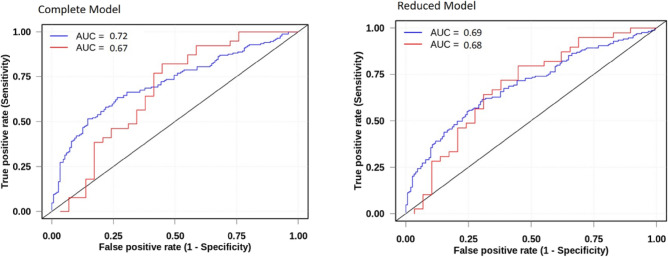
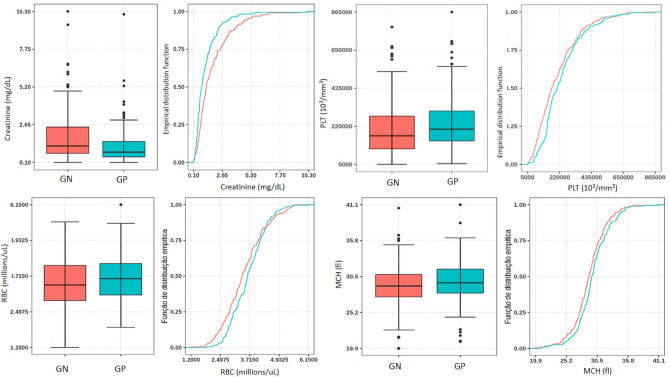
This study evaluated routine laboratory biomarkers (RLB) to predict the infectious bacterial group, Gram-positive (GP) or Gram-negative (GN) associated with bloodstream infection (BSI) before the result of blood culture (BC). A total of 13,574 BC of 6787 patients (217 BSI-GP and 238 BSI-GN) and 68 different RLB from these were analyzed. The logistic regression model was built considering BSI-GP or BSI-GN as response variable and RLB as covariates. After four filters applied total of 320 patients and 16 RLB remained in the Complete-Model-CM, and 4 RLB in the Reduced-Model-RM (RLB p > 0.05 excluded). In the RM, only platelets, creatinine, mean corpuscular hemoglobin and erythrocytes were used. The reproductivity of both models were applied to a test bank of 2019. The new model presented values to predict BSI-GN of the area under the curve (AUC) of 0.72 and 0.69 for CM and RM, respectively; with sensitivity of 0.62 and 0.61 (CM and RM) and specificity of 0.67 for both. These data confirm the discriminatory capacity of the new models for BSI-GN (p = 0.64). AUC of 0.69 using only 4 RLB, associated with the patient's clinical data could be useful for better targeted antimicrobial therapy in BSI.

摘要

本研究评估了常规实验室生物标志物(RLB),以在血液培养(BC)结果之前预测与血流感染(BSI)相关的感染性细菌群,革兰氏阳性(GP)或革兰氏阴性(GN)。分析了来自 6787 名患者的 13574 次 BC(217 次 BSI-GP 和 238 次 BSI-GN)和 68 种不同的 RLB。考虑到 BSI-GP 或 BSI-GN 作为因变量和 RLB 作为协变量,构建了逻辑回归模型。经过四个过滤器的应用,共有 320 名患者和 16 个 RLB 留在完整模型-CM 中,而简化模型-RM 中则有 4 个 RLB(排除 RLB p > 0.05)。在 RM 中,仅使用血小板、肌酐、平均红细胞血红蛋白和红细胞。这两个模型的重现性都应用于 2019 年的测试库。新模型对革兰氏阴性菌血流感染(BSI-GN)的预测表现出 0.72 和 0.69 的曲线下面积(AUC)值;CM 和 RM 的敏感性分别为 0.62 和 0.61,特异性均为 0.67。这些数据证实了新模型对 BSI-GN 的区分能力(p=0.64)。仅使用 4 个 RLB 获得的 0.69 AUC,与患者的临床数据相结合,可能有助于在 BSI 中更好地靶向抗菌治疗。

https://cdn.ncbi.nlm.nih.gov/pmc/blobs/53c3/9474441/86e5a90b04e2/41598_2022_19643_Fig3_HTML.jpg
https://cdn.ncbi.nlm.nih.gov/pmc/blobs/53c3/9474441/4bf0a6682d9b/41598_2022_19643_Fig1_HTML.jpg
https://cdn.ncbi.nlm.nih.gov/pmc/blobs/53c3/9474441/ebbe11940eb1/41598_2022_19643_Fig2_HTML.jpg
https://cdn.ncbi.nlm.nih.gov/pmc/blobs/53c3/9474441/86e5a90b04e2/41598_2022_19643_Fig3_HTML.jpg
https://cdn.ncbi.nlm.nih.gov/pmc/blobs/53c3/9474441/4bf0a6682d9b/41598_2022_19643_Fig1_HTML.jpg
https://cdn.ncbi.nlm.nih.gov/pmc/blobs/53c3/9474441/ebbe11940eb1/41598_2022_19643_Fig2_HTML.jpg
https://cdn.ncbi.nlm.nih.gov/pmc/blobs/53c3/9474441/86e5a90b04e2/41598_2022_19643_Fig3_HTML.jpg

相似文献

1
Routine laboratory biomarkers used to predict Gram-positive or Gram-negative bacteria involved in bloodstream infections.用于预测血源感染中革兰氏阳性或革兰氏阴性细菌的常规实验室生物标志物。
Sci Rep. 2022 Sep 14;12(1):15466. doi: 10.1038/s41598-022-19643-1.
2
The clinical value of IL-3, IL-4, IL-12p70, IL17A, IFN-γ, MIP-1β, NLR, P-selectin, and TNF-α in differentiating bloodstream infections caused by gram-negative, gram-positive bacteria and fungi in hospitalized patients: An Observational Study.IL-3、IL-4、IL-12p70、IL17A、IFN-γ、MIP-1β、中性粒细胞与淋巴细胞比值(NLR)、P-选择素及肿瘤坏死因子-α(TNF-α)在区分住院患者革兰阴性菌、革兰阳性菌及真菌所致血流感染中的临床价值:一项观察性研究
Medicine (Baltimore). 2019 Sep;98(38):e17315. doi: 10.1097/MD.0000000000017315.
3
Combined procalcitonin and hemogram parameters contribute to early differential diagnosis of Gram-negative/Gram-positive bloodstream infections.降钙素原和全血细胞参数联合有助于早期鉴别革兰阴性菌/革兰阳性菌血流感染。
J Clin Lab Anal. 2021 Sep;35(9):e23927. doi: 10.1002/jcla.23927. Epub 2021 Aug 6.
4
Pcv-aCO and procalcitonin levels for the early diagnosis of bloodstream infections caused by gram-negative bacteria.降钙素原和血培养阴性需氧菌引起血流感染的早期诊断。
Am J Med Sci. 2022 Dec;364(6):752-757. doi: 10.1016/j.amjms.2022.07.014. Epub 2022 Jul 30.
5
Rapid testing using the Verigene Gram-negative blood culture nucleic acid test in combination with antimicrobial stewardship intervention against Gram-negative bacteremia.使用Verigene革兰氏阴性血培养核酸检测进行快速检测并联合抗菌药物管理干预以应对革兰氏阴性菌血症。
Antimicrob Agents Chemother. 2015 Mar;59(3):1588-95. doi: 10.1128/AAC.04259-14. Epub 2014 Dec 29.
6
Evaluation of early clinical failure criteria for gram-negative bloodstream infections.革兰氏阴性菌血流感染早期临床失败标准的评估。
Clin Microbiol Infect. 2020 Jan;26(1):73-77. doi: 10.1016/j.cmi.2019.05.017. Epub 2019 May 31.
7
Follow-up blood culture in Gram-negative bacilli bacteraemia: for whom is follow-up blood culture useful?革兰氏阴性杆菌菌血症的后续血培养:哪些患者的后续血培养有用?
Curr Opin Infect Dis. 2022 Dec 1;35(6):552-560. doi: 10.1097/QCO.0000000000000865. Epub 2022 Aug 3.
8
The Hypothetical Impact of Accelerate Pheno on Time to Effective Therapy and Time to Definitive Therapy for Bloodstream Infections Due to Drug-Resistant Gram-Negative Bacilli.耐药革兰氏阴性杆菌血流感染的有效治疗时间和确定性治疗时间因 Accelerate Pheno 而产生的假设性影响。
Antimicrob Agents Chemother. 2019 Feb 26;63(3). doi: 10.1128/AAC.01477-18. Print 2019 Mar.
9
Risk factors for positive follow-up blood cultures in Gram-negative bacteremia among immunocompromised patients with neutropenia.中性粒细胞减少的免疫功能低下患者革兰阴性菌血症随访血培养阳性的危险因素。
Transpl Infect Dis. 2024 Feb;26(1):e14203. doi: 10.1111/tid.14203. Epub 2023 Nov 27.
10
Procalcitonin is useful in driving the choice of early antibiotic treatment in patients with bloodstream infections.降钙素原有助于指导血流感染患者早期抗生素治疗的选择。
Eur Rev Med Pharmacol Sci. 2018 May;22(10):3130-3137. doi: 10.26355/eurrev_201805_15072.

引用本文的文献

1
Leveraging innovative diagnostics as a tool to contain superbugs.利用创新诊断方法作为遏制超级细菌的工具。
Antonie Van Leeuwenhoek. 2025 Mar 26;118(4):63. doi: 10.1007/s10482-025-02075-y.
2
Identifying key blood markers for bacteremia in elderly patients: insights into bacterial pathogens.识别老年患者菌血症的关键血液标志物:对细菌病原体的见解
Front Cell Infect Microbiol. 2025 Jan 16;14:1472765. doi: 10.3389/fcimb.2024.1472765. eCollection 2024.
3
Exploring the clinical value of procalcitonin, c-reactive protein, white blood cell count, and neutrophil-to-lymphocyte ratio in the early diagnosis of bloodstream infections in children.

本文引用的文献

1
Surviving sepsis campaign: international guidelines for management of sepsis and septic shock 2021.拯救脓毒症运动:2021年脓毒症和脓毒性休克国际管理指南
Intensive Care Med. 2021 Nov;47(11):1181-1247. doi: 10.1007/s00134-021-06506-y. Epub 2021 Oct 2.
2
Developing Machine-Learning Prediction Algorithm for Bacteremia in Admitted Patients.开发住院患者菌血症的机器学习预测算法。
Infect Drug Resist. 2021 Feb 25;14:757-765. doi: 10.2147/IDR.S293496. eCollection 2021.
3
Hematological parameters in patients with bloodstream infection: A retrospective observational study.
探讨降钙素原、C反应蛋白、白细胞计数及中性粒细胞与淋巴细胞比值在儿童血流感染早期诊断中的临床价值。
BMC Pediatr. 2025 Jan 24;25(1):62. doi: 10.1186/s12887-025-05402-4.
4
Epidemiology and drug resistance analysis of bloodstream infections in an intensive care unit from a children's medical center in Eastern China for six consecutive years.六年连续监测华东地区某儿童医院重症监护病房血流感染的流行病学和耐药性分析。
Int Microbiol. 2024 Oct;27(5):1345-1355. doi: 10.1007/s10123-024-00481-2. Epub 2024 Jan 18.
5
Procalcitonin and C-reactive protein as diagnostic biomarkers in COVID-19 and Non-COVID-19 sepsis patients: a comparative study.降钙素原和 C 反应蛋白作为 COVID-19 和非 COVID-19 脓毒症患者的诊断生物标志物:一项比较研究。
BMC Infect Dis. 2024 Jan 4;24(1):45. doi: 10.1186/s12879-023-08962-x.
6
Development and validation of a nomogram for predicting gram-negative bacterial infections in patients with peritoneal dialysis-associated peritonitis.预测腹膜透析相关性腹膜炎患者革兰氏阴性菌感染的列线图的开发与验证
Heliyon. 2023 Jul 23;9(8):e18551. doi: 10.1016/j.heliyon.2023.e18551. eCollection 2023 Aug.
血流感染患者的血液学参数:一项回顾性观察研究。
J Infect Dev Ctries. 2020 Nov 30;14(11):1264-1273. doi: 10.3855/jidc.12811.
4
Follow-up blood cultures are associated with improved outcome of patients with gram-negative bloodstream infections: retrospective observational cohort study.随访血培养与革兰氏阴性菌血流感染患者转归改善相关:回顾性观察性队列研究。
Clin Microbiol Infect. 2020 Jul;26(7):897-903. doi: 10.1016/j.cmi.2020.01.023. Epub 2020 Jan 30.
5
Role of procalcitonin in predicting etiology in bacteremic patients: Report from a large single-center experience.降钙素原在菌血症患者病因预测中的作用:来自一项大型单中心经验的报告。
J Infect Public Health. 2020 Jan;13(1):40-45. doi: 10.1016/j.jiph.2019.06.003. Epub 2019 Jun 24.
6
Clinical Value of Whole Blood Procalcitonin Using Point of Care Testing, Quick Sequential Organ Failure Assessment Score, C-Reactive Protein and Lactate in Emergency Department Patients with Suspected Infection.即时检测全血降钙素原、快速序贯器官衰竭评估评分、C反应蛋白和乳酸在急诊科疑似感染患者中的临床价值
J Clin Med. 2019 Jun 12;8(6):833. doi: 10.3390/jcm8060833.
7
Early Blood Biomarkers to Improve Sepsis/Bacteremia Diagnostics in Pediatric Emergency Settings.早期血液生物标志物改善儿科急诊脓毒症/菌血症诊断。
Medicina (Kaunas). 2019 Apr 10;55(4):99. doi: 10.3390/medicina55040099.
8
Distribution of main Gram-positive pathogens causing bloodstream infections in United States and European hospitals during the SENTRY Antimicrobial Surveillance Program (2010-2016): concomitant analysis of oritavancin in vitro activity.哨兵抗菌监测计划(2010 - 2016年)期间美国和欧洲医院引起血流感染的主要革兰氏阳性病原体分布:奥利万星体外活性的伴随分析
J Chemother. 2018 Sep;30(5):280-289. doi: 10.1080/1120009X.2018.1516272.
9
A systematic review shows no performance benefit of machine learning over logistic regression for clinical prediction models.系统评价显示,机器学习在临床预测模型中并未优于逻辑回归。
J Clin Epidemiol. 2019 Jun;110:12-22. doi: 10.1016/j.jclinepi.2019.02.004. Epub 2019 Feb 11.
10
Accurate prediction of blood culture outcome in the intensive care unit using long short-term memory neural networks.使用长短时记忆神经网络准确预测重症监护病房的血培养结果。
Artif Intell Med. 2019 Jun;97:38-43. doi: 10.1016/j.artmed.2018.10.008. Epub 2018 Nov 9.