RIKEN Center for Emergent Matter Science (CEMS), Wako, Japan.
Department of Applied Chemistry, Graduate School of Engineering, Osaka University, Suita, Japan.
Nature. 2022 Sep;609(7927):502-506. doi: 10.1038/s41586-022-05132-y. Epub 2022 Sep 14.
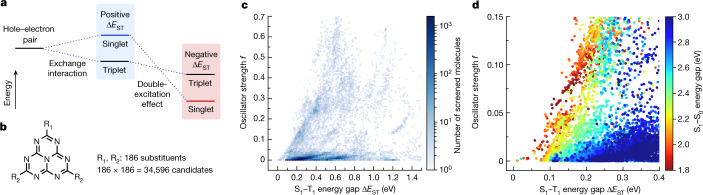
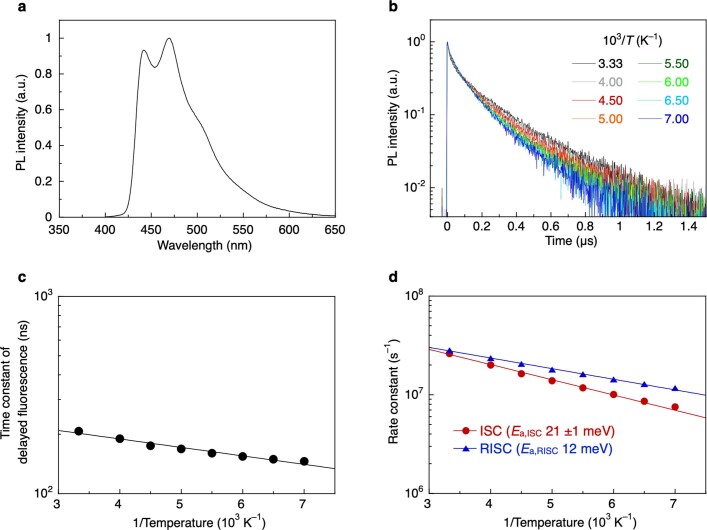
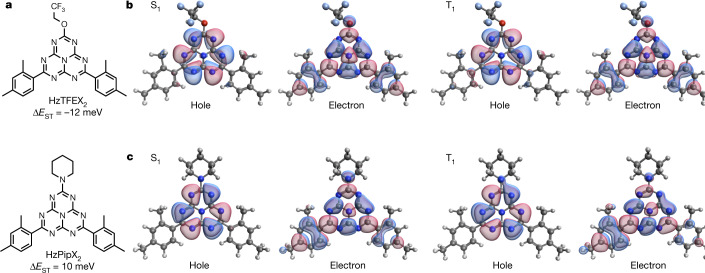
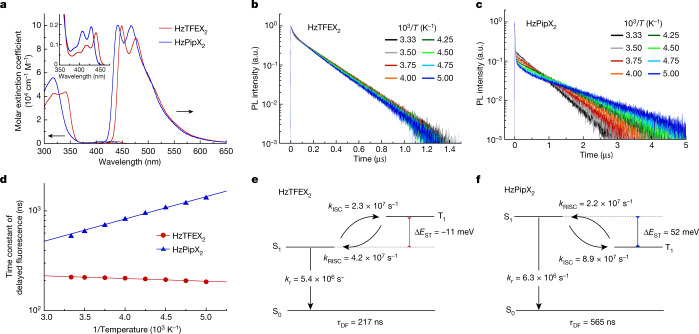
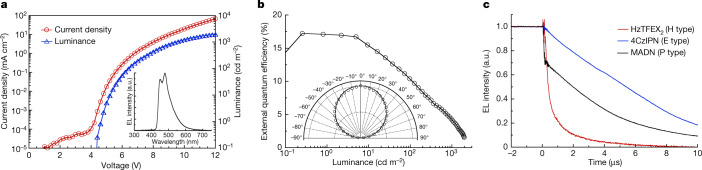
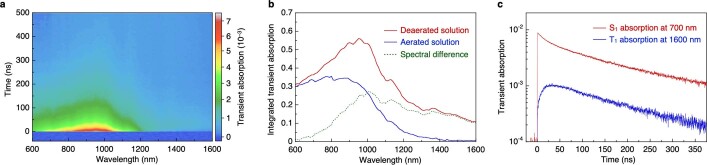
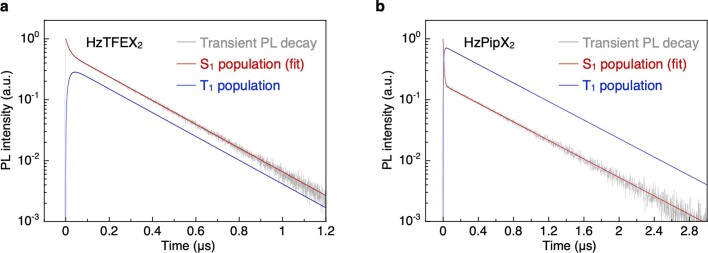
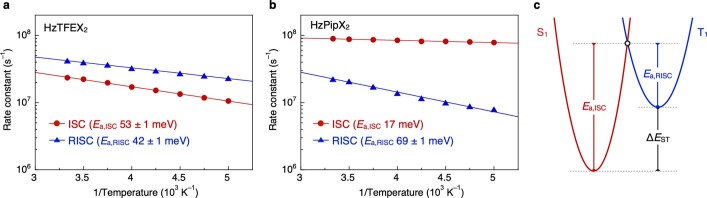
Hund's multiplicity rule states that a higher spin state has a lower energy for a given electronic configuration. Rephrasing this rule for molecular excited states predicts a positive energy gap between spin-singlet and spin-triplet excited states, as has been consistent with numerous experimental observations over almost a century. Here we report a fluorescent molecule that disobeys Hund's rule and has a negative singlet-triplet energy gap of -11 ± 2 meV. The energy inversion of the singlet and triplet excited states results in delayed fluorescence with short time constants of 0.2 μs, which anomalously decrease with decreasing temperature owing to the emissive singlet character of the lowest-energy excited state. Organic light-emitting diodes (OLEDs) using this molecule exhibited a fast transient electroluminescence decay with a peak external quantum efficiency of 17%, demonstrating its potential implications for optoelectronic devices, including displays, lighting and lasers.
洪特定则指出,对于给定的电子构型,高自旋态具有较低的能量。将这一规则重新表述为分子激发态,可以预测自旋单重态和三重态激发态之间存在正能隙,这一预测在近一个世纪以来与大量实验观察结果一致。在这里,我们报告了一种违反洪特定则的荧光分子,其单重态-三重态能隙为-11±2 毫电子伏特。单重态和三重态激发态的能量反转导致延迟荧光,其时间常数为 0.2 微秒,由于最低能量激发态具有单重态的发射性质,这些时间常数会异常随温度降低而减小。使用这种分子的有机发光二极管(OLED)表现出快速的瞬态电致发光衰减,其峰值外量子效率为 17%,这表明其在光电设备方面具有潜在的应用,包括显示器、照明和激光。