Department of Molecular Psychology, Institute of Psychology and Education, Ulm University, Ulm, Germany.
The Clinical Hospital of Chengdu Brain Science Institute, Ministry of Education Key Lab for Neuroinformation, University of Electronic Science and Technology of China, Chengdu, China.
Brain Behav. 2022 Oct;12(10):e2747. doi: 10.1002/brb3.2747. Epub 2022 Sep 15.
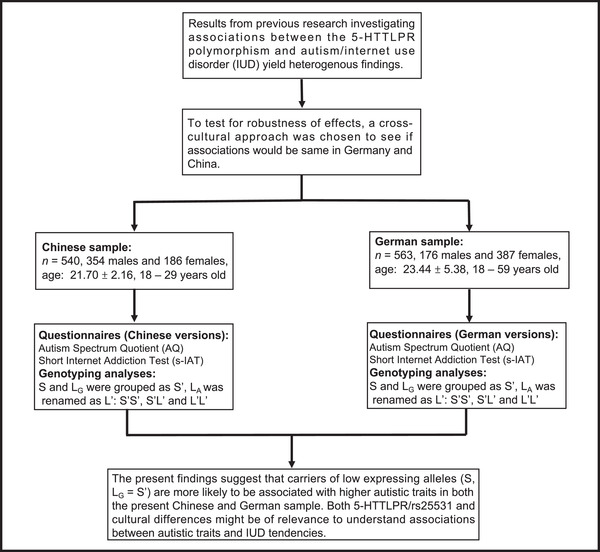
The serotonin transporter polymorphism 5-HTTLPR is an extensively investigated genetic marker of autistic traits or autism spectrum disorder, and recently has also been studied in the realm of internet use disorder (IUD), yet the findings remain controversial. Therefore, the present study aimed to explore associations between 5-HTTLPR (also including SNP rs25531) and autistic traits/IUD tendencies and to assess whether the relationship between autistic traits and IUD tendencies varies by this genetic marker in participants from China and Germany.
A total of 540 Chinese and 563 German subjects were genotyped for 5-HTTLPR/rs25531 and completed the Adult Autism Spectrum Quotient questionnaire and the short version of the Internet Addiction Test.
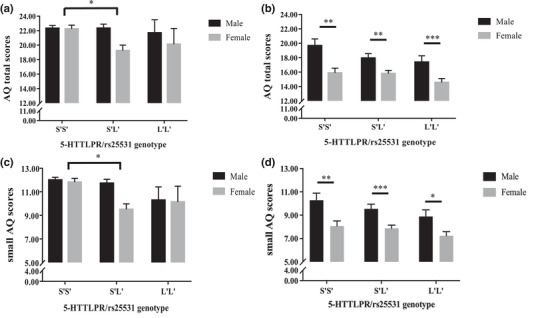
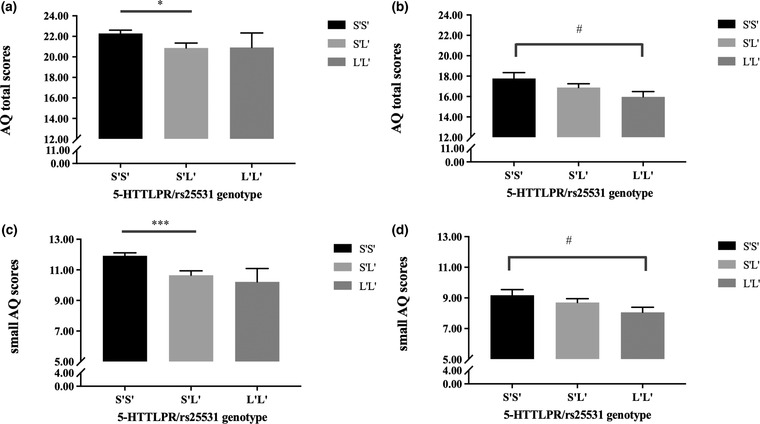
Carriers of the low expressing S'S' genotype (S, L ) showed significantly higher levels of autistic traits than the high expressing allele (e.g. L ) carriers in both samples. There was no significant effect of 5-HTTLPR/rs25531 on IUD either in the Chinese or Germany samples, whereas positive correlations between autistic traits and IUD varied by 5-HTTLPR/rs25531 genotypes and also differed between Chinese and German samples. In the Chinese sample, positive correlations were mainly driven by S'S' and S'L' carriers, while they were mainly determined by S'L' and L'L' carriers in the German sample. Further analyses revealed that the associations between autistic traits and IUD tended in parts to be more strongly pronounced in the complete German sample compared to the complete Chinese sample, and also varied depending on 5-HTTLPR/rs25531 genotypes (in S'S' carriers: China > Germany; in S'L' and L'L' carriers: China < Germany; both in terms of more positive associations).
Our findings suggest carriers of low expressing alleles (S, L ) are more likely to show higher autistic traits in both Chinese and German samples. Furthermore, the present work shows that both 5-HTTLPR/rs25531 and cultural differences might be of relevance to understand associations between autistic traits and IUD tendencies, but this needs to be further backed up.
5-羟色胺转运体基因多态性 5-HTTLPR 是广泛研究的自闭症特征或自闭症谱系障碍的遗传标志物,最近也在网络使用障碍(IUD)领域进行了研究,但研究结果仍存在争议。因此,本研究旨在探索 5-HTTLPR(包括 SNP rs25531)与自闭症特征/IUD 倾向之间的关联,并评估在来自中国和德国的参与者中,这种遗传标记与自闭症特征和 IUD 倾向之间的关系是否存在差异。
共有 540 名中国和 563 名德国受试者接受了 5-HTTLPR/rs25531 基因分型,并完成了成人自闭症谱系问卷和互联网成瘾测试简短版。
在两个样本中,低表达 S'S'基因型(S,L)的携带者比高表达等位基因(例如 L)的携带者表现出更高水平的自闭症特征。5-HTTLPR/rs25531 对中国和德国样本的 IUD 均无显著影响,而自闭症特征与 IUD 之间的正相关关系因 5-HTTLPR/rs25531 基因型而异,且在中德样本之间也存在差异。在中国样本中,正相关主要由 S'S'和 S'L'携带者驱动,而在德国样本中,它们主要由 S'L'和 L'L'携带者决定。进一步的分析表明,自闭症特征与 IUD 之间的关联在部分程度上在中国的完整样本中比在中国的完整样本中更为明显,并且还取决于 5-HTTLPR/rs25531 基因型(在 S'S'携带者中:中国>德国;在 S'L'和 L'L'携带者中:中国<德国;两者均表现出更积极的关联)。
我们的研究结果表明,在中德两个样本中,低表达等位基因(S,L)的携带者更有可能表现出更高的自闭症特征。此外,本研究表明,5-HTTLPR/rs25531 以及文化差异可能与理解自闭症特征与 IUD 倾向之间的关联有关,但这需要进一步证实。