George S. Wise Faculty of Life Sciences, School of Neurobiology, Biochemistry, and Biophysics, Tel Aviv University, Tel Aviv 69978, Israel.
Department of Drug Discovery, Moffitt Cancer Center and Research Institute, Tampa, Florida 33612, United States.
ACS Synth Biol. 2022 Oct 21;11(10):3343-3353. doi: 10.1021/acssynbio.2c00247. Epub 2022 Sep 15.
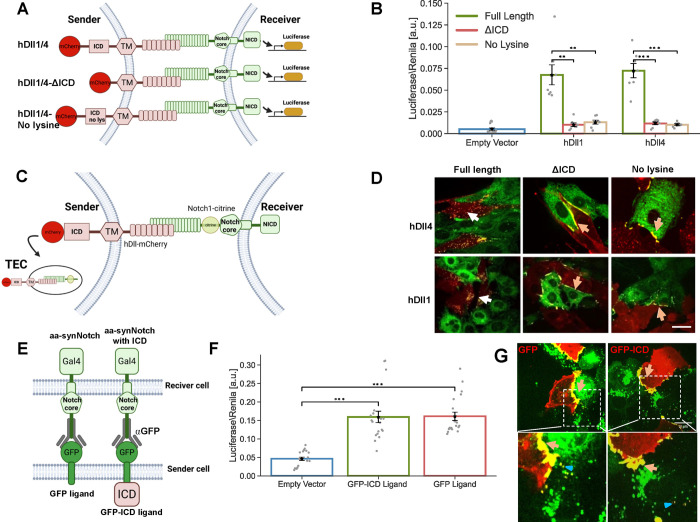
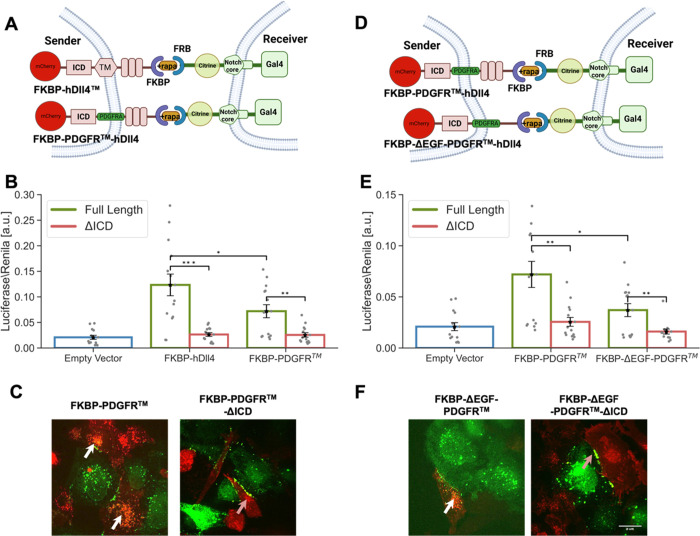
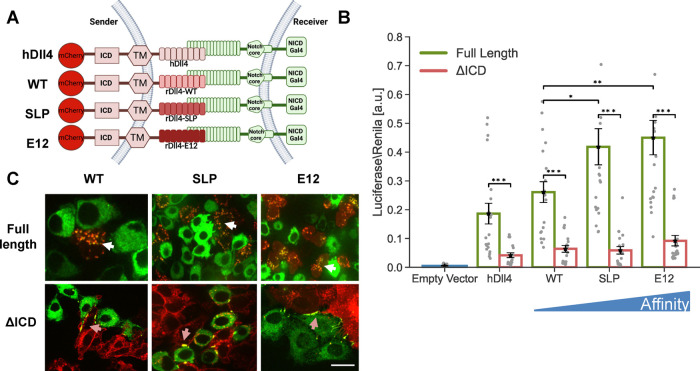
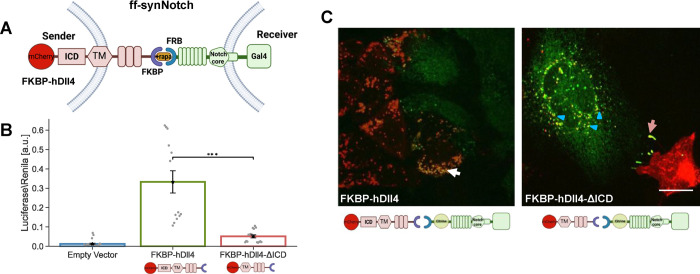
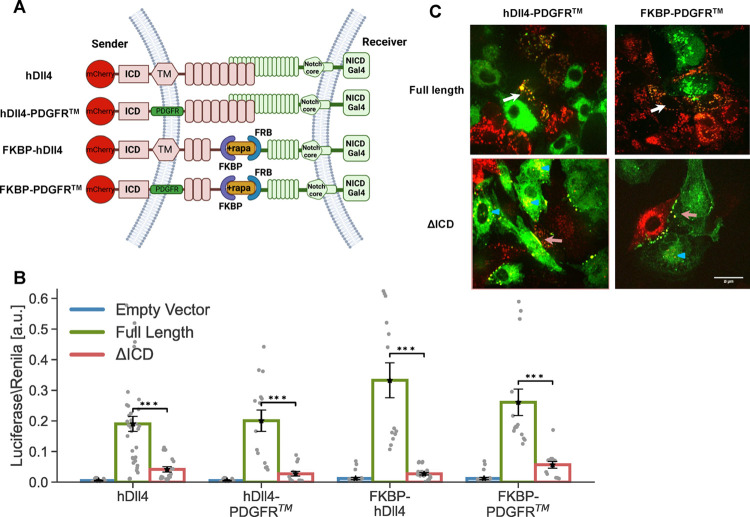
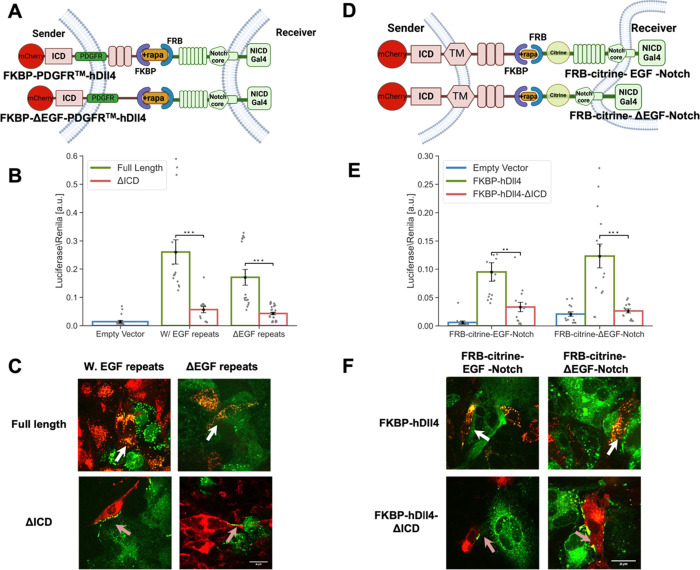
The Notch pathway converts receptor-ligand interactions at the cell surface into a transcriptional response in the receiver cell. In recent years, synthetic Notch systems (synNotch) that respond to different inputs and transduce different transcriptional responses have been engineered. One class of synNotch systems uses antibody-antigen interactions at the cell surface to induce the proteolytic cleavage cascade of the endogenous Notch autoregulatory core and the consequent release of a synNotch intracellular domain (ICD), converting surface antigen detection into a cellular response. While the activation of endogenous Notch requires ubiquitylation and subsequent endocytosis of the ligand ICD, these synNotch systems do not seem to have such a requirement because the synNotch ligands completely lack an ICD. This observation raises questions about existing models for the synNotch activation mechanism. Here, we test how different structural and biochemical factors affect the dependence of endogenous and synthetic Notch activation on ligand ICD. We compare the behavior of antibody-antigen synNotch (aa-synNotch) to that of endogenous Notch, and to a synNotch system that uses rapamycin induced dimerization of FK506 binding protein (FKBP) and FKBP rapamycin binding (FRB) domaindimerization domains (ff-synNotch), which still requires a ligand ICD. We found that differences in receptor-ligand affinity, in the identity of the transmembrane domain, or in the presence or absence of extracellular epidermal growth factor repeats cannot explain the differences in ligand ICD requirement that distinguishes aa-synNotch from endogenous Notch or ff-synNotch. We also found that unlike endogenous Notch and ff-synNotch, the aa-synNotch system does not exhibit trans-endocytosis of the receptor extracellular domain into the sender cell. These findings suggest that the aa-synNotch systems bypass the ligand ICD requirement because antigen-antibody pairs are able to promote other adhesive cell-cell interactions that provide the mechanical tension needed for ligand activation.
Notch 通路将细胞表面的受体-配体相互作用转化为受体细胞中的转录反应。近年来,已经设计出了响应不同输入并转导不同转录反应的合成 Notch 系统(synNotch)。一类 synNotch 系统利用细胞表面的抗体-抗原相互作用来诱导内源性 Notch 自我调节核心的蛋白水解级联反应,从而释放 synNotch 细胞内结构域(ICD),将表面抗原检测转化为细胞反应。虽然内源性 Notch 的激活需要配体 ICD 的泛素化和随后的内吞作用,但这些 synNotch 系统似乎没有这样的要求,因为 synNotch 配体完全缺乏 ICD。这一观察结果引发了对 synNotch 激活机制现有模型的质疑。在这里,我们测试了不同的结构和生化因素如何影响内源性和合成 Notch 激活对配体 ICD 的依赖性。我们比较了抗体-抗原 synNotch(aa-synNotch)与内源性 Notch 的行为,以及使用雷帕霉素诱导 FK506 结合蛋白(FKBP)和 FKBP 雷帕霉素结合(FRB)结构域二聚化结构域(ff-synNotch)的 synNotch 系统的行为,后者仍然需要配体 ICD。我们发现,受体-配体亲和力、跨膜结构域的身份、或细胞外表皮生长因子重复序列的存在与否的差异不能解释区分 aa-synNotch 与内源性 Notch 或 ff-synNotch 的配体 ICD 需求差异。我们还发现,与内源性 Notch 和 ff-synNotch 不同,aa-synNotch 系统不会将受体细胞外结构域向内源细胞进行跨内吞作用。这些发现表明,aa-synNotch 系统绕过了配体 ICD 的要求,因为抗原-抗体对能够促进其他粘附细胞-细胞相互作用,为配体激活提供所需的机械张力。