John Snow, Inc., Ethiopia Data Use Partnership, Addis Ababa, Ethiopia.
Ethiopia Ministry of Health, Addis Ababa, Ethiopia.
Glob Health Sci Pract. 2022 Sep 15;10(Suppl 1). doi: 10.9745/GHSP-D-21-00690.
Health information systems (HIS) performance in Ethiopia is currently insufficient, and improvements are required to ensure that decision making is data driven. We share our experiences from the early-stage implementation of a package of HIS capacity-strengthening interventions as part of an innovative academic-government collaboration that addresses challenges in HIS performance.
We used routine program data to assess HIS performance using the Performance of Routine Information System Management (PRISM) assessment tools. The assessment employed a pre-post design and was conducted in a total of 24 selected health facilities (6 hospitals and 18 health centers) from 11 districts in Ethiopia at project baseline (2018) and midline (2020).
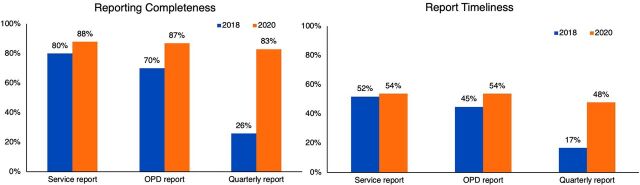
Source document completeness rate reached less than 80% for the majority of the assessed data elements. Improvements were observed in quarterly report completeness (26% vs. 83%) and timeliness (17% vs. 48%). Though data inaccuracies are noted for all assessed data elements in 2020, the majority (83%) of skilled birth attendance and HIV reports (68%) fall within the acceptable range of reporting accuracy. The identification of performance-related problems, using performance monitoring team (PMT) meetings, improved between 2018 and 2020 (67% vs 89%). Similar improvements were also observed in developing action plans to solve identified problems via the PMT (52% in 2018 vs. 89% in 2020). Data use for planning and target setting (65% in 2018 vs. 90% in 2020), reviewing performance (58% in 2018 vs. 60% in 2020), and supervision (51% in 2018 vs. 53% in 2020) all improved among assessed health facilities.
This study showed that a capacity-building and mentorship program that engages experts from multiple disciplines and sectors can improve the quality and use of health data. This partnership enabled engagement between government and academic stakeholders and allowed for a more robust exchange of resources and expertise toward HIS improvement.
埃塞俄比亚的卫生信息系统(HIS)目前表现不佳,需要进行改进,以确保决策基于数据。我们分享了在实施一整套 HIS 能力建设干预措施早期阶段的经验,这些干预措施是创新的学术-政府合作的一部分,旨在解决 HIS 绩效面临的挑战。
我们使用常规项目数据,通过使用常规信息系统管理绩效评估(PRISM)评估工具来评估 HIS 的绩效。该评估采用了预-后设计,在埃塞俄比亚的 11 个区的 24 个选定的卫生机构(6 家医院和 18 个卫生中心)进行了基线(2018 年)和中期(2020 年)评估。
大多数评估数据元素的原始文件完整性率不到 80%。在季度报告的完整性(26%对 83%)和及时性(17%对 48%)方面有了提高。虽然 2020 年所有评估数据元素都存在数据不准确的情况,但大多数(83%)熟练分娩和艾滋病毒报告(68%)在报告准确性的可接受范围内。使用绩效监测团队(PMT)会议确定与绩效相关的问题的能力在 2018 年至 2020 年间有所提高(67%对 89%)。通过 PMT 制定解决已确定问题的行动计划的能力也有所提高(2018 年为 52%,2020 年为 89%)。数据在规划和设定目标(2018 年为 65%,2020 年为 90%)、审查绩效(2018 年为 58%,2020 年为 60%)和监督(2018 年为 51%,2020 年为 53%)方面的使用也在评估的卫生机构中有所提高。
本研究表明,一个多学科和部门专家参与的能力建设和指导计划可以提高卫生数据的质量和使用。这种伙伴关系使政府和学术利益攸关方之间得以互动,并允许更有力地交流资源和专业知识,以改进 HIS。