Centre for Evaluation, Department of Public Health, Environment & Society, London School of Hygiene & Tropical Medicine, London, UK.
Department of Disease Control, Faculty of Infectious and Tropical Diseases, London School of Hygiene & Tropical Medicine, London, UK.
Glob Health Action. 2021 Jan 1;14(1):1901390. doi: 10.1080/16549716.2021.1901390.
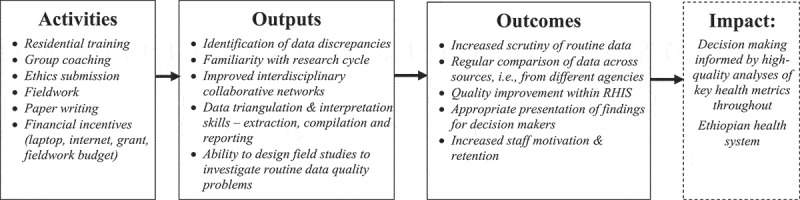
Many routine health information systems (RHIS) show persistent gaps between recording and reporting data and their effective use in solving problems. Strengthening RHIS has become a global priority to track and address national health goals. In Ethiopia, the Ministry of Health and Bill & Melinda Gates Foundation introduced the Operational Research and Coaching for Analysts (ORCA) capacity development project, co-designed with the London School of Hygiene & Tropical Medicine, which delivered training, coaching and mentoring support. We present the development, experiences, and perceptions of ORCA as a mechanism to enhance data quality, analysis, interpretation and use. ORCA integrated capacity development activities into national data analysts' routine workload over a period of 2 years. Participating analysts were drawn from across the Ministry of Health directorates and two of its closely aligned agencies: the Ethiopian Public Health Institute and the Ethiopian Pharmaceutical Supply Agency. We used mixed methods (knowledge questionnaire, semi-structured interviews, programme records) to document the fidelity, feasibility, reach, and acceptability of ORCA and identify early signs of improved knowledge and changing institutional practices. Thirty-six participants completed the programme. Working in interdisciplinary groups on specific national health indicators, they received training workshops and support for study design, fieldwork, and analysis to build skills in assessing data quality and interpreting findings relevant to policy. Personal development grants and laptops provided incentives for sustained engagement. Participants appreciated ORCA's applied and practical approach as well as good communication from administrators and clear links to national strategy. They also expressed frustration with delays, difficulties prioritising project work over routine responsibilities, and lack of formal accreditation. Knowledge and analytic skills increased and participants were able to integrate experiences from the project into their future work. Health system managers saw potential in longer-term improvements in data analysis and application to policy, although no clear changes were observed yet.
许多常规健康信息系统 (RHIS) 显示,在记录和报告数据及其在解决问题方面的有效利用之间存在持续差距。加强 RHIS 已成为全球重点,以跟踪和解决国家卫生目标。在埃塞俄比亚,卫生部和比尔及梅琳达·盖茨基金会引入了运营研究和分析师辅导 (ORCA) 能力发展项目,该项目与伦敦卫生与热带医学学院共同设计,提供培训、辅导和指导支持。我们介绍了 ORCA 的发展、经验和看法,将其作为提高数据质量、分析、解释和利用的一种机制。ORCA 将能力发展活动整合到国家数据分析师的日常工作中,为期 2 年。参与的分析师来自卫生部各局以及其两个紧密相关的机构:埃塞俄比亚公共卫生研究所和埃塞俄比亚药品供应机构。我们使用混合方法(知识问卷、半结构化访谈、项目记录)记录了 ORCA 的保真度、可行性、覆盖范围和可接受性,并确定了知识提高和机构做法改变的早期迹象。36 名参与者完成了该计划。他们跨学科小组合作,针对特定的国家卫生指标开展工作,接受了培训研讨会和研究设计、实地工作和分析方面的支持,以培养评估数据质量和解释与政策相关发现的技能。个人发展补助金和笔记本电脑为持续参与提供了激励。参与者赞赏 ORCA 的应用和实用方法,以及管理员的良好沟通和与国家战略的明确联系。他们还对延迟、在日常职责之上优先考虑项目工作的困难以及缺乏正式认证表示沮丧。知识和分析技能有所提高,参与者能够将项目经验融入未来的工作中。卫生系统管理者看到了数据分析和应用于政策方面的长期改进的潜力,尽管尚未观察到明显的变化。