Babiker Mohamed O E, Kurian Manju A, Suleiman Jehan
Neurosciences Centre, Al Jalila Children's Specialty Hospital, Dubai, United Arab Emirates.
Developmental Neurosciences Department, University College London (UCL) Great Ormond Street Institute of Child Health, London, United Kingdom.
Front Pediatr. 2022 Aug 30;10:964201. doi: 10.3389/fped.2022.964201. eCollection 2022.
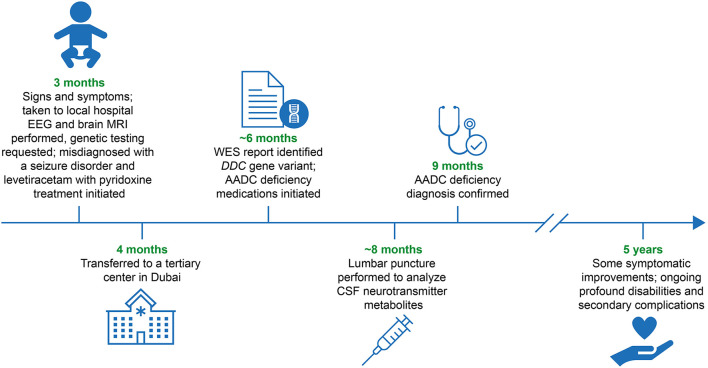
Aromatic L-amino acid decarboxylase (AADC) deficiency is a rare, neurometabolic disorder resulting from biallelic mutations in the dopa decarboxylase gene. This is the first reported case of AADC deficiency in the United Arab Emirates (UAE) and describes an Emirati male patient who presented in the first few months of life with a severe phenotype of global hypotonia, developmental delay and oculogyric crisis. Following whole exome sequencing, a novel homozygous mutation in the gene (c.1144G>T, p.Val382Phe) was reported and the patient underwent further testing, after which a diagnosis of AADC deficiency was confirmed. This mutation has not been previously described, but the clinical phenotype and corresponding biochemical profile confirmed that it is a pathogenic variant. The patient is currently managed at a tertiary referral center in the UAE and is treated in accordance with published guidance on AADC deficiency, including the recommended medical therapy combined with multidisciplinary care from a team of specialists. Some symptomatic improvements have been reported but at 5 years of age the patient continues to exhibit profound developmental delay, oculogyric crisis and is prone to recurrent respiratory infections. In order to improve outcomes for patients with AADC deficiency in the Middle Eastern region, there is an urgent need to raise the index of clinical suspicion, particularly among primary care physicians, pediatricians, and pediatric neurologists, and to improve access to diagnostic testing. This is particularly relevant at the current time, given the ongoing development of potentially disease-modifying gene therapy for AADC deficiency.
芳香族L-氨基酸脱羧酶(AADC)缺乏症是一种罕见的神经代谢紊乱疾病,由多巴脱羧酶基因的双等位基因突变引起。这是阿拉伯联合酋长国(阿联酋)首次报道的AADC缺乏症病例,描述了一名阿联酋男性患者,他在出生后的头几个月就表现出严重的全身肌张力低下、发育迟缓及动眼危象的症状。经过全外显子组测序,报告了该基因中的一种新型纯合突变(c.1144G>T,p.Val382Phe),患者接受了进一步检测,随后确诊为AADC缺乏症。此前尚未描述过这种突变,但临床表型和相应的生化特征证实它是一种致病变异。该患者目前在阿联酋的一家三级转诊中心接受治疗,并按照已发表的关于AADC缺乏症的指南进行治疗,包括推荐的药物治疗以及由一组专家提供的多学科护理。据报道有一些症状改善,但在5岁时,该患者仍表现出严重的发育迟缓、动眼危象,且易反复发生呼吸道感染。为了改善中东地区AADC缺乏症患者的治疗效果,迫切需要提高临床怀疑指数,特别是在初级保健医生、儿科医生和儿科神经科医生中,并改善诊断检测的可及性。鉴于目前正在为AADC缺乏症开发潜在的疾病修正基因疗法,这一点在当前尤为重要。