Department of Immunology, College of Basic Medical Sciences, School of Public Health, Jilin University, Changchun, China.
Front Immunol. 2022 Aug 30;13:948259. doi: 10.3389/fimmu.2022.948259. eCollection 2022.
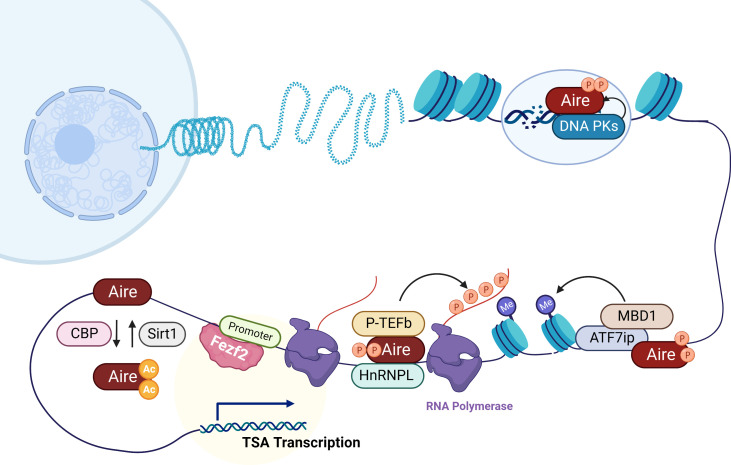
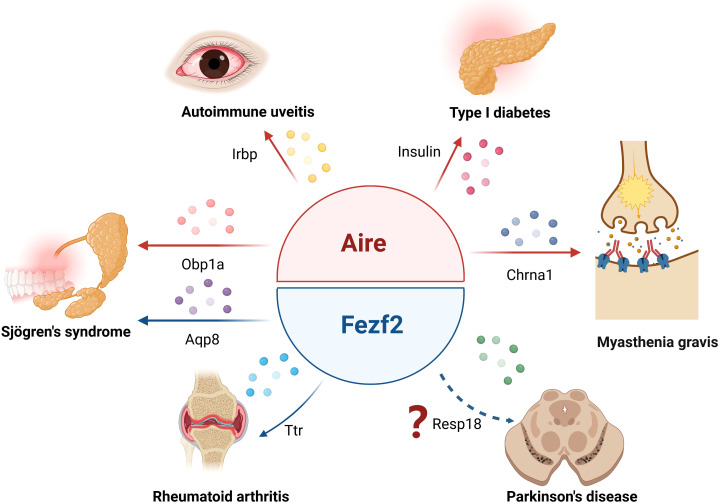
The expression of tissue-specific antigens (TSAs) in medullary thymic epithelial cells (mTECs) is believed to be responsible for the elimination of autoreactive T cells, a critical process in the maintenance of central immune tolerance. The transcription factor autoimmune regulator (Aire) and FEZ family zinc finger 2(Fezf2) play an essential role in driving the expression of TSAs in mTECs, while their deficiency in humans and mice causes a range of autoimmune manifestations, such as type 1 diabetes, Sjögren's syndrome and rheumatoid arthritis. However, because of their regulatory mechanisms, the expression profile of TSAs and their relationship with special autoimmune diseases are still in dispute. In this review, we compare the roles of Aire and Fezf2 in regulating TSAs, with an emphasis on their molecular mechanisms in autoimmune diseases, which provides the foundation for devising improved diagnostic and therapeutic approaches for patients.
组织特异性抗原 (TSAs) 在髓质胸腺上皮细胞 (mTECs) 中的表达被认为是负责清除自身反应性 T 细胞的原因,这是维持中枢免疫耐受的关键过程。转录因子自身免疫调节因子 (Aire) 和 FEZ 家族锌指蛋白 2 (Fezf2) 在驱动 mTECs 中 TSA 的表达方面发挥着重要作用,而它们在人类和小鼠中的缺乏会导致一系列自身免疫表现,如 1 型糖尿病、干燥综合征和类风湿关节炎。然而,由于它们的调节机制,TSAs 的表达谱及其与特殊自身免疫性疾病的关系仍存在争议。在这篇综述中,我们比较了 Aire 和 Fezf2 在调节 TSA 方面的作用,重点介绍了它们在自身免疫性疾病中的分子机制,为制定针对患者的改进诊断和治疗方法提供了基础。