Department of Cell and Cancer Biology, University of Toledo College of Medicine and Life Sciences, Toledo, Ohio, USA.
Department of Pathology, University of Toledo College of Medicine and Life Sciences, Toledo, Ohio, USA.
Pigment Cell Melanoma Res. 2023 Jan;36(1):19-32. doi: 10.1111/pcmr.13068. Epub 2022 Oct 3.
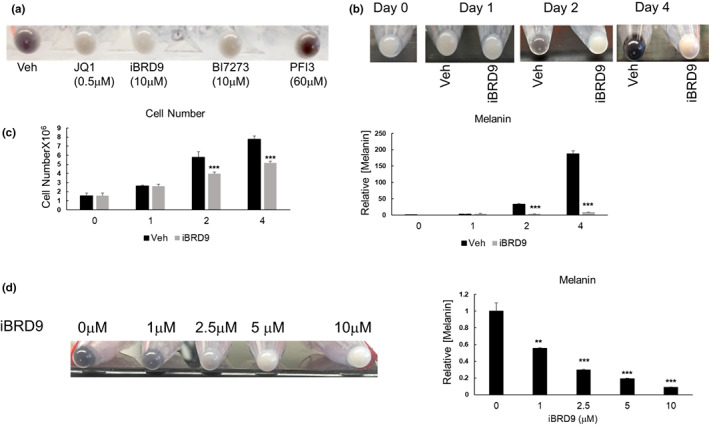
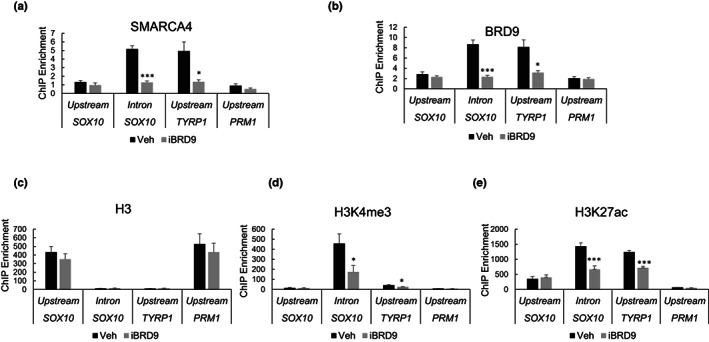
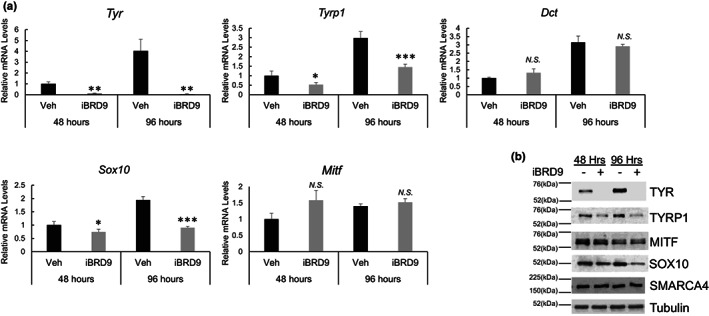
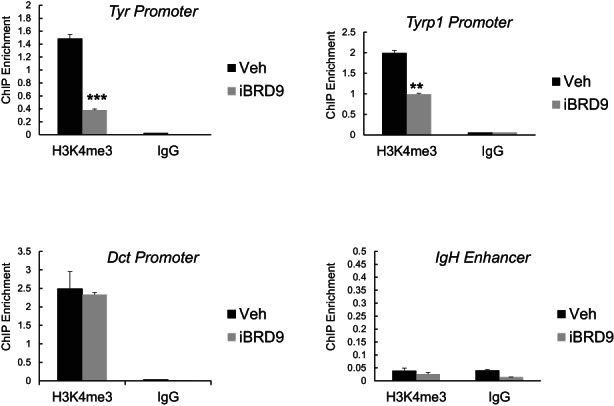
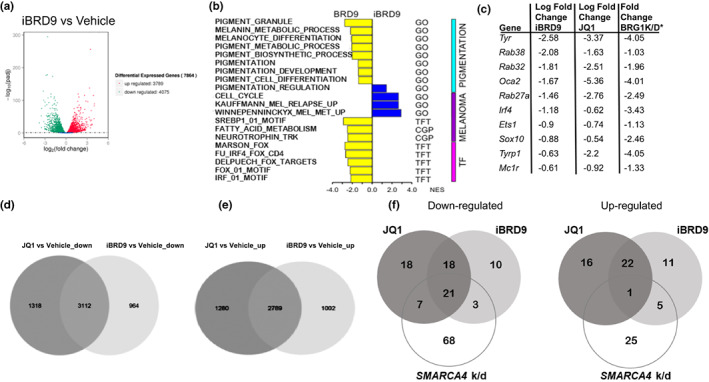
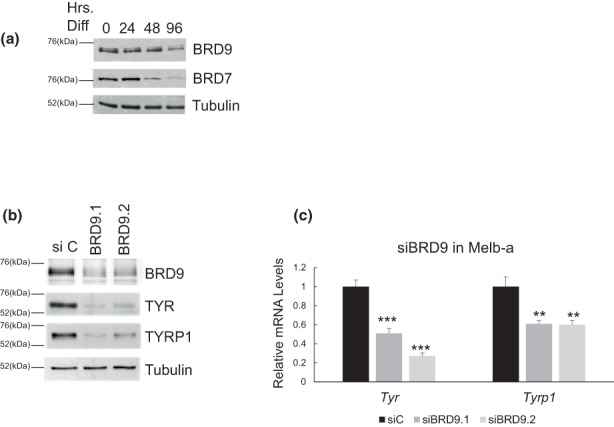
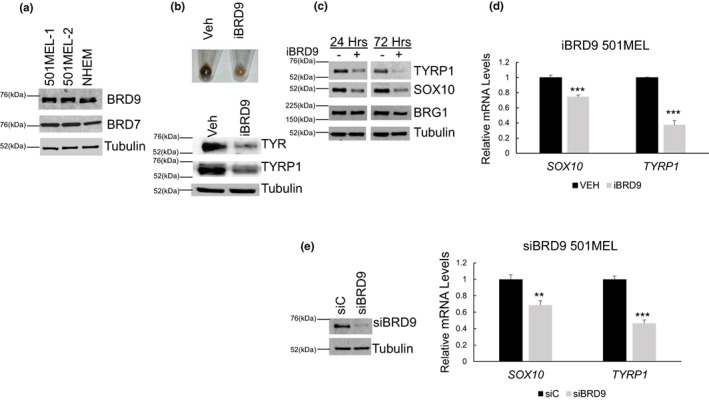
Lineage-specific differentiation programs are activated by epigenetic changes in chromatin structure. Melanin-producing melanocytes maintain a gene expression program ensuring appropriate enzymatic conversion of metabolites into the pigment, melanin, and transfer to surrounding cells. During neuroectodermal development, SMARCA4 (BRG1), the catalytic subunit of SWItch/Sucrose Non-Fermentable (SWI/SNF) chromatin remodeling complexes, is essential for lineage specification. SMARCA4 is also required for development of multipotent neural crest precursors into melanoblasts, which differentiate into pigment-producing melanocytes. In addition to the catalytic domain, SMARCA4 and several SWI/SNF subunits contain bromodomains which are amenable to pharmacological inhibition. We investigated the effects of pharmacological inhibitors of SWI/SNF bromodomains on melanocyte differentiation. Strikingly, treatment of murine melanoblasts and human neonatal epidermal melanocytes with selected bromodomain inhibitors abrogated melanin synthesis and visible pigmentation. Using functional genomics, iBRD9, a small molecule selective for the bromodomain of BRD9 was found to repress pigmentation-specific gene expression. Depletion of BRD9 confirmed a requirement for expression of pigmentation genes in the differentiation program from melanoblasts into pigmented melanocytes and in melanoma cells. Chromatin immunoprecipitation assays showed that iBRD9 disrupts the occupancy of BRD9 and the catalytic subunit SMARCA4 at melanocyte-specific loci. These data indicate that BRD9 promotes melanocyte pigmentation whereas pharmacological inhibition of BRD9 is repressive.
谱系特异性分化程序是通过染色质结构的表观遗传变化激活的。产生黑色素的黑素细胞维持着一个基因表达程序,确保适当的酶促转化代谢物成色素黑色素,并转移到周围细胞。在神经外胚层发育过程中,SMARCA4(BRG1),SWItch/Sucrose Non-Fermentable(SWI/SNF)染色质重塑复合物的催化亚基,对于谱系特化是必不可少的。SMARCA4 对于多能神经嵴前体细胞分化为黑素细胞也很重要,后者分化为产生黑色素的黑素细胞。除了催化结构域外,SMARCA4 和几个 SWI/SNF 亚基含有溴结构域,可进行药理学抑制。我们研究了 SWI/SNF 溴结构域的药理学抑制剂对黑素细胞分化的影响。引人注目的是,用选定的溴结构域抑制剂处理小鼠黑素细胞和人新生儿表皮黑素细胞,可阻断黑色素合成和可见的色素沉着。使用功能基因组学,发现小分子 iBRD9 是 BRD9 溴结构域的选择性抑制剂,可抑制特化于黑色素生成的基因表达。BRD9 的耗竭证实了 BRD9 在从黑素细胞前体细胞分化为有色素的黑素细胞和黑色素瘤细胞的分化程序中表达色素生成基因的要求。染色质免疫沉淀测定显示,iBRD9 破坏了 BRD9 和催化亚基 SMARCA4 在黑素细胞特异性基因座上的占有率。这些数据表明 BRD9 促进黑素细胞色素沉着,而 BRD9 的药理学抑制则具有抑制作用。